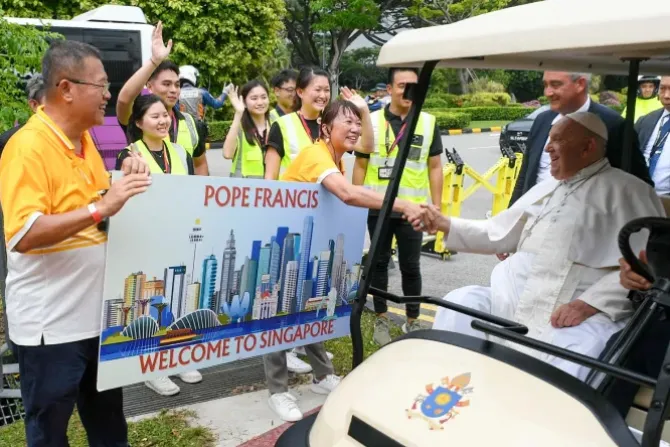
Despite the strong presence of Buddhism, Catholicism is the religion that is growing the most in Singapore, the last country that Pope Francis will visit on his extensive tour of Asia and Oceania.
The origin of the Catholic Church in Singapore, the Southeast Asian country the Holy Father is currently visiting, is closely linked to the first missionaries who, together with St. Francis Xavier, arrived in Malaysia in the 16th century.
Singapore lies at the tip of Malaysia, an island separated only by a narrow strait.
The missionary saint arrived in Malacca in southwest Malaysia, about 150 miles from Singapore, in 1545 and three years later the territory became a diocese dependent on the Archdiocese of Goa, then a Portuguese colony on India’s west coast, about 2,200 miles away.
Catholicism was banned under the Dutch Calvinist occupation until it was restored in 1819, when Singapore came under the jurisdiction of the British East India Company.
French missionaries built Catholic churches and schools
In 1821, a missionary found a group of 12 Catholics on the island, a number that would grow to 500 within 17 years. Members of the Paris Foreign Missions Society also arrived in those years and founded churches and schools.
French missionary Jean-Marie Beurel was responsible for the construction of Good Shepherd Cathedral, a boys school run by the Brothers of the Christian Schools, and a girls school run by the Sisters of the Child Jesus.
From the beginning, the Catholics of the then-Diocese of Malacca were divided into two jurisdictions due to an old conflict between the Holy See and Portugal that was not resolved until 1886 with the signing of a new concordat.
The Catholics of the Portuguese mission were placed under the authority of the bishop of Macao (then a Portuguese colony), and those of the French mission under that of the apostolic vicar of Ava and Pegu (then Burma).
From 1888, the Portuguese Mission and missionaries of the Paris Foreign Missions Society worked together to consolidate the Church’s presence in Singapore.
The Church suffered severe persecution during the Japanese occupation between 1942 and 1945. The Catholic community revived in the postwar 1950s and the Church intensified its work in the educational, health, and social fields.
Cardinal William Goh
In 1972, Singapore was elevated to an archdiocese subject to the Holy See and in 1977, Gregory Yong became its first archbishop. Singapore currently has one cardinal, William Goh, created by Pope Francis during the consistory of 2022.
Following the establishment of diplomatic relations with the Holy See in 1981, Singapore received a visit from Pope John Paul II on Nov. 20, 1986, as part of his 32nd apostolic journey to Bangladesh, Singapore, Fiji, and New Zealand.
Today, Singapore is considered a secular and pluralistic state and a multiethnic city. Approximately 43% of its more than 5 million inhabitants are Buddhists. About 20% are Christians, 14% are Muslims, and there is also a small percentage of Hindus.
The Catholic Church currently has 176,000 faithful in the country and is considered one of the most dynamic and vital in Southeast Asia.
About 50% of Catholics regularly attend Sunday Mass, and the churches remain full thanks to emigrants, who are an important component of the local Church.
Current growth spurt
Based on the most recent data from the Singapore Statistics Office, the Holy See reported that Christianity, and Catholicism in particular, is the only religion that is growing.
This vitality is confirmed both by the active presence of the Church in the social sphere and by the large and participatory attendance at liturgies.
In general, the policies of the Singaporean authorities are oriented toward promoting dialogue and cooperation with religions, especially in the educational and social areas.
This coexistence between different religions is also favored by the frequency of mixed marriages in the city-state.
This story was first published by ACI Prensa, CNA’s Spanish-language news partner. It has been translated and adapted by CNA.