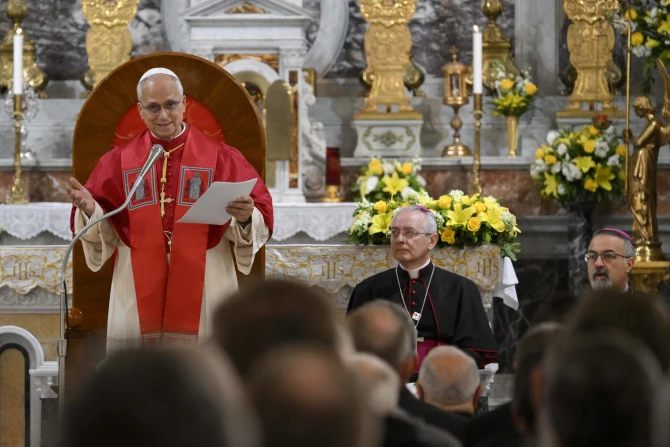
Pope Leo XIV encouraged Turkey’s small Catholic community Friday to rediscover what he called the Gospel’s “logic of littleness,” urging them not to be discouraged by their tiny numbers but to recognize in them the strength of authentic Christian witness.
The pope addressed bishops, priests, religious, pastoral workers, and laypeople at the Cathedral of the Holy Spirit in Istanbul on his second day in the country. Catholics in Turkey make up roughly 0.05% of the nation’s 85 million people.
Calling Turkey a “holy land” where the Old and New Testaments meet, the pope recalled the deep Christian roots of the region: Abraham’s journey through Harran, the early Christian communities in Antioch and Ephesus, and the long and influential history of Byzantine Christianity. He noted in particular that the Ecumenical Patriarchate of Constantinople, currently led by Patriarch Bartholomew I, remains “a point of reference” both for its Greek faithful and for other Orthodox Churches.
The pope warned Christians not to treat this heritage merely as a memory of past greatness. Instead, he urged them to adopt “an evangelical vision” that sees their present reality through the Holy Spirit’s light.
“When we look with God’s eyes, we discover that he has chosen the way of littleness,” he said, pointing to the mustard seed, the little ones praised by Jesus, and the quiet growth of the kingdom of God. The Church’s true strength, he explained, “does not lie in her resources or structures,” nor in numbers or influence, but in remaining gathered around Christ and sent by the Holy Spirit.
Quoting Jesus’ words, “Do not be afraid, little flock,” the pope encouraged Christians in Turkey to cultivate hope. He pointed to the growing number of young people approaching the Catholic Church as a sign of promise and asked communities to continue welcoming and accompanying them.
He urged particular dedication to ecumenical and interreligious dialogue, the transmission of the faith to local communities, and pastoral service to refugees and migrants—many of whom are among the most vulnerable people in the country. The pope also noted that many Catholics in Turkey come from abroad, a reality that calls for a deeper process of inculturation so that the language and culture of the country become “more and more your own.”
The pope highlighted Turkey’s unique role in the history of the Church, recalling that the first eight ecumenical councils were held on its soil. Marking the 1700th anniversary of the First Council of Nicaea, he said the council continues to pose three questions to Christians today: What is the essence of the faith? Who is Jesus for us? And how should doctrine be expressed in ways that speak to contemporary culture?
He warned against what he described as a “new Arianism,” a version of the heresy that divided Christianity in its early centuries, that reduces Jesus to a moral teacher or heroic figure while denying his divinity and lordship over history.
Before concluding, the pope invoked the memory of St. John XXIII, who served in Turkey and wrote affectionately of its people. Reflecting on the saint’s image of Bosporus fishermen laboring through the night, he encouraged Turkish Catholics to persevere in the same spirit: working faithfully, joyfully, and courageously “in the Lord’s boat.”
The Cathedral of the Holy Spirit, where the meeting took place, was built in 1846 and houses relics of early popes, including St. Linus. A statue of Pope Benedict XV stands in its courtyard, erected in gratitude for his efforts to help victims of the 1915–1918 war. The inscription honors him as a “benefactor of peoples, without distinction of nationality or religion.”
LIVE updates: Follow Pope Leo XIV’s first Apostolic Journey to Türkiye (Turkey) and Lebanon
This article was originally published by CNA.