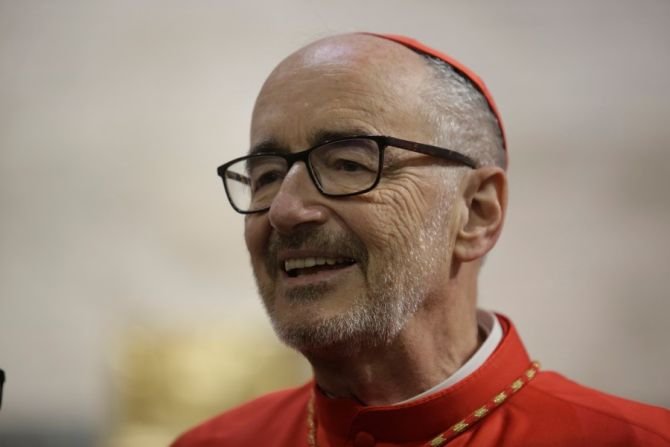
The cardinal who is seen as Pope Francis’ point man on the environment said in an address at Gonzaga University last week that universities, especially Catholic universities, have a major role to play in constructing a plan to “care for our common home.”
Canadian Jesuit Cardinal Michael Czerny, prefect of the Dicastery for Promoting Integral Human Development, spoke at his alma mater in Spokane, Washington, on March 9. Noting that Catholics are called to celebrate nature as an “expression of the love of a personal God, who brought the universe into being,” Czerny said Pope Francis invites us to follow St. Francis of Assisi in “immersing ourselves in the wonder and awe of nature.”
He asserted that since the 2015 publication of Pope Francis’ encyclical on the environment, Laudato Si’ (On Care for Our Common Home), many people now accept that it is vital to recognize the interconnectedness of the world and the ways in which many of the actions of humans are harming the planet.
In Laudato Si’, Francis decried what he described as a “technocratic paradigm,” whereby humans use science and technology to use and exploit the natural world without a “development in human responsibility, values, and conscience.” He also spoke against a “throwaway culture” that does not take into account the connectedness of living things on earth.
“We exist only within a web of relationships,” Czerny said, with God, with our neighbor, and with the earth itself. In promoting concern for our neighbors, Jesus’ parable of the good Samaritan provides a model for breaking out of tribal attitudes and seeking to help other people.
In his speech, Czerny quoted extensively from Pope Francis’ two encyclicals Laudato Si’ and Fratelli Tutti, (On Fraternity and Social Friendship). “The poor” are mentioned 60 times in Laudato Si’, Czerny said. He called for universities to provide a “concrete, visionary, and courageous response” to the problem of environmental destruction, which he said disproportionately affects the poor.
“The problem now isn’t ignorance … the real problem, instead, is indifference and despair,” Czerny said, saying that a spate of climate-related disasters in recent years such as wildfires, hurricanes, floods, and droughts have helped to open people’s eyes to the issues at hand.
“All of us can cooperate as instruments of God for the care of creation, each according to his or her own culture, experience, involvements, and talents,” Czerny said. “Dialogue and better politics … are the only, only, only way out.”
He urged Catholic universities to take care to factor in concern for the poor in “research projects, educational curricula, public programming, institutional infrastructures, policies, and practices, and political and social involvements as colleges and universities.”
Czerny also promoted a publication on “Our Common Home” developed by the Vatican and the Stockholm Environment Institute, as well as the Laudato Si’ Action Platform, an initiative Pope Francis launched in 2021. The seven-year plan provides goals, projects, and ideas for implementing environmental sustainability in different sectors of the Church, from religious orders to Catholic schools and hospitals, as well as within individual families. More than 1,000 educational institutions have signed up for the plan, Czerny said.
Above all, he said, it is important for those working to combat environmental degradation to be able to say “our Church is with us.”