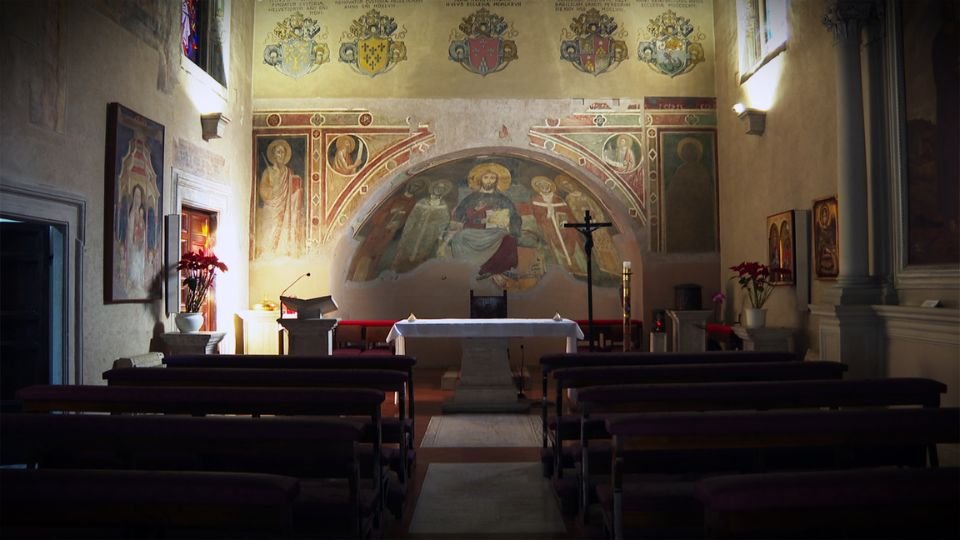
This is one of the most ancient churches on the Vatican Hill. It was first mentioned—and thus already existed—at the time of the pontificate of Pope St. Leo III at the end of the 8th century! According to what we can read in the Liber Pontificalis, the Pope donated a silver lamp to this little church located next to Saint Peter’s Basilica.
“The first date mentioned is in 795, because Leo III, at that time, entrusted it to the care of some priests,” noted Father Franco Fontana, Chaplain of the Pontifical Gendarmerie.
Vatican tour guide Jowita Ludwikiewicz explained, “It’s a very small church and originally it was called St. Peregrine at the Naumachia. What was a Naumachia? Naumachia was an ancient stadium where the Romans used to organize naval battles, and apparently in ancient times there used to be Naumachia in that particular area.”
The ancient tradition associates the following name with Charlemagne in the year 800.
Ludwikiewicz continued, “It changed its name to the Church of. St. Peregrine, when in the 9th century, during the coronation of Charlemagne (Charles the Great), the church received the relics of the Bishop of Auxerre, St. Peregrine.”
He was a Roman priest, missionary and then bishop who died as martyr in a persecution in the 4th century.
At that point the chapel became the Church of Saint Peregrine and it was part of a larger complex, like others that sprang up around St. Peter’s.
Father Fontana noted, “It was still outside the walls, as the Vatican walls had not yet been built, and there was an inn for pilgrims and a cemetery.”
The location of the church is unique and refers to the centuries-old history of pilgrimage. It is to be found on the street called via del Pellegrino, Pilgrim Street in English. The pilgrims used to walk along this pathway arriving to Saint Peter’s Basilica, situated just 200 meters from here.
Ludwikiewicz explained, “They could find shelter nearby the church and if, unfortunately, the Vatican or Rome was their final destination that was also the place where they could get buried.”
“Because sometimes pilgrims arrived exhausted and were therefore buried in this cemetery,” added Father Fontana.
Already in the Middle-Ages thousands of people from northern Europe were traveling to Rome along this route.
It was actually the last church before they entered St. Peters Basilica and it was at the same time the very last stretch of the Via Francigena, the famous “pilgrim way” that led the Romei, the pilgrims from northern Europe “ad limina Apostolorum,” to the tomb of St. Peter.
Maria Pace Guidotti, tour guide and historian of the ancient city of Bolsena, highlighted, “The Via Francigena originates from the description made by the first to trace this route, Archbishop Sigeric of Canterbury, who, before the year 1000, described this road upon his return from Rome.”
The church, after having been a place of welcome and prayer for ancient pilgrims, had become the property of the Vatican Chapter. In 1657 Pope Alexander VII officially granted it to the Pontifical Swiss Guard Corps, which had already been celebrating there for some years.
“The Swiss Guards kept it and used it as their chapel until 1977,” noted Father Fontana.
The walls are still decorated with numerous colorful coats of arms of officers and commanders of the pontifical army.
The restoration performed a hundred years ago revealed some amazing frescoes that apparently date back to the 9th century.
The value of the chapel is inestimable, especially now during the Jubilee Year of Hope, when millions of pilgrims from all over the world are once again making their way to Saint Peter’s Tomb, just like it used to be hundreds and hundreds of years ago.
Adapted by Jacob Stein