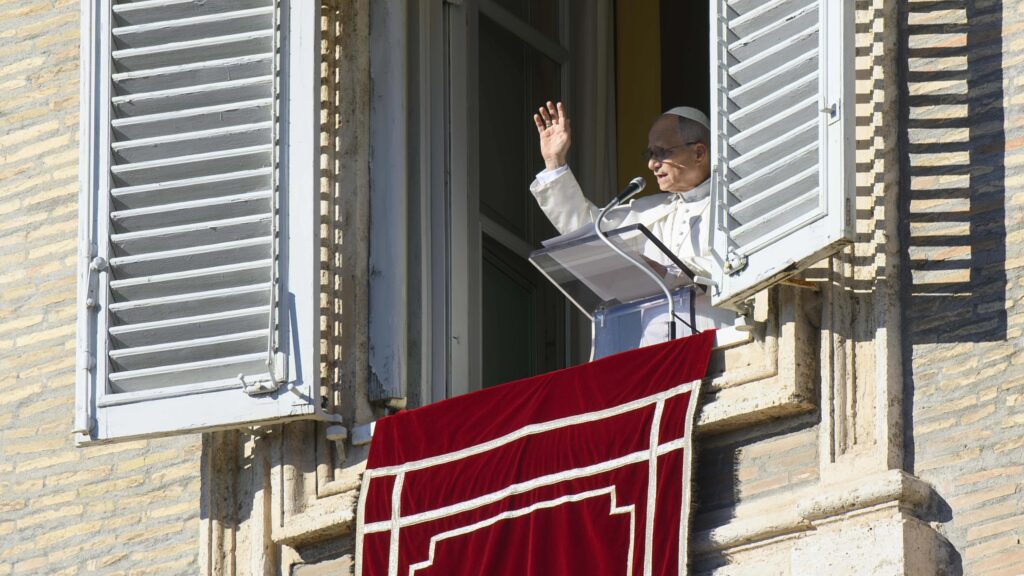
“Buon pranzo e arrivederci!” (“Have a nice lunch and see you later!” ) — just hearing the way Pope Francis concludes his message to the faithful at the end of the Angelus every Sunday tells you something about the importance he attaches to food.
The Holy Father has made reference to food in a humorous tone on several occasions. During a press conference on his return from one of his apostolic journeys, he jokingly mentioned that his next destination would depend on the country’s gastronomy.
Always with a smile when addressing journalists who accompany him on his world trips, he usually wishes them a good lunch as well. On his return from Budapest last year, he laughed as he suggested in an ironic tone that he was not sure whether there would be dinner on the plane “or something to trick the stomach.”
On that occasion, he also said he had only understood two words in the Hungarian language: “goulash” (a typical Hungarian dish made mainly with meat, onions, peppers, and paprika) and “tokaji” (a typical Hungarian wine).
It has become almost a tradition for him to stop the popemobile in St. Peter’s Square when a pilgrim offers him one of the drinks he most enjoys, mate. And “chipa,” a traditional food in some Latin American countries made from manioc starch and cheese, is also one of the foods that Pope Francis likes the most. “Where’s the chipa?” he asked once during a meeting with Paraguayans at St. Peter’s.
On his trip to Luxembourg he stopped “as a surprise” at a café. He has even invited the owner of his favorite ice cream shop, Padrón, to the Vatican, and we know that his favorite sweets are the El Nazareno brand of Argentine “alfajores” (a traditional Latin American dessert).
In the “The Vatican Cookbook,” published in 2014, the Holy Father also referred to other recipes such as meat empanadas or mozzarella pizza with fainá (a chickpea pancake).

Spaghetti and sword featured in the Vatican Cookbook. Credit: Katarzyna Artymiak
His appreciation for food is so well known that leaders or prelates who visit him in the Vatican often bring gifts that can be tasted. But without a doubt, his favorite dish, which he was able to enjoy with his family on the occasion of the 90th birthday of his cousin Daniela di Tignlioi, is the so-called “bagna calda,” well known in the Italian region of Piedmont, which is usually prepared with anchovies, oil, and garlic and used as a sauce for vegetables.
However, pleasure and enjoyment are not the only reasons why the Holy Father has extolled the value of food and nutrition. Throughout his pontificate, he has also given it a pastoral focus and highlighted its spiritual significance.
Going no further than his recent encyclical Dilexit Nos, released Oct. 24, Pope Francis recalls that when he was a child, for carnival “my grandmother used to make a pastry using very thin batter.”
“When she dropped the strips of batter into the oil,” the pope continues, “they would expand, but then, when we bit into them, they were empty inside. In the dialect we spoke, those cookies were called ‘lies’… My grandmother explained why: ‘Like lies, they look big, but are empty inside; they are false, unreal’” (Dilexit Nos, 7)
In the same document he states that “no algorithm will ever be able to capture, for example, the nostalgia that all of us feel, whatever our age, and wherever we live.”
“When we recall how we first used a fork to seal the edges of those little homemade empanadas that we helped our mothers or grandmothers to make … It was a moment of culinary apprenticeship, somewhere between child-play and adulthood, when we first felt responsible for working and helping one another,” the Holy Father writes (Dilexit Nos, 20).
Italian theologian Bishop Bruno Forte explained that this encyclical “offers us the key to understanding the entire magisterium” of Pope Francis. Thus, there could not be missing some reference to food.
For the Holy Father, food is also a key element of human dignity. He has repeatedly advocated for a fair distribution of food. In fact, he has even warned that to waste food “is to snatch it from the hands” of the poor.
With the poor, the most needy, he shares a feast in the Vatican every year during the World Day of the Poor. There was even a rumor in Rome that some nights, years ago, he would dress incognito and distribute food to the homeless he found around St. Peter’s.
For the Holy Father, food also has a meaning of fraternity, even of love. In his homily at the World Day of Families in 2015 in Philadelphia, the Holy Father noted that “faith opens a ‘window’ to the presence and working of the Spirit. It shows us that, like happiness, holiness is always tied to little gestures.”
“These little gestures are those we learn at home, in the family; they get lost amid all the other things we do, yet they do make each day different. They are the quiet things done by mothers and grandmothers, by fathers and grandfathers, by children, by brothers and sisters. They are little signs of tenderness, affection, and compassion. Like the warm supper we look forward to at night, the early breakfast awaiting someone who gets up early to go to work.”
However, the Holy Father’s fundamental teaching regarding food is that which refers to the essential nourishment, the Eucharist: “Those who receive the body and blood of Christ with faith not only eat but are satisfied,” he said after the Angelus prayer in June 2022.
“To eat and to be satisfied: These are two basic necessities that are fulfilled in the Eucharist,” he affirmed.
This story was first published by ACI Prensa, CNA’s Spanish-language news partner. It has been translated and adapted by CNA.