The pontiff said the Holy See’s diplomatic service is a unique ministry rooted in peace, truth, and justice and directed not only to Catholics but also to the entire human family.
Pope Leo XIV on Monday outlined the qualities needed in priests who serve as Vatican diplomats, describing their work as a unique ministry that serves not only Catholics but also the entire human family in individual nations and international organizations.
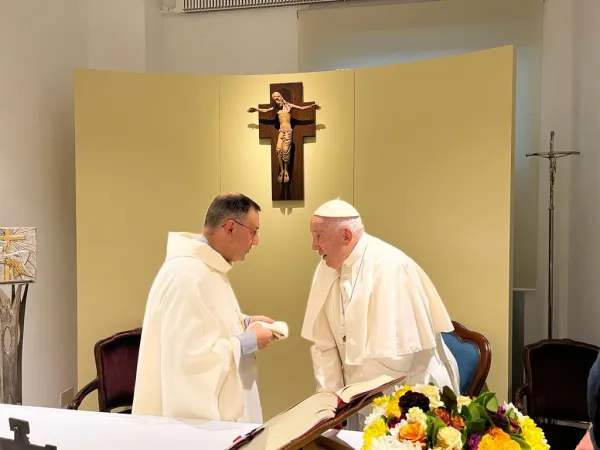
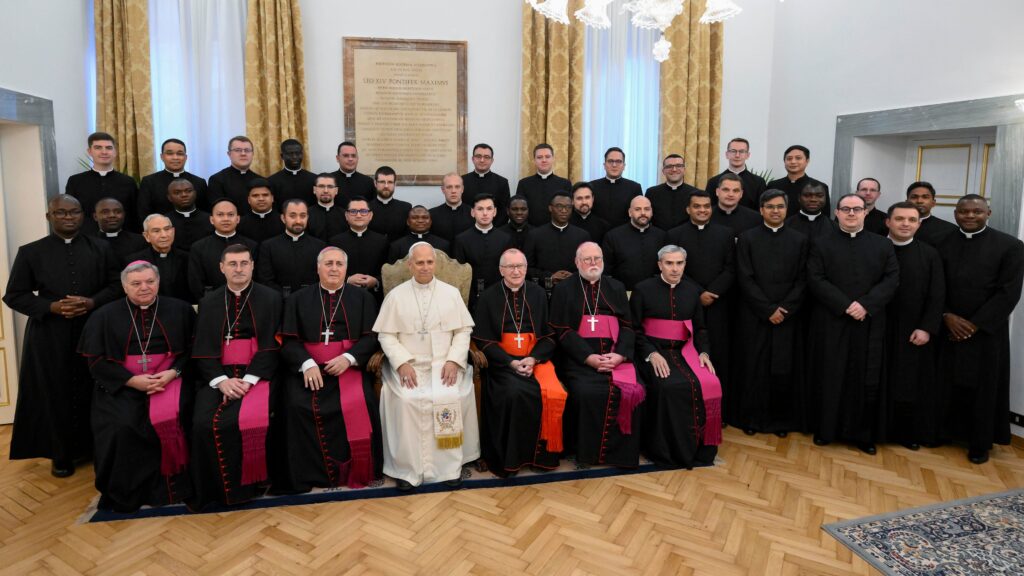
The pope made the remarks April 27 during a visit to the Pontifical Ecclesiastical Academy, the Holy See’s school for training diplomats, on the occasion of the 325th anniversary of its founding.
Leo recalled that a few years earlier, while serving as prefect of the Dicastery for Bishops, he had visited the academy and reflected on “the essential mission carried out by the alma mater of the pontifical diplomats.”
“Today, almost a year after the start of my Petrine ministry, accompanied by the diligent commitment of the Secretariat of State and the pontifical representations,” he said, “I therefore look with deep gratitude upon the history of dedication and service that this joyful anniversary celebrates.”
That history, the pope said, rooted in the very Catholicity of the Church, has included an unbroken chain of priests from various parts of the world who have contributed “with their humble efforts to the building of that unity in Christ which, amid the diversity of origins, makes communion a fundamental characteristic of the diplomatic service of the Holy See.”
Referring to reforms made to the academy by Pope Francis in March 2025, Leo said the most important reform required of those entering the community is “a constant exercise in conversion, aimed at cultivating ‘closeness, attentive listening, witness, a fraternal approach, and dialogue … combined with humility and meekness.’”
The pope said the gathering was an opportunity to outline some characteristics of the pontifical diplomatic priest, who participates in the ministry of the successor of Peter and serves peace, truth, and justice.
The Vatican diplomat, he said, “must be, first of all, a messenger of the paschal proclamation ‘Peace be with you!’”
“Even when the hopes for dialogue and reconciliation seem to vanish and peace ‘as the world gives it’ is trampled upon and put to the test,” Leo said, “you are called to continue to bring the word of the risen Christ to all. ‘Peace I leave with you; my peace I give to you.’”
Before trying to build peace “with our own meager strength,” the pope said, the mission of pontifical diplomats calls them to be bridges and channels for it, “so that the grace that comes from heaven may find its way through the vicissitudes of history.”
Leo also said the papal diplomat, working in different cultural settings and international organizations, “is specifically assigned to bear witness to the truth that is Christ.”
Such a diplomat, he said, must bring Christ’s message to the forum of nations and become “a sign of his love for that portion of humanity entrusted to his mission as a shepherd, even before that of a diplomat.”
The pope also stressed the importance of clear language in diplomacy, citing his January address to the diplomatic corps accredited to the Holy See in which he said it is urgently necessary that “words once again … express distinct and clear realities unequivocally,” because “only in this way can authentic dialogue resume without misunderstandings.”
“For this reason, too,” he told the students, “it is important that you bring to the world the Word of Life, who revealed himself not through the affirmation of abstract principles and ideas but by becoming flesh.”
Leo reminded the academy’s students that they are preparing for a ministry “which is not limited to safeguarding the good of the Catholic community but extends to the entire human family living in a particular nation or participating in the work of various international organizations.”
This, he said, requires them “to be promoters of all forms of justice that help to recognize, rebuild, and protect the image of God imprinted in every person.”
“In the defense of human rights — among which the rights to religious freedom and to life are prominent — I therefore urge you to continue to show the way, not toward confrontation and demands but toward the protection of human dignity, the development of peoples and communities, and the promotion of international cooperation,” he said. “These are the only means that allow us to embark on authentic paths of peace.”
The pope acknowledged that in a world marked by tensions, where conflict can appear to be the only way to address needs and demands, efforts at dialogue, listening, and reconciliation may seem insufficient, at times even futile.
“This must not discourage us!” he said. “Let us continue to invoke with confidence the gift of Christ’s peace, without fear.”
He assured the superiors and students that their ministry, at any time and in any place, will be “an instrument for promoting and safeguarding the dignity of every man and woman, created in the image and likeness of God, and for advancing the common good.”
This story was first published by ACI Prensa, the Spanish-language sister service of EWTN News. It has been translated and adapted by EWTN News English.