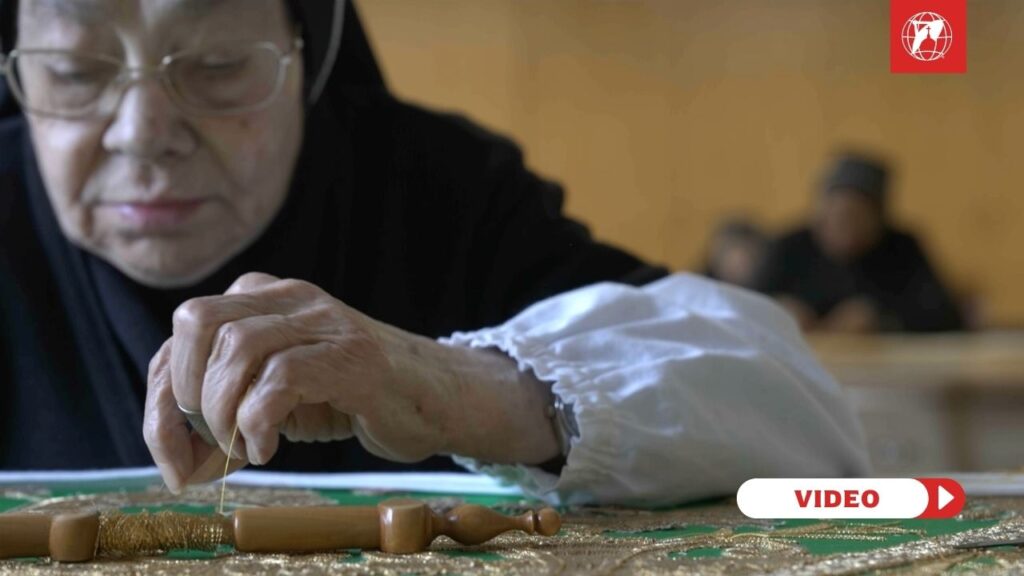
A needle and thread in the right hands can create something extraordinary. For the Daughters of St. Joseph, those tools become instruments of devotion, transforming fabric into the intricate liturgical vestments worn during the celebration of the Mass.
One of the longstanding ministries of this congregation of sisters is the creation of ecclesiastical garments. Their work includes vestments crafted for priests, bishops, and religious communities, as well as for parishes and churches that request them.
For the sisters, the craft is not simply a form of artistic expression—it is an act of faith. Sister Chinelo Aniagboso, Councillor for Formation for the Daughters of St. Joseph, explains that seeing clergy wear the vestments they have created brings joy, but not for personal recognition.
“When we see the bishops or priests wear what we made, yeah, I feel happy and we feel happy,” she says. “But it’s more because the Lord is glorified. What they’re wearing is what it’s worth to serve the Lord because all that we made is what they put on during the celebration of the Mass.”
Following the Example of St. Joseph
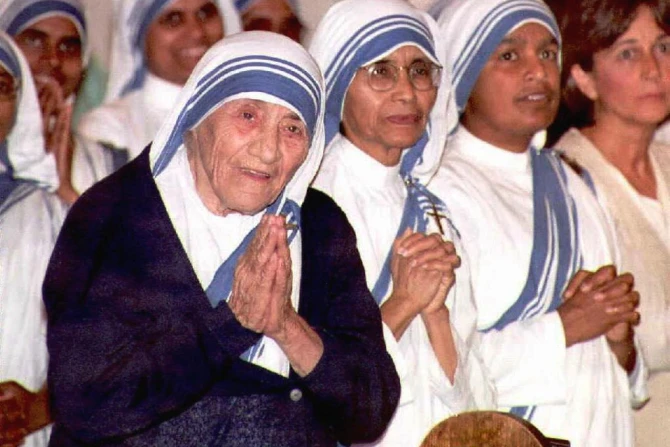
Sisters Chinelo Aniagboso and Cicera Neuza Da Cruz live with the congregation of the Daughters of St. Joseph in Rome. The congregation was founded by Blessed Clemente Marchisio in 1875 in Rivalba, Italy, and its charism centers on devotion to the Holy Eucharist.
According to Sister Chinelo, the spirituality of the congregation is rooted in the example of the Holy Family and the quiet strength of St. Joseph.
“The spirit behind it, is that our founder wants their daughters to live the life imitating the Holy Family of Nazareth, where Joseph is a father,” she explains. “And secondly, when Joseph was on earth, he was taking care of Jesus. He walked to take care of Jesus. But now, Joseph is no more on earth, but Jesus is still in the Eucharist. So we are taking after our father, Saint Joseph, to take care of Jesus in the Eucharist and everything that pertains to Jesus.”
She adds that the congregation’s life mirrors the hidden simplicity of Nazareth. “Our lifestyle is modeled from the Holy Family. A hidden life, yet our work speaks loud.”
Each sister receives training in the craft of liturgical sewing, learning how to make vestments such as mitres, albs, chasubles, copes, and altar linens. They also prepare the bread and wine used during Mass.
Yet the sisters see their work as more than craftsmanship—it is a form of prayer.
“Our work, it’s like it has a missionary dimension,” Sister Chinelo says. “Wherever this work reaches, wherever it goes, there it also goes with our prayer and our intention because while we work, we pray. In fact, our work time is like prayer time.”
A Silent Witness of Faith
For the sisters, St. Joseph remains a powerful spiritual example. Though often associated with fatherhood and masculinity, his quiet strength also inspires the women of the congregation.
Sister Cicera Neuza Da Cruz, Secretary General of the Daughters of St. Joseph, reflects on the virtues she sees in the saint.
“The virtue of Saint Joseph that inspires me the most is that he was a man of a tender masculinity and, at the same time, strong—a love that guards and protects without dominating, without possessing,” she says.
She also points to his silence as a model for modern believers.
“Saint Joseph is the patron of families. In a world so noisy, Saint Joseph teaches us that it is possible to be immersed in great depth without making noise.”
For Sister Cicera, his example continues to speak to families and Catholics today. “He is a model for Catholics, and especially for families, because he loved his family in an extraordinary way. And so he also teaches families today, and all Catholics, how one should live within the family and how one should safeguard the family.”
A Spiritual Father
The Feast of St. Joseph holds special meaning for the congregation. In Italy, the celebration coincides with Father’s Day, making it a moment to honor not only their patron saint but also the one they consider their spiritual father.
Sister Chinelo says that the sisters frequently turn to St. Joseph in prayer.
“Anytime we are in need, we call on Joseph, we make a novena, we make prayers. Without fail, Saint Joseph answers us.”
For Sister Cicera, the life of St. Joseph also carries a message for young people searching for their vocation.
“What is God’s dream for me?” she asks. “Saint Joseph certainly had his own dreams, but he also knew how to understand God’s dream.”
She concludes with a reflection drawn from the saint’s example: “And we see that in Saint Joseph’s life, every choice he made was a concrete act of love for God. Here is my message: in every choice that you young people make in your life, always remember that God also has a dream for your life.”
Adapted by Jacob Stein. Produced by Alexey Gotovskiy; Camera by Alberto Basile, Fabio Gonnella; Video Edited by Ilaria Chimenti.