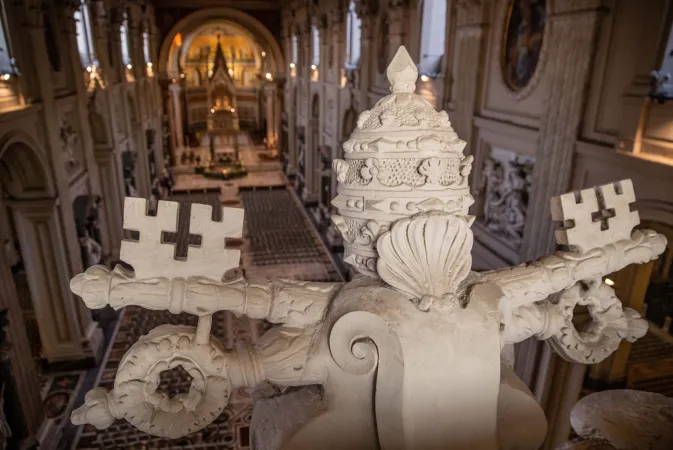
The Feast of the Dedication of the Lateran Basilica is a solemnity that finds its historical roots in the first half of the 4th century: the end of the harsh persecutions of Christians and the Constantinian Advent.
This liturgical celebration cannot be fully understood except in the light of the figure of the Emperor Constantine, and the consequent creation of what we still commonly call the “Basilica of Saint John Lateran.”
In late antique sources, the building is called basilica lateranensis with reference to the place, basilica constantiniana with reference to the patron, and basilica Salvatoris with reference to the dedication. Only in the early Middle Ages was the title of Basilica of Saint John added to the church.
The Feast of the Dedication of the Lateran Basilica is a liturgical celebration that pays homage to the first official monument of Christianity, consecrated for the first time on November 9, 318 — or 324 — by Pope Sylvester I (314-335). In the same period, as we read in the Liber Pontifcalis — a collection of the biographies of the popes composed in Rome starting from the beginning of the 6th century — there were numerous gifts that the emperor made in favor of the Lateran Church. It is a series of precious liturgical furnishings, including seven silver altars of which unfortunately we know nothing.
This historical turning point which occurred in the guise of “royal power” — traced by the famous Edict of Milan in 313 — passes through the construction works of the imposing Basilica of Saint John Lateran which began immediately after Constantine’s victory in the battle of the Milvian Bridge in 312.
It is a construction, that of the Cathedral of Rome, which represents an ex-voto of gratitude for the triumph obtained against his rival Maxentius. In the famous story by Eusebius of Caesarea reported in the Vita Costantini, it is said that on the eve of the battle the future emperor saw “the trophy of a cross of light” appear in the sky with an inscription next to it: “In hoc signo vinces” (By this sign, you will conquer). A sign, Eusebius continues, that Constantine had fixed on a labarum, a golden rod in the shape of a cross surmounted by a crown with the Christogram (XP).
In the policy adopted by Constantine, of making the Christian religion the “banner” under which to unite the empire, the emperor decided to return to the Church not only the property confiscated during the period of persecution, but also to make available to Christian communities various lands on the fringes of the walls of the City, what would over the years become Rome’s “Christian pole.”
Among these also the large area of the Lateran, where at that time the barracks of the imperial guards were located, the so-called castra nova equitum singularium built by Septimius Severus between the 2nd and 3rd centuries. The buildings of the equites singulares (horse guard), who remained faithful to Maxentius, were demolished to make way for the Constantinian Basilica.
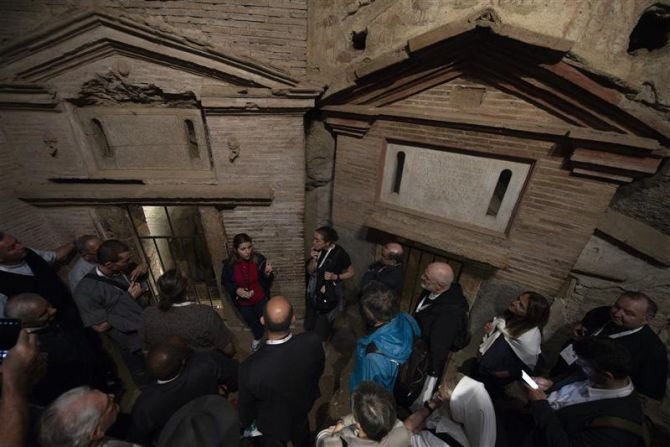
The remains of the Constantinian era are still partially visible today under the cladding of the current Cathedral of Rome built by Borromini in the years 1646-1650. In a painting from the second half of the 1600s by Filippo Gagliardi, preserved in the Church of San Martino ai Monti (Rome), the pre-Borrominian Lateran Basilica can still be seen.
Furthermore, the archaeological excavations carried out in 1934-1938 under the Lateran basilica brought to light houses from the 1st and 2nd centuries, most likely the remains of the palace of the Lateran family which gave its name to this area, which later passed under the control of the emperor’s estate.
In the Constantinian building process, another work of extreme importance within the Lateran complex is the baptistery that the emperor himself had built near the basilica, and defined in the Liber Pontificalis as fons sanctus. This baptisterium, in reference to the building that houses the baptismal font, is the oldest sacred building intended for the rite of the sacrament of baptism, thus making the Lateran basilica the “prototype of Christian churches.”
The Feast of the Dedication of the Lateran Basilica recalls precisely these historical and archaeological memories, which over the centuries have become symbols of the conquest of “religious tolerance” by the Christian communities from the imperial power which had until then proved hostile; a conquest which for the well-known French historian and archaeologist Paul Veyne represents the beginning of a “Christian Europe.”
Initially the liturgical Feast of the Dedication of the Cathedral of Rome was celebrated only within the confines of the city of Rome. Only later, in 1724 — under the pontificate of Benedict XIII — was this solemnity extended to all the churches of the Roman rite to pay homage to the “mother church of all the churches of Rome and the world.”
Translated and Adapted by Jacob Stein.