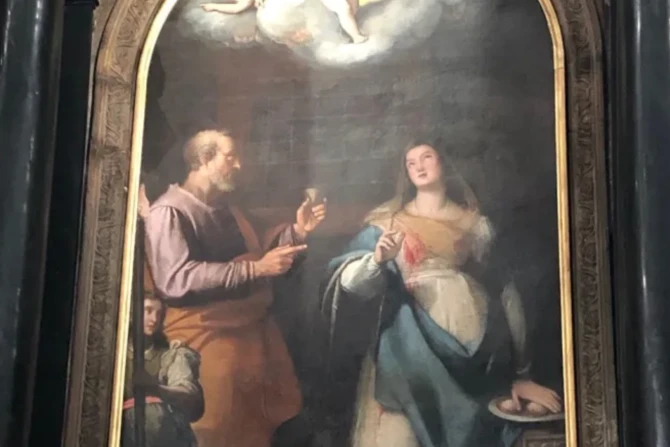
Every Feb. 5, the Church remembers St. Agatha of Catania, a young woman who consecrated her virginity to God and died a martyr’s death during the persecution of the Roman Emperor Decius in the third century.
Agatha was born in Catania, Sicily, in southern Italy, around the year 230. Like many women of her time, she decided to consecrate her life to Jesus Christ by remaining a virgin.
In the days of the persecution of Decius, the proconsul Quintianus, the governor of Sicily, fell in love with Agatha and sought her in marriage. However, the young woman rejected each of his proposals.
The constant refusals greatly annoyed the proconsul, who ordered her to be taken to a brothel as punishment. Contrary to what Quintianus expected, in that sad place, Agatha managed to avoid any occasion that could jeopardize the promise she had made to the Lord. And, as if this were not enough, many women subjected to that world that treated them as merchandise converted to Christ.
Quintianus then ordered Agatha to be subjected to a series of taunts and insults, and then ordered her to be tortured. Her executioners, in a fit of insanity, cut off her breasts. A certain hagiography preserves her words in the face of such wickedness: “Cruel tyrant, are you not ashamed to torture in a woman the same breast which fed you as a child?”
Tradition has it that Agatha miraculously survived the horrors and cruelties committed against her, and during the night while she was bleeding to death, St. Peter the Apostle appeared to her to heal her wounds and encourage her to remain steadfast.
At dawn, when the guards realized that the woman had recovered, the executioners resumed the tortures and Agatha gave up her life. It was the fifth day of the second month of the year 251.
One year after the martyrdom of St. Agatha, the volcano Etna erupted. The lava that spread along the slopes of the volcano threatened to destroy Catania. Then, some of its inhabitants who remembered the young martyr asked for her intercession to stop the fury of nature.
Miraculously, the sea of burning rock and ash that began to move never reached the city. In gratitude, Catania and other surrounding towns chose Agatha as their patron saint.
Today, devotees of St. Agatha ask her to intercede for women who have complicated childbirths or problems with lactation. She is also invoked by those who suffer from breast ailments. She is considered the protector of women and patron saint of nurses.
In traditional iconography, St. Agatha is usually shown with the palm of martyrdom, the palm of victory, in her hand; or she is holding the tray on which her breasts were placed.
This story was first published by ACI Prensa, CNA’s Spanish-language news partner, and has been translated and adapted by CNA.