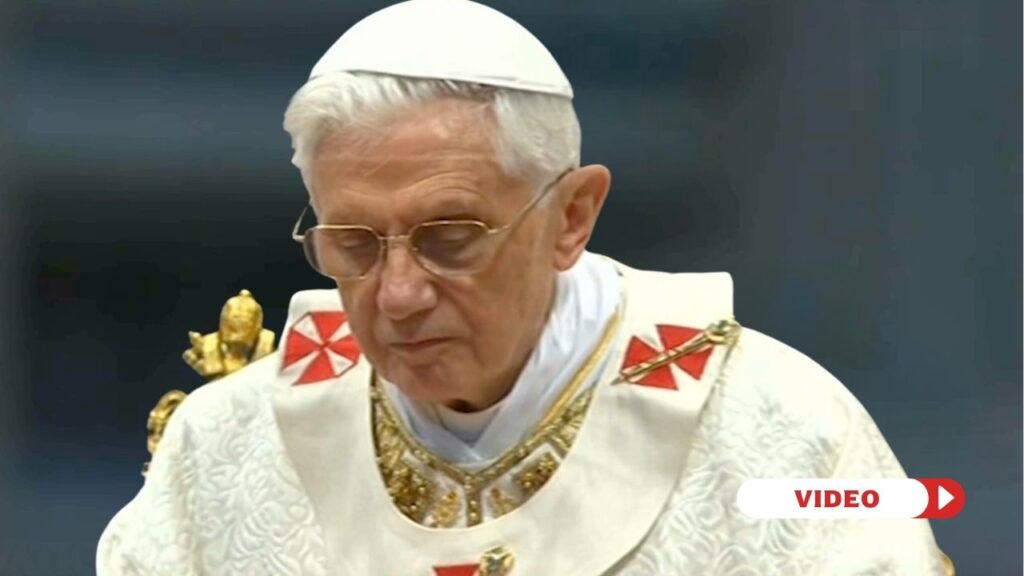
Cardinal Joseph Ratzinger, soon to become Pope Benedict XVI, delivered a stark critique during the 2005 conclave preparations: “Today, having a clear faith based on the Creed of the Church is often labeled as fundamentalism. Whereas relativism, that is, letting oneself be “tossed here and there, carried about by every wind of doctrine”, seems the only attitude that can cope with modern times. We are building a dictatorship of relativism that does not recognize anything as definitive and whose ultimate goal consists solely of one’s own ego and desires.”
A Prophetic Warning on the Eve of the Papacy
Spoken on April 18, 2005, as he celebrated Holy Mass to open the conclave, these words preceded his election the very next day. More than twenty years later, his warning about this “dictatorship of relativism” feels prescient amid Western society’s cultural shifts.
Analytical Foresight from the 1960s and Beyond
Pope Benedict’s prophetic insight shone early. EWTN Vatican’s Rudolf Gehrig noted Ratzinger’s remarkable precision: “When you read the texts Ratzinger wrote in the 1960s and 1970s, you can’t help but notice his analytical gift—a kind of precision that is almost frightening…”
Archbishop Georg Gänswein, Benedict’s former private secretary, elaborated on this gift rooted in faith: “Being a prophet isn’t necessarily a pleasant experience. Anyone who reads the Old Testament will see that most prophets haven’t had an easy live —quite the opposite, in fact. Ratzinger not only possessed analytical gifts, but was also deeply rooted in faith; by gauging and evaluating the trends of the times, he foresaw many things and recognized the long-term consequences they would have.”
Gehrig highlighted a specific early warning from the late 1960s: “In the late 1960s, Cardinal Ratzinger wrote – and I quote: ‘We have no need of a Church that celebrates the cult of action in political prayers. lt is utterly superfluous. Therefore, it will destroy itself.’”
Gänswein emphasized letting God shape action over activism: “Cardinal Ratzinger / Pope Benedict often spoke of how it is not first and foremost important that I do this or that, but rather that I first let God into my life and then, out of faith, do the things I have to do. That changes everything. That’s why I share your opinion, your critical remarks…”
Gehrig chuckled, clarifying: “Those weren’t my words—I was just quoting Ratzinger!” Gänswein agreed, underscoring the ongoing relevance: “Yes, I share that view—and that is what is so prophetic about Ratzinger—that, unfortunately, this has become more and more of a reality in recent years. Ratzinger issued warnings—or rather, he made suggestions and took the initiative. However, he was very often simply blocked, for a variety of reasons, especially during his time as pope.”
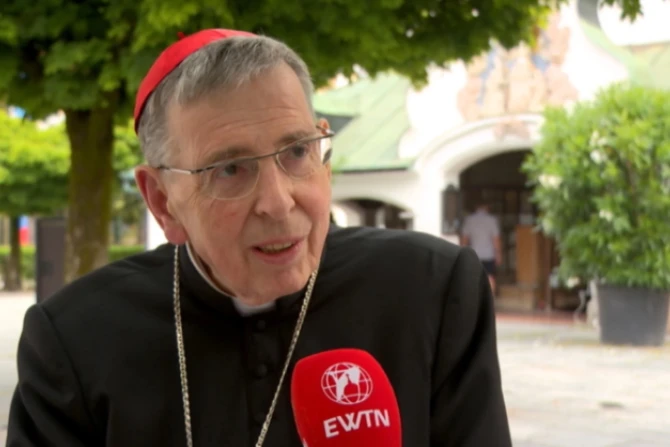
Swiss Cardinal Kurt Koch, Prefect of the Dicastery for Promoting Christian Unity, echoed this validation: “He foresaw many problems we have today. For example, back in the 1970s he wrote: ‘The battle for humanity is being fought today through the battle for the family.’ That was very prophetic. That is exactly what happened. But his theology offers us new perspectives and answers to today’s greatest challenges as well.”
A Lasting Legacy of Faith and Holiness
Today, many believe Pope Benedict remains underappreciated. Fr. Markus Graulich, Under Secretary of the Dicastery for Legislative Texts, pointed to his enduring works and witness: “Oh, there are several of his works that remain. They are surely reread in the next years to come. And there is his great testimony, his life, as he was a person who believed deeply in God and who tried to do the will of God in all the different circumstances that he did not look for but that were given to him.”
Pilgrim Anna Diouf from Germany celebrated his integrated theology: “I think his legacy is a deep theology that shows us that reason and faith are not opposed to each other and that our intellect, our brain, our head, our heart, our soul, that they all belong together, and that we should search for the Lord and that we should search for Jesus in all of this.”
Fr. Thorsten Weber, Cathedral Priest of St. Mary’s Cathedral in Hamburg, went further: “I truly believe that we will reach the point where he will be declared a Doctor of the Church, and I hope so too!” Gehrig quipped: “You heard it here first on EWTN! (laughs)”
Far from pessimistic, Joseph Ratzinger—Pope Benedict XVI—always saw hope amid challenges. In 1969, he wrote: “The future of the Church, once again as always, will be reshaped by the saints, by men, that is, whose minds probe deeper than the slogans of the day, who see more than others see, because their lives embrace a wider reality.”
Gänswein captured this optimism: “For Pope Benedict, for Joseph Ratzinger, the very fact of holiness—that there were people who lived like saints—was always the best proof of the truth of the Gospel. Not theological conclusions, not logical arguments, no matter how clever, but rather faith lived out and embodied in a person—that was what mattered most to him and served as his model. The point is that we must not lose either our faith or our courage, and that we must truly believe in God’s providence.”
Adapted by Jacob Stein. Camera by Tim Hotzelmann; Special thanks & Credits to EWTN Germany; Martin Rothweiler; Fundatio Christiana Virtus e.V.; MAKA Germany.