Starting on July 8, no parish churches will be permitted to celebrate the Traditional Latin Mass in the diocese, Bishop Martin said.
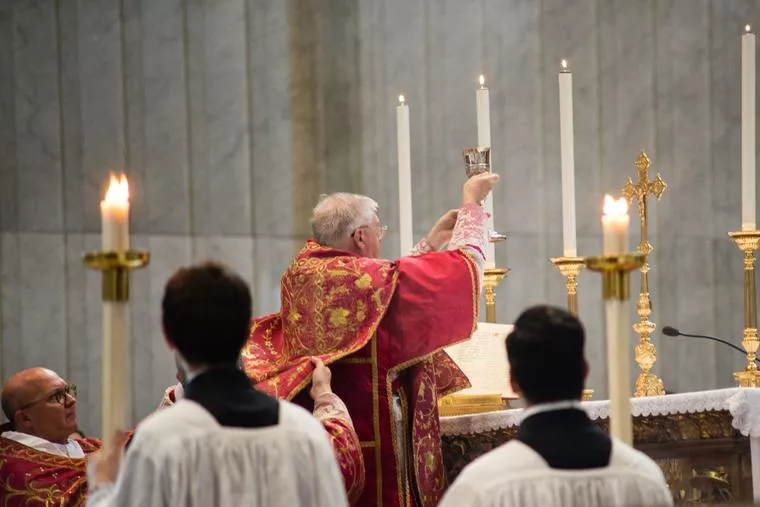
The Diocese of Charlotte, North Carolina will significantly restrict the practice of the Traditional Latin Mass, limiting it to a single chapel in what Bishop Michael Martin said is a bid to “promote the concord and unity of the Church.”
Bishop Martin issued a statement on Friday announcing the new policy, directing that the ancient liturgy would henceforth be celebrated in an as-yet-unnamed chapel in the town of Mooresville.
Bishop Martin in his statement said the measure was meant to bring the Charlotte diocese in line with Pope Francis’ 2021 motu proprio Traditionis Custodes, which greatly restricted the Latin Mass “in defense of the unity of the Body of Christ.”
The Pope said at the time that he was saddened that the celebration of the extraordinary form was characterized by a rejection of the Second Vatican Council and its liturgical reforms. To doubt the Council, he said, is “to doubt the Holy Spirit himself who guides the Church.”
Bishop Martin on Friday noted that his predecessor, Bishop Peter Jugis, requested an extension on the directive in order to prepare for the transition. The extension expires this year, Bishop Martin noted, and he is “now ready to finish the diocese’s implementation of the norms established.”
Starting on July 8, no parish churches will be permitted to celebrate the Traditional Latin Mass in the diocese, Bishop Martin said. In accordance with Traditionis Custodes, the bishop said he was “designating a chapel in the diocese” that will be permitted to use the Roman Missal of 1962 and where “faithful adherents may gather for the celebration of the Eucharist” only on Sundays and Holy Days of Obligation.
“A priest of the diocese will be appointed as chaplain, to be responsible for celebrating two Sunday Masses and Holy Day Masses using the 1962 Roman Missal at this site,” the bishop said.
“Those who are interested in participating in the Eucharistic celebration in this form will remain active members of their current parishes, where they may continue receiving the sacraments,” he added.
Citing the Gospel of John, Bishop Martin expressed hope that the new rule “will further ‘promote the concord and unity of the Church’ among the People of God in the Diocese of Charlotte so that, as Jesus prayed to His Father, we ‘may all be one.’”
This article was originally published on Catholic News Agency.