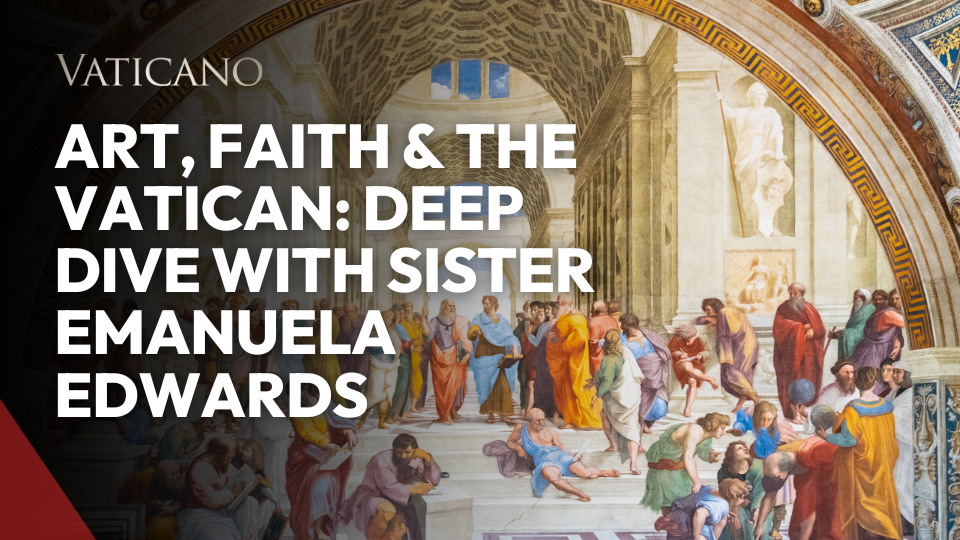
In the heart of Rome, millions of people from all corners of the globe make a pilgrimage to the Vatican Museums every year. These museums house some of the world’s most magnificent art and cultural treasures. But beyond the breathtaking masterpieces, there is a deeper purpose, a mission of faith and education.
Andreas Thonhauser, EWTN Vatican Bureau Chief, sits down with Sister Emanuela Edwards, the head of the didactic office at the Vatican Museums, to delve into the fascinating world of art, faith, and education at the Vatican. Join us as we explore the role of art in evangelization, the Vatican’s educational initiatives, and the extraordinary ways in which the museums are made accessible to all, including those with disabilities.
Every year, millions of people come to visit the Vatican Museums in the heart of Rome. Sister Emanuela Edwards is the head of the didactic office. Sister, could you explain to us a little bit what that exactly means and what your role entails?
Of course, my role is about creating programs for the schools to come into the Vatican Museums in order to use the collection for education. So, we have the possibility for school groups and university groups to come and visit the museum, and my job is to create content and tools that support their educational programs. In addition, we also look after those special visitors who come to the museum, those who have disabilities. So that they, too, can enjoy the museums of the Holy Father.
Children and art. Sometimes, many might think, does that not contradict each other a little bit? Is there interest on the part of the young visitors of the Vatican Museums?
I think the young visitors are some of the most important visitors to the museum, and indeed, they teach us so much because they really test the ability of the guide to make these wonderful masterpieces accessible to them. Because art attracts everyone. There’s no age limit on a great masterpiece, but we have to deliver it in such a way that young people are interested and are able to engage with the story. For example, every child, I think, finds the story of creation by Michelangelo fascinating, and of course, in the Latin museums, we have the greatest masterpieces ever created.
So, what do you wish the young visitors learned from visiting the Vatican Museums?
Young visitors, just like every visitor, my greatest desire is that they learn the wonderful story of the Gospel and that they take away from the Vatican Museums the knowledge that God loves them.
God loves them. You can see that in the art. So, what role does art also play when we talk about evangelization when we talk about teaching about the Gospel?
Art has always been a powerful means used by the church in order to transmit the contents of the faith. We only need to look in the Pius-Christian Museum to see the wonderful sarcophaguses which are sculpted with the Gospel stories. And so from the very earliest times, the church used art in order to transmit the faith in order to remind people of the faith, and then to create devotion, to bring them closer to God.
And so, if you like, art is a bridge. It’s a bridge where people can come to understand the contents of the faith. Pope Benedict, in the opening to the compendium, said that pictures transmit far more than what can be said with words. And this is a powerful means in our society today that is so used to them. On average, I think someone said you see 265 images a day, but how often do we think?
What does that mean? If by chance one were to think about a sacred image, one would instantly switch to the words of the Gospel because in order to understand the sacred book of art, we would take reference from the Gospel. And so it’s an ingenious way of bringing the Gospel into everybody’s life, even those who ordinarily would never enter a church, for example. How many people enter the Sistine Chapel? Pope Francis calls it a work of evangelization. And so you’re a person, you may enter the Sistine Chapel without any real religious faith, but in looking at the wonderful masterpieces, all of a sudden, the heart is raised to God. Plato said that at the sight of beauty, our soul gains wings. So, imagine the impact of going into the Sistine Chapel; the human heart that searches for truth, goodness, and beauty sees that revealed clothes, if you like, in the wonders of the Gospel. And so these wonderful pictures become a way of transmitting the words of the Gospel.
Sister, thank you so much for being with us.
(Adapted by Jacob Stein)