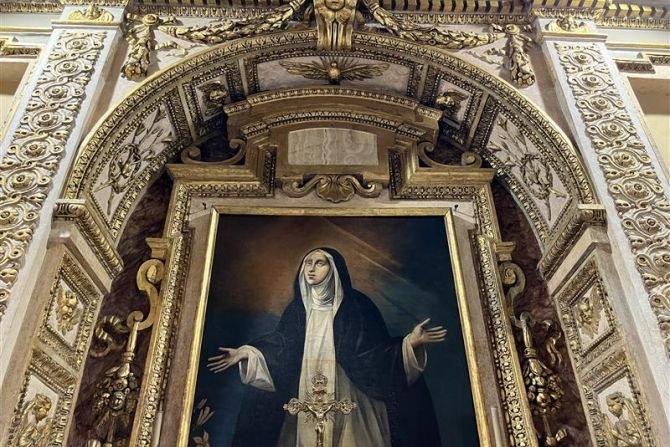
While most people associate St. Catherine with the Italian hill town of Siena, the Dominican Doctor of Church is one of the patron saints of Rome and spent her last years in the Eternal City, where one can visit her tomb and the room where she died.
Located around the corner from the Pantheon, the tomb of St. Catherine of Siena sits within the high altar of the Basilica of Santa Maria Sopra Minerva under the striking blue and gold vaulted ceiling of Rome’s only church with a Gothic interior.
Visitors can reach out and touch the marble tomb as they pray on kneelers behind the altar and many leave small pieces of paper scribbled with prayer intentions atop her sarcophagus.
Even lesser known than her tomb is the exact location where St. Catherine died. It can be found by walking two minutes from the basilica along the Via di Santa Chiara. The building where St. Catherine lived in Rome with some of her followers has been replaced with a theater, the Opera Lirica di Roma.
Hidden inside the theater building is a little gilded chapel dedicated to St. Catherine that marks the spot where she died in Rome. People who want to visit can simply stop by and tell the theater staff that they wish to pray in the chapel.
Sister Catherine Joseph Droste, a Dominican Sister of St. Cecilia in Nashville, is a theology professor at the Angelicum in Rome. In an interview at St. Catherine’s tomb, Droste told CNA about St. Catherine’s importance to the city of Rome.
“Catherine is co-patroness of Rome with Peter and Paul because of her role in helping the papacy to return to Rome,” Droste said.
When Catherine was born in 1347, the pope was living in Avignon, France. Catherine was adamant that the pope needed to return to Rome, so much so that she went to Avignon and spoke with Pope Gregory XI encouraging him to fulfill a secret promise he had made that if he became pope, he would return the papacy to Rome.
Gregory eventually heeded her request and returned to Rome in 1370, but during the reign of his successor, Pope Urban VI, French cardinals unhappy with Urban’s reform efforts elected an antipope in Avignon.
“Urban asks Catherine to come to Rome, so she came to Rome at the end of 1378 to help Urban with the reform,” Droste explained.
“And Catherine, in the last months of her life, even though she was very sickly, would walk daily from here [her residence in Rome] to the Vatican. … She would go there daily and pray for the pope,” she said.
“You can see today right as you walk into the Vatican before you go into the main church in the narthex — if you turn around, above the entrance there is a mosaic of Christ and the boat with the apostles in it — that was from the original basilica. It was in a different spot, but it is reported that that is where Catherine prayed daily for [the successor of] Peter.”
After Catherine died in the spring of 1380, the walls of the room where she died were moved to a small chapel inside the Basilica of Santa Maria Sopra Minerva. (This chapel can also be visited by passing through the basilica’s sacristy, which is a historic location in itself for hosting two papal conclaves in the 15th century.)
Pope Pius IX named St. Catherine a co-patroness of Rome in April 1866. Pope Pius XII named Catherine a co-patron saint of Italy in 1939, along with St. Francis of Assisi.
“Catherine has influenced me a great deal in my love of the Church, in my love of the papacy,” reflected Droste, who received the name Catherine when she made her vows as a religious sister.
“One of the most important messages of Catherine she learned from Christ,” she added.
“Christ asked her one day, ‘Do you know who you are and who I am?’ And he said to her, ‘You are she who is not. I am he who is.’ Now that is a challenging phrase because many people would think that means ‘I am nothing.’ Well, I am nothing before God because he created me and gave me everything. But in his eyes, I am everything because I am a human being that he loves.”
“And so, Catherine would say, Christ is crazy in love with you. He’s madly in love with you. He’s drunk in love with you. So Catherine’s first message is understanding what it means to be a human being, to be loved by God. And that’s important for every one of us.”
This article was originally published on Catholic News Agency.