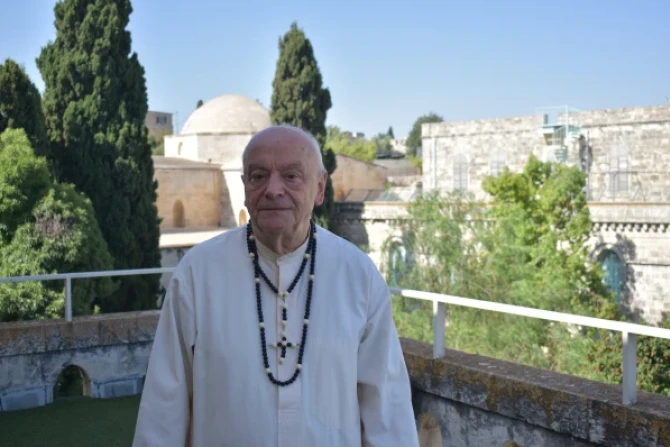
Father Frans Bouwen, a missionary with the African Missionary Society — better known as the White Fathers for the color of their habit — and one of the most renowned Catholic voices in ecumenical dialogue, holds that “there are no real theological reasons” to justify Christians celebrating Easter on different dates.
Catholics and Protestants commemorate the resurrection of Jesus following the Gregorian calendar, while the Orthodox follow the Julian calendar. However, this year will be different. Thanks to the two calendars coinciding, all Christians will celebrate Easter together on Sunday, April 20.
“There are no real theological reasons for celebrating Easter on different dates, but sometimes the calendar seems to have become sacred,” the priest told ACI Prensa, CNA’s Spanish-language news partner, noting that the desire to share the Easter holiday is especially felt in areas where Catholic and Orthodox communities coexist.
In Jerusalem, a holy city for Jews, Christians, and Muslims, there are currently some 591,000 Jews and barely 13,000 Christians. However, the small Christian community is made up of different churches: Catholic, Eastern Orthodox, Oriental Orthodox, Armenian, and Protestant.
In this sense, in the Holy Land, “almost all Christian families are made up of Catholic and Orthodox faithful who wish to celebrate together and form a community united in witness, most often remaining small numerical minorities amid a majority of believers of other religions, Muslims, or Jews,” explained Bouwen, who was a consultant to the Pontifical Council for Promoting Christian Unity.
In fact, nowhere else in the world do Eastern and Western Christian traditions coexist as closely as in the small space that delimits the Old City of Jerusalem, the place where Christ died.
The Belgian priest, who has lived in Jerusalem since 1969, emphasized that ecumenism “already exists as a primarily local reality,“ alluding to the “sensus fidei,“ that spontaneous instinct of the faithful that drives communities to seek unity naturally, without theological diatribes.
“Thanks to recent advances in ecumenical relations, the diversity of liturgical traditions is no longer seen as a scandal but as a living testimony that the Gospel has been able to reach many different languages and cultures, which have been able to perceive, express, and celebrate the Christian faith and life according to their own innate genius,” he explained.
“The fact that they all gather around Calvary and the tomb of Christ manifests their common roots and fundamental belonging,” added the priest, who has served on international commissions for theological dialogue with Orthodox churches.
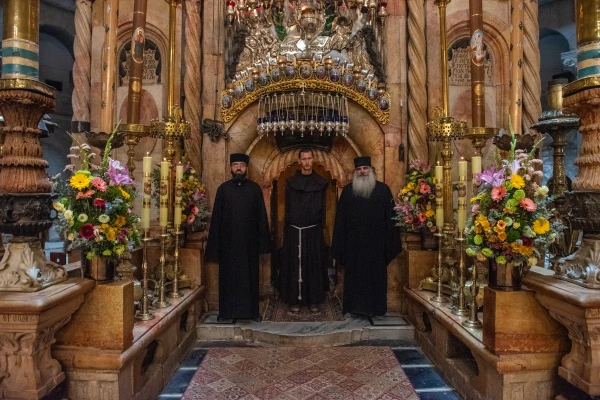
The Gregorian and Julian calendars coincide periodically. Thus, the Status Quo, the unwritten law governing holy sites shared by two or more Christian communities, also determines the scheduling of celebrations for Easter at the Basilica of the Holy Sepulcher.
“It rigorously stipulates how liturgical celebrations should be carried out by the various churches, fully respecting the rights of each. The fraternal spirit that currently marks these celebrations shows that, also around the holy sites, there has been notable ecumenical progress in recent years,” he noted.
Attempts at a common celebration
In fact, both in Jerusalem and in other areas of the Holy Land, “there have been several attempts to achieve a common celebration of Easter at the local level,” due primarily to the influence of their neighbors.
“For several decades, in Egypt, Jordan, and Cyprus, Catholics have celebrated Easter with the Orthodox of these countries — that is, according to the Julian calendar,” he explained.
After noting the positive results of the common celebration of Easter, “many faithful and pastors in the Holy Land began to promote the desire to do the same in the Holy Land,” Bouwen added.
Specifically, there were two attempts in 1995 and 2016, thanks to a joint initiative of the Catholic bishops and the Anglican and Lutheran churches. However, the results were not as hoped for.
“Many international Catholic religious congregations preferred to continue celebrating Easter together with their brothers in Western countries. The Maronite community also did not join this initiative,” Bouwen explained.
These past attempts did not include a joint celebration at the Basilica of the Holy Sepulcher because there was no time to address the complexities imposed by the Status Quo.
In fact, as new divisions arose within the Catholic Churches, the idea of celebrating Easter in the Holy Land together with other Christian churches “has been abandoned for the time being,” Bouwen said.
The holy places pose an obstacle
The presence of the holy places poses an additional obstacle. “Following the Julian calendar at the Basilica of the Holy Sepulcher in years when the dates do not coincide with the Gregorian calendar would mean that Holy Week pilgrims from Western countries would not find any Holy Week celebrations in Jerusalem,” the Belgian missionary pointed out.
Thus a common celebration of Easter would impose “certain time and freedom of movement limitations on the celebrations of the different churches within the Holy Sepulcher.”
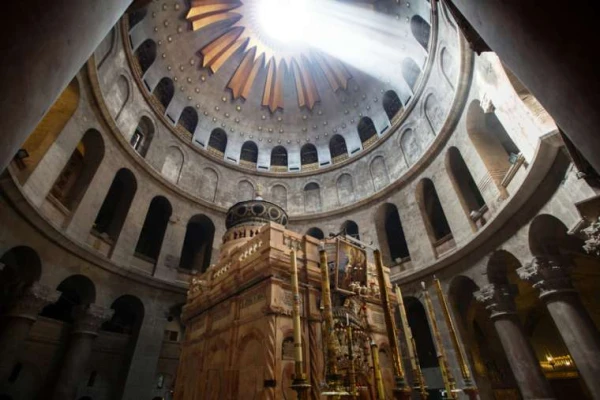
“Extending this arrangement to all years would require careful negotiations, as it would imply a change in the Status Quo. Therefore, a worldwide agreement would undoubtedly help enormously,” Bouwen commented.
Similarly, if the holy places were excluded, Catholics in the Holy Land would end up celebrating Holy Week on different dates at the Holy Sepulcher and in the rest of the parishes.
In any case, at this time, there are some parishes north of Jerusalem where Catholics, Anglicans, and Lutherans continue to celebrate Easter with the Orthodox, that is, according to the Julian calendar.
Possible joint celebrations for Pentecost
Furthermore, due to the difficult situation in the Holy Land, with the war between Hamas and the Israeli army, “it has not been possible this year to plan joint celebrations to rejoice together with the calendars coinciding.”
“Some plans had been considered, but the situation remains too volatile to organize extraordinary events beyond the traditional celebrations, which already require great efforts on the part of the churches. Joint celebrations, however, are being planned for the time of Pentecost,” Bouwen explained.
Nonetheless, Bouwen assured that local Christians are “happy and eager to show their joy at the opportunity to bear witness to their faith together and celebrate Holy Week and Easter together in their mixed faith families.”
The Council of Nicaea, held in 325, attempted to unify the calculation of the date of Easter with a single criterion, and in fact Easter was celebrated jointly for 1,300 years.
However, in the 16th century, the calendar reform introduced by Pope Gregory XIII marked a new division among the Christian churches.
Oriental Orthodox view changing the date of Easter as a ‘threat’
In Oriental Orthodox Christianity, particularly in the Middle East, due to historical and political circumstances, “the different churches have often lived isolated from one another due to communication difficulties,” Bouwen explained.
Furthermore, he noted that “living as minorities and facing oppression or even persecution in certain periods, the churches were able to preserve their identity and faith thanks to their fidelity to traditions.”
For this reason, liturgical and popular traditions “have become markers of identity that kept the community united in a hostile environment.”

Both the date and the ways of celebrating Easter are an integral part of these traditions, which is why the Oriental Orthodox Churches have historically felt “that they must hold fast to them in order to remain faithful, as individuals and as communities.”
“Changing customs and dates has historically been perceived as a threat,” Bouwen pointed out.
According to the priest, the opportunity to celebrate Easter simultaneously, thanks to the Gregorian and Julian calendars coinciding, serves to strengthen the hope and commitment “for a growing communion in faith and life.”
He pointed out that the commemoration of the 1,700th anniversary of the Council of Nicaea constitutes “a symbolic and practical opportunity for rapprochement among the Christian churches,” recalling the foundations of the Christian faith.
Bouwen concluded that despite “many advances in ecumenical dialogues, most of the fruits of these dialogues still await effective acceptance by the churches.”
This story was first published by ACI Prensa, CNA’s Spanish-language news partner. It has been translated and adapted by CNA.