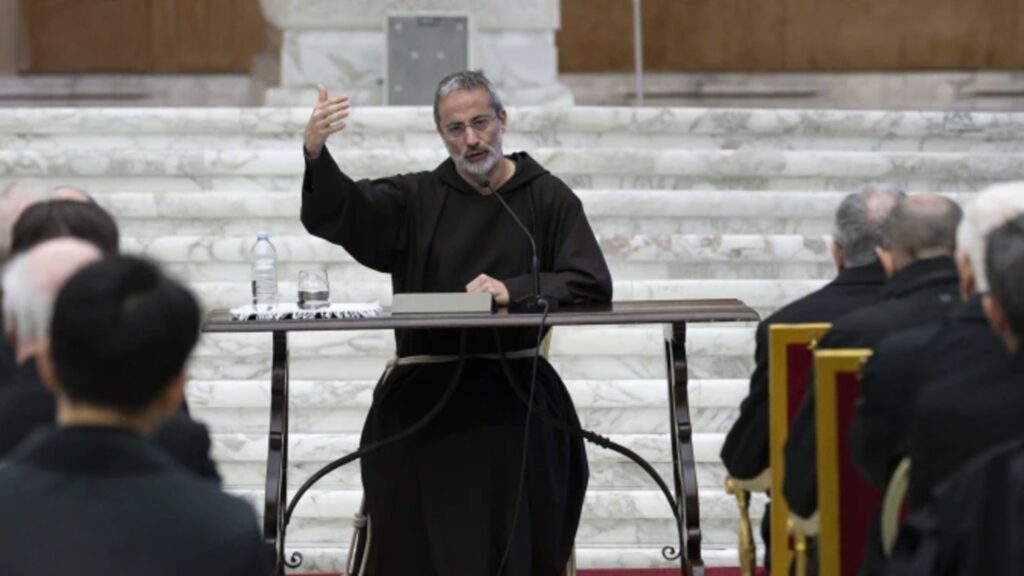
In a Lenten sermon to the pope, Roman Curia, and Vatican employees, Capuchin friar Father Roberto Pasolini drew the connection between humility, conversion, and peace in life of St. Francis of Assisi.
The Lenten sermons began March 6 in the Paul VI Audience Hall at the Vatican, delivered by the Capuchin friar and preacher to the papal household, Father Roberto Pasolini, and inspired by the conversion of St. Francis of Assisi.
In the first of the meditations, which will take place every Friday until March 27, Pasolini reflected in the presence of Pope Leo XIV, members of the Roman Curia, and Vatican employees on “Conversion: Following the Lord Jesus on the Path of Humility.”
Aware of the crisis gripping the Middle East and the escalating violence, the priest noted that, in these days marked by sorrow, “speaking of humility might seem abstract, almost a spiritual luxury.”
Reflecting on the threat of war, he emphasized that “peace is born not only from political agreements, nor from diplomatic or military strategies, but from men and women who find the courage to humble themselves.”
These people, marked by humility, are, according to Pasolini, “capable of taking a step back, of renouncing violence in all its forms, of not yielding to the temptation of revenge and oppression, of choosing dialogue even when circumstances seem to thwart it.”
He then described the saint of Assisi as “a man pierced by the fire of the Gospel, capable of rekindling in each person the longing for a new life in the Spirit.”
In light of the example of St. Francis, the priest posed this question as a starting point: “What is meant by conversion?”
“It is, first and foremost, God’s initiative, in which man is called to participate with all his freedom,” he said.
He further explained that it occurs “in the innermost recesses of our nature, where the image of God imprinted within us awaits awakening. It is when something, long silent, begins to stir anew within the person.”
“Conversion is no longer an attempt to straighten out one’s life through one’s own strength but rather a response to a grace that has redefined the parameters of how we perceive, judge, and desire,” he added.

“Conversion is no longer an attempt to straighten out one’s life through one’s own strength but rather a response to a grace that has redefined the parameters of how we perceive, judge, and desire.”
Father Roberto Pasolini, Capuchin friar and preacher to the papal household
For a true evangelical conversion, the friar emphasized the need to identify the root of evil — that is, sin — without falling into the temptation of reducing it “to a small mistake or weakness.”
He proposed “deep healing” for this purpose, emphasizing that “if the possibility of true evil no longer exists, we cannot even believe in the possibility of true good. If sin disappears, even holiness becomes an abstract and incomprehensible destiny.”
He emphasized that humility “is a path that every baptized person is called to follow if they wish to fully embrace the grace of life in Christ.” Furthermore, he emphasized that it “does not impoverish man” but rather restores him to himself and to his true greatness.
“Original sin arises precisely from the rejection of humility: from the refusal to accept oneself as a finite human being, dependent on God. Conversion, then, can only be understood as a return to humility,” he affirmed.
Finally, Pasolini exhorted everyone to ongoing conversion and reiterated that evangelical humility is most necessary “in times of conflict and difficulty.”
This story was first published by ACI Prensa, the Spanish-language sister service of EWTN News. It has been translated and adapted by EWTN News English.