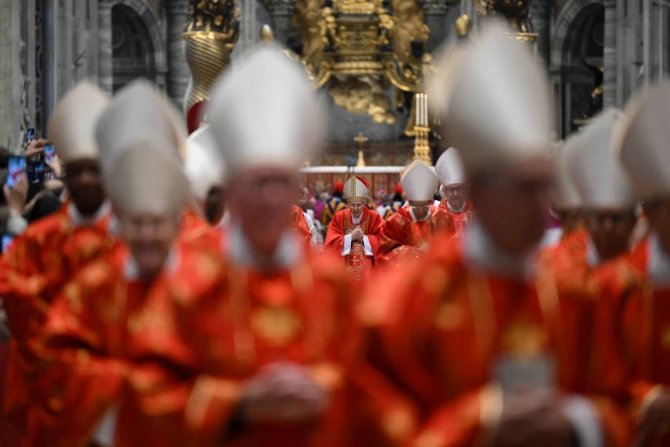
Five French priests who were executed by an anticlerical insurrectionist government in Paris in 1871 were beatified as martyrs on Saturday, April 22, in a Mass in which increased security precautions were taken in light of recent political unrest.
“As pastors inspired by apostolic zeal, the priests were united in their witness to the faith to the point of martyrdom, which they suffered in Paris in 1871 during the so-called Paris ‘Commune,’” Pope Francis said the day after the beatification Mass — Sunday, April 23 — after his Regina Caeli address. “A round of applause for the new Blesseds!”
The five priests beatified on Saturday as martyrs, recognized by the Vatican as dying because of “hatred of their faith,” were Father Henri Planchat of the Congregation of St. Vincent de Paul and four priests who were part of the Congregation of the Sacred Hearts of Jesus and Mary: Father Ladislas Radigue, Father Polycarpe Tuffier, Father Marcellin Rouchouze, and Father Frézal Tardieu.
The priests were executed by firing squad on May 26, 1871, during the Haxo Street massacre that took place at the end of the two-month reign of the Paris Commune, the revolutionary and anti-Catholic movement that controlled Paris from March 18–May 28, 1871. The insurrection was defeated by French troops in a “Bloody Week” that saw as many as 20,000 killed.
Cardinal Marcello Semeraro, head of the Vatican’s Congregation for the Causes of Saints, led the celebration of the beatification Mass at Saint-Sulpice Church in Paris with Archbishop Laurent Ulrich of Paris and as many as 2,500 people in attendance, Agence France-Presse reported.
After the collapse of Napoleon III’s Second Empire following its defeat in the Franco-Prussian War, the French Third Republic was established to govern the country. A peace negotiated with the Prussians, which allowed them to occupy the city of Paris, sparked a left-wing uprising known as the Paris Commune. During the insurrectionists’ brief reign, power and resources were wrested from the Catholic Church, and a harsh secular government was imposed on the local populace.
The Paris Commune instituted socialist reforms such as a 10-hour workweek but also shut down Catholic churches and schools, seized Church money and properties, and arrested hundreds of priests, monks, and nuns after accusing the Church of being complicit with the monarchy. The French school system was also secularized by the strict anticlerical government.
People were arrested based on supposed complicity with the monarchy as “hostages of the people of Paris” and threatened with execution if any of their supporters were executed. According to the decree, three prisoners would be executed at random for every one of their supporters who was executed: “Any execution of a prisoner of war or a supporter of the regular government of the Commune of Paris will be followed immediately by the execution of three times the number of hostages held … and they will be designated by lot.”
As French troops gained ground and the Paris Commune appeared to be nearly defeated, the insurrectionist government carried out more than 100 executions. Many of those who were killed were members of the clergy, including Archbishop of Paris Georges Darboy.
The five priests beatified Saturday were declared martyrs by Pope Francis last November:
Father Henri Planchat
Father Henri Planchat (1823–1871) was raised in a devoutly Christian family in the Loire region of France and was inspired at a young age to serve the poor. He entered the seminary of San Sulpice in Paris and was ordained a priest in 1850. Nicknamed “hunter of souls” and “the apostle of the suburbs” for his work with the poor and his efforts to ensure people had access to the sacraments, according to the Religious of St. Vincent de Paul, he served the suburbs of Grenelle and Vaugirard, where he sought to spread the Gospel among working-class people, some of whom were hostile toward the Church. Despite his wealthy upbringing, he spent most of his life with the poor.
Father Ladislas Radigue
Father Ladislas Radigue (1823–1871) grew up in Normandy and pursued his vocation to the priesthood at the College of the Congregation of the Sacred Hearts of Jesus and Mary. For 20 years he trained novices and was elected prior of the motherhouse of the Congregation of the Sacred Hearts of Jesus and Mary, where he and his fellow priests were arrested on April 12, 1871.
Father Polycarpe Tuffier
Father Polycarpe Tuffier (1807–1871) was sent to the fathers of the Sacred Heart of Jesus as a child and made his religious vows at the age of 16. He became the procurator of the congregation, taught philosophy, and then worked at several colleges in Belgium as a religious brother before being ordained a priest and serving as the congregation’s secretary general.
Father Frézal Tardieu
Father Frézal Tardieu (1814–1871), born in Lozère in southern France, made his vows in 1839. When he was a director of the novitiate of Vaugirard, he was sent to Louvain in Belgium before becoming a general council of the congregation. He is remembered for his compassion and humility. He was known for saying “It is better to talk to God than to talk about God.”
Father Marcellan Rouchouze
Father Marcellan Rouchouze (1810–1871) was born in the Loire region of France the first of three children, all of whom became religious of the Congregation of the Sacred Hearts. He took his vows in 1837 but did not become a priest until the age of 42 after meeting St. John Vianney, who told him, “My son, you must be a priest! The good Lord has great plans for you.”
Cardinal Semeraro said in his homily during the beatification Mass that these men were “massacred by the violent madness of the revolutionaries.”
The cardinal added that the event also serves as “a warning for today.” He said that even though the good “may seem to be defeated by abuse and cunning, in reality, it continues to work in silence and in discretion, bearing fruit in the long term.”
“Such is the Christian social renewal, founded on the transformation of consciences, on moral formation [and] on prayer,” Semeraro said.
The ceremony took place amid security precautions to ensure the safety of attendees because of violence that erupted when Catholics tried to honor the martyrs almost two years earlier. When Catholics held a procession in Paris on May 29, 2021, to honor the victims on the 150th anniversary of the massacre, the group faced violent backlash from counter-demonstrators. About 50 people ultimately blocked the procession from moving forward and forced organizers to run into a church for shelter.