Latin sung over nervous giggles and the intermittent sound of trickling water filled the small room attached to the 16th-century Church of the Most Holy Trinity of the Pilgrims on a mild March evening in Rome.
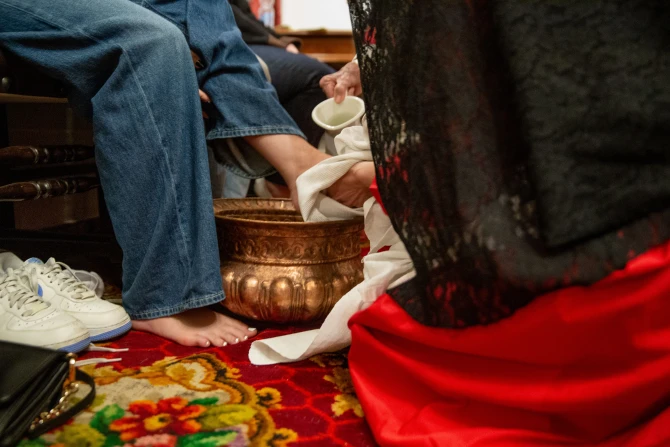
Here members of a centuries-old Catholic fraternity welcomed a group of Australian teens, in Rome for a jubilee pilgrimage, with the same gesture once performed by the great saint of charity, St. Philip Neri, and his collaborators nearly 500 years ago: washing their feet.
The practice, with its deep spiritual symbolism, is one of several ways Catholics in Rome — drawing inspiration from the medieval history of the city — are welcoming the many pilgrims taking part in the Jubilee of Hope in 2025.
Washing pilgrims’ feet
Shortly after St. Philip Neri’s charitable lay group, the Confraternity of the Most Holy Trinity of Pilgrims and Convalescents, was officially recognized, the Catholic Church celebrated the Jubilee Year of 1550.
Neri, called the “Third Apostle of Rome” for his evangelization of the Eternal City, saw the throngs of pilgrims arriving for the jubilee year and wanted to do something.
“In Rome at that time, pilgrims arrived on foot or on horseback, so … many of them were arriving in desolate conditions,” Fabrizio Azzola, a guardian of Neri’s archconfraternity, which today has both laymen and laywomen members, told CNA.
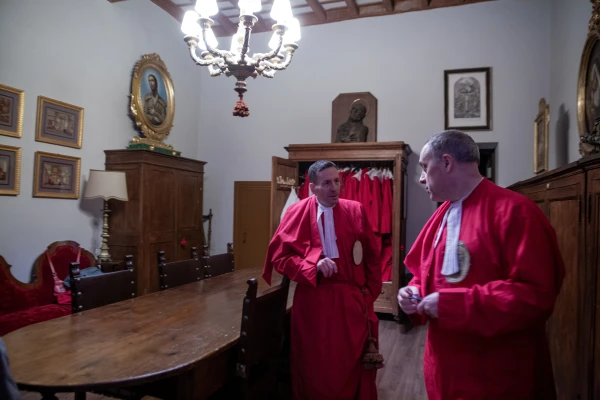
St. Philip Neri “thought of directing confreres to help pilgrims,” Azzola said. “On the one hand, [there was] the practical necessity of washing them, housing them, feeding them, and so on, but there was also the symbolic need: that is, to welcome the pilgrim and repeat the gesture of Jesus with the apostles.”
In the saint’s time, the confraternity (now archconfraternity) had many members and access to hundreds of buildings in Rome to host pilgrims, but today, at just a little over 100 members, the group is still trying to do all it can, including leaning on its pillars of prayer and feeding the poor.
“Today, we cannot do anymore all of the things the old confraternity did — it was very powerful and had buildings in all of Rome where it could welcome hundreds of thousands of pilgrims,” Azzola explained. “However, this symbolic act [of washing the feet of pilgrims] we can do, and so, bit by bit we are reintroducing the customs of the archconfraternity.”
Open to any individual jubilee pilgrim or pilgrims’ groups who request it, the foot washing follows the same Latin rite used by Neri in the 1500s. The short and simple ritual, which follows a brief explanation of its history and significance, includes a reading from the Gospel of John: the account of when Jesus washed the feet of his disciples. At the end, everyone prays the Our Father together.
An aspect particularly significant to the archconfraternity members who volunteer to wash pilgrims’ feet is that they use the same white aprons used during St. Philip Neri’s time.
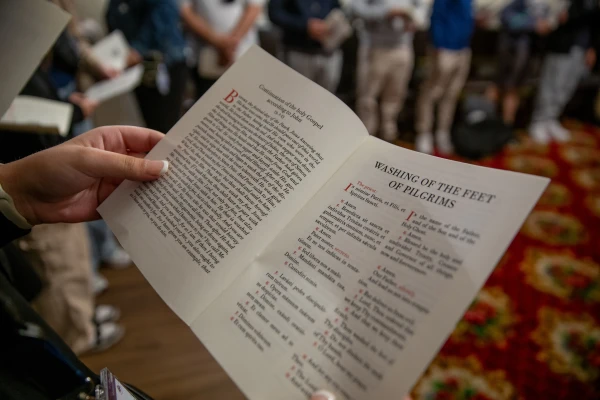
Azzola said hundreds of people, hailing from different parts of the world, have participated in the rite thus far, including the group of 16 high schoolers from Melbourne, Australia, who entered a small room off the sacristy of the Church of the Most Holy Trinity of Pilgrims on the Roman spring evening of March 24.
Duly warned not to lean against a massive painting awaiting restoration on one side of the room, the teens and their chaperones sat down to have their feet washed: first the boys by two male confraternity members, then the girls by two female confraternity members.
Heaven-like chants mixed with the human sounds of uncomfortable murmurs that evening, as the high schoolers took off their shoes, preparing to let strangers wash a vulnerable part of their bodies.
Father Vilmar Pavesi, of the Priestly Fraternity of St. Peter and an assistant priest at the parish, led the prayers and sang the Latin chants, as Minnie, the dog of one of the archconfraternity members, looked on.
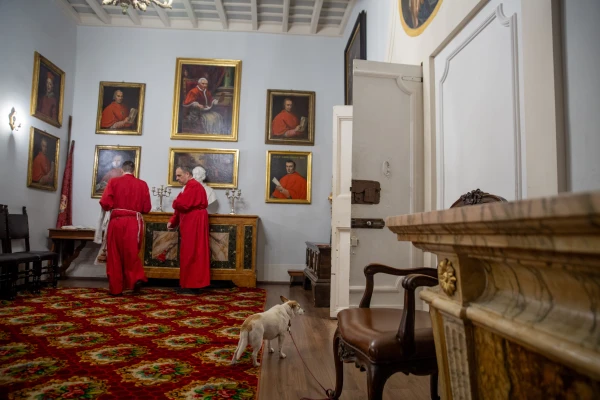
The feet washing, which symbolizes the spiritual cleansing of a jubilee pilgrimage, is recommended as one of the first stops on a pilgrimage itinerary and can be booked by sending an email to the archconfraternity.
History of welcoming pilgrims
The Church of the Most Holy Trinity of the Pilgrims is one of many churches and areas in Rome’s historic center with a tradition of welcoming pilgrims.
Less than a quarter-mile down the street, the Venerable English College — now a seminary for future priests of England — offered lodging to English pilgrims for almost two centuries beginning around the mid-1300s.
Buildings connected with the Santo Spirito Hospital, conveniently located on the same side of the Tiber River as the Vatican, was also originally a place to welcome and house Anglophone pilgrims, while Portuguese-speaking pilgrims were once welcomed near Piazza Navona in Via dei Portogesi (Portuguese Street).
Tapping into the city’s long history of sheltering Catholic pilgrims, the Diocese of Rome will also be opening its parishes and homes to travelers during the Jubilee of Hope — especially during two events expected to draw the biggest crowds of the year.
During the Jubilee of Teenagers, which will be the last weekend of April and culminate in the canonization of the Italian teenager Blessed Carlo Acutis on April 27, “the Diocese of Rome is really experimenting with the ministry of welcoming,” Father Alfredo Tedesco, the head of the diocesan youth office, told CNA.
Some parishes and religious congregations, he said, will be offering sleeping arrangements for teenage pilgrims in parish halls and convents. Families, too, are opening their homes.
“The parish communities are getting themselves organized, both through accommodation facilities, but also through the people, the communities, who are organizing volunteer services to welcome teenagers in our communities,” Tedesco said.
“Through showing hospitality, we remember what holy Scripture says: We have ‘entertained angels,’” the priest said, “and we hope that these youth will truly become witnesses of this encounter.”
This article was originally published on Catholic News Agency.