A German bishop participating in the Synod on Synodality challenged the idea that the Catholic community in his country is at odds with the universal Church — and reasserted that it will continue to play a role in the ongoing discussions in Rome about the Church’s future.
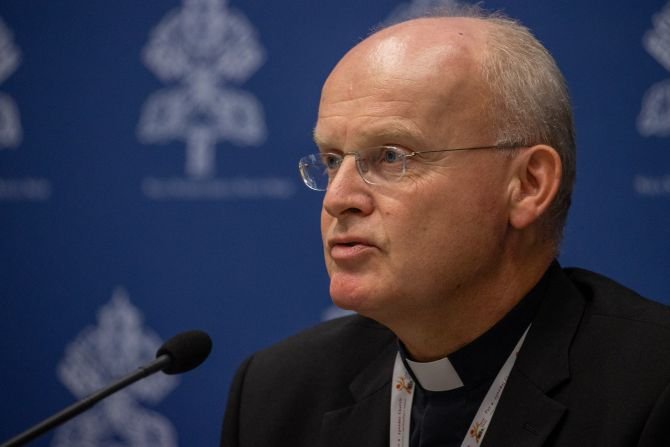
Speaking at the Synod press briefing Saturday afternoon, Bishop Franz Josef Overbeck of Essen acknowledged that others have expressed concerns to him regarding the Catholic Church in Germany’s controversial “Synodal Way.”
“Many people have asked me, ‘Are you still Catholics and part of the Catholic Church?”, said Overbeck, one of the German Bishops Conference’s three delegates to the universal Synod, and a major proponent of the German Synodal Way. “And I say, ‘Yes, of course, we are Catholics, and we are here to stay.”
Begun in 2019, the Synodal Way is a non-canonical initiative of the German bishops’ conference and the Central Committee of German Catholics (ZdK). The collaboration approved blessings of same-sex unions, incorporated transgender ideology into Church practice, and petitioned Rome to open ordained ministry to women at its final assembly in Frankfurt in March 2023.
Pope Francis has criticized the Synodal Way as “elitist” and “not helpful,” while bishops from around the world have written to express their concern that the process could induce schism between Germany and the universal Church. Vatican officials and German bishops have held multiple meetings to discuss the Synodal Way, most recently on July 27.
Contextual argument
Speaking for nearly 10 minutes about the Synodal Way to journalists, Overbeck asserted that the controversial process was responding to the uniquely “post-secular” context of German culture, in which “people have no idea” about transcendence, the Church, or Jesus Christ.
“This changes the entire framework for the questions we are carrying out,” said Overbeck, adding that if Catholic teaching is in contradiction with “the signs of the times,” then “nobody is going to be convinced” by the Church’s guidance.
Overbeck repeatedly referred to Germany’s particular cultural situation to justify some of the Synodal Way’s most controversial proposals. For instance, he alluded to exploring an end to mandatory priestly celibacy by noting that in his 13 years as Bishop of Essen, he has only ordained 15 new priests, while 300 priests have died. The Diocese of Essen, he said, currently has no seminarians in formation.
In addition, Overbeck suggested that the widespread presence of both the Catholic permanent diaconate as well as ordained women as Lutheran ministers in Germany makes the question of opening the diaconate to women particularly relevant to the local Church.
“We live in this world, and these are the questions that come up,” said Overbeck, who said that any consideration of including women in the diaconate should be in response to “a vocation,” and not simply creating a rite “so that women can be a part of the sacramental ministry of the Church.”
Overbeck, who has previously said that same-sex “marriage” should be accepted and not described as immoral, also said at the press event that the Church must keep Christ at the center but set aside its “habit and tradition” to meet contemporary needs, though he seemed to clarify that by “tradition” he was not referring to Apostolic Tradition.
The bishop of Essen added that the Synodal Way and its calls for change in Church teaching related to sexuality, ordination, and governance were aimed at addressing the systemic causes of the sex abuse crisis, which has rocked the Catholic Church in Germany over the past decade.
Bishop Overbeck also acknowledged that a “synodal committee” will begin work in Germany in November, with the aim of establishing a permanent synodal council made up of bishops and laity to govern the Catholic Church in Germany. The Vatican has explicitly forbidden the establishment of this council as inconsistent with the Church’s ecclesiology, and four out of Germany’s 27 ordinaries voted in June to block funding for the synodal committee from a common fund.
Decentralization and “Convergence”
Notably, Overbeck’s inclusion on the panel and his comments came during the Synod on Synodality’s exploration of the theme of “participation, governance, and authority,” which includes a focus on the “decentralization” of Church governance.
To this effect, the synod’s working document quotes Pope Francis’s instruction in Evangelii Gaudium that “it is not advisable for the Pope to take the place of local Bishops in the discernment of every issue which arises in their territory. In this sense, I am conscious of the need to promote a sound ‘decentralization.’”
During this part of the Synod, participants are being asked to consider questions including, “What degree of doctrinal authority can be attributed to the discernment of Episcopal Conferences?”
Another question asks “to what extent” the “convergence” of local Church entities, such as episcopal conferences, on “the same issue commit the Bishop of Rome to address it at the level of the universal Church?”
The founding president of the German Synodal Way said in December 2022 that the initiative was designed to create “pressure” on the Universal Church.
Overbeck and Bishop Georg Bätzing, president of the German Bishops Conference, have both expressed their intention to advance the proposals of the Synodal Way at the ongoing Synod on Synodality. In fact, Bätzing reportedly shared a 159-page document detailing the Synodal Way’s findings with the rest of the Roman synod’s 365 members earlier this month.
Overbeck has previously said that the Synod on Synodality must take up the proposals advanced by the German Synodal Way, “from the role of women to the question of sexuality and the question of people who love each other.”
However, Overbeck added at the press conference that he may also be taking something from the Synod on Synodality back to Germany. He noted that the synod’s “conversation in the spirit method,” emphasizing listening without asking questions and times of silent prayer, could be incorporated into the German Synodal Way’s work going forward.
This article was originally posted on CNA.