Cardinal Louis Raphael Sako’s resignation leaves the Chaldean patriarchal see vacant and raises questions about how his successor will be chosen.
Pope Leo XIV announced this week that he had accepted the resignation of Chaldean Patriarch Cardinal Louis Raphael Sako from the leadership of the Chaldean Church in Iraq and throughout the world after more than a decade of service marked by major pastoral and political challenges.
The resignation raises questions about the timing of the move — especially given the difficulties facing Iraq, home to the Chaldean patriarchal see — and the broader Middle East amid the horrors of war and renewed conflicts.
But other questions about the next step in this transitional period, and about how a successor to the resigned patriarch will be elected, may be even more pressing today for the faithful looking to the future at a time when the Church in Iraq and the countries of the East more broadly faces fundamental challenges to its presence in its historic homeland, especially the continuing drain of emigration.
An autonomous, self-governing church within the Catholic Church
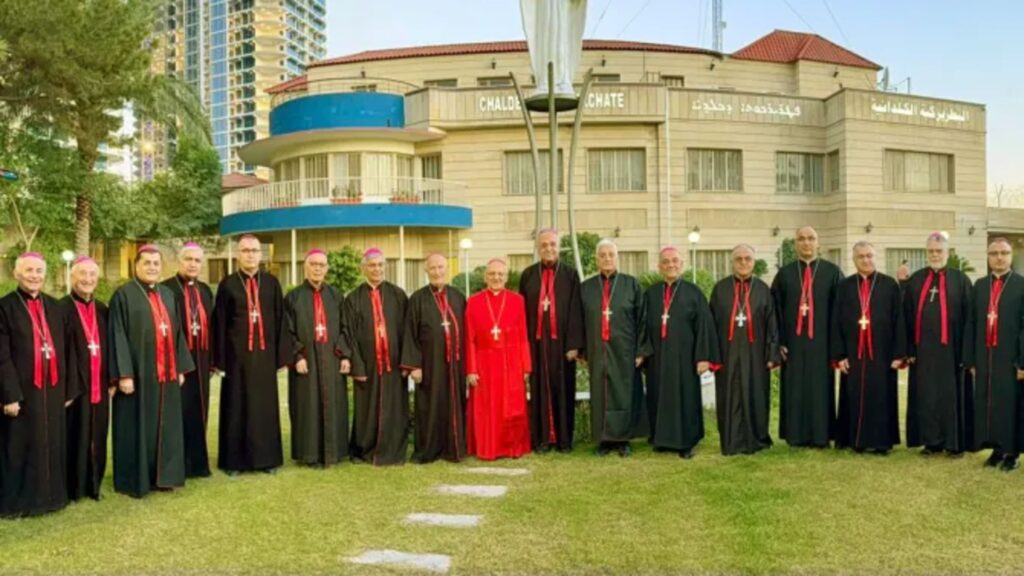
The Chaldean Church, one of the churches born from the ancient Church of the East, is one of the Eastern Churches that follows the papal authority in Rome while at the same time enjoying “self-governance” under Canon 27 of the Code of Canons of the Eastern Churches. This allows it to manage its internal affairs in accordance with the law it has established for itself or with the higher authority in the Catholic Church.
It is also important to note that the process of electing a new patriarch is the same in all Eastern Catholic Churches.
How is a patriarch of the Chaldean Church elected?
The Code of Canons of the Eastern Churches, discussed by Father Salim Saka, a specialist in canon law, in his book on the Eastern Catholic patriarchates, lays out the mechanisms for electing a new patriarch. It first states that the bishop senior by episcopal ordination among the bishops of the patriarchal territory becomes the administrator of the Church when the patriarchal see is vacant, whether because of “the death of the patriarch or his resignation.”
The administrator is responsible for preparing everything necessary for the election of the new patriarch and for convoking the Synod of Bishops, whose members are in turn obliged to attend the election unless a legitimate impediment arises.
The code also affirms that the election of a patriarch “in a lawful manner” takes place in the Synod of Bishops of the Church, which must be held “at the patriarchal residence or in another place designated by the administrator with the consent of the synod” within one month from the date of the vacancy, while observing the particular law of the Church, provided that the period does not exceed two months.
Only the synod fathers have the right to vote. No one else may be present in the election hall, except clerics who assist in counting the votes and recording the proceedings. At the same time, the law does not require that the person elected patriarch already be a bishop at the time of the election.
A two-thirds quorum
The Code of Canons of the Eastern Churches sets the legal quorum at two-thirds of the synod fathers “after excluding those detained by a legitimate impediment,” so that the synod may be considered lawful and capable of electing the patriarch.
Unless there are different criteria under the particular law of the Church, the person who obtains a two-thirds majority is considered elected, underscoring the need for broad agreement on the future patriarch.
The synod fathers must observe the legal time frame for the election, which is 15 days. If the election fails within that period, the matter is referred to the Roman pontiff.
Acceptance, announcement, and enthronement
If the person elected does not declare his acceptance within two days, he loses every right acquired through the election. If he accepts, the synod announces the election of the new patriarch and sets the date for his enthronement.
The new patriarch must then request ecclesiastical communion from the Roman pontiff by a signed written letter as soon as possible. Although he does not begin to exercise his responsibilities lawfully until after enthronement, he may not convoke the Synod of Bishops or ordain any bishop before receiving ecclesiastical communion from the Roman pontiff.
What about the resigned patriarch?
The code also states that a patriarch who resigns from office “retains his title and dignity, especially in liturgical celebrations.” A suitable residence is to be provided for him, with his consent, along with decent means of support.
Election, then hereditary succession, then election again
It is worth noting that Patriarch Shimun IV Basidi (1437–1497) introduced hereditary succession in the selection of patriarchs, replacing election, so that the choice of a new patriarch was restricted to members of the previous patriarch’s family. This provoked dissatisfaction and opposition within the Church, especially in 1539, when “Patriarch Shimun VII Ishoyahb (1538–1558) was compelled to ordain his nephew, who had scarcely reached the age of 12, as metropolitan because there was no one else in the patriarchal family.”
At that time, the opponents gathered and chose Yohannan Sulaqa as patriarch. He then went to Rome to establish union with the Catholic Church. There he received episcopal ordination from Pope Julius III in April 1553, who proclaimed him patriarch of the Chaldeans, vested him with the sacred pallium, and gave him the bull granting him authority over the East, India, and China, making him the first Chaldean patriarch in the “Catholic” Chaldean Church.
The roots of Christianity in Mesopotamia go back to the first centuries after Christ. According to tradition, the apostle Thomas is regarded as the founder and first preacher of Christianity there, together with Addai, one of the 72 disciples, and his disciples Aggai and Mari. In later ages, the Christians of Mesopotamia came to be known as the Church of the East.
This story was first published by ACI MENA, the Arabic-language sister service of EWTN News. It has been translated and adapted by EWTN News English.