Pope Francis passed away at the age of 88 on April 21st at 7:35 in the morning in his Vatican residence, Domus Santa Marta. As news of his death spread, the world fell silent. In the midst of shock and mourning, a fundamental question emerged: what would happen to the celebrations of the Holy Year?
Such a moment was almost without precedent. Only once before in the Church’s long history had a pope died during a Jubilee Year — in 1700, when Pope Innocent XII passed away and was succeeded by Clement XI. Now, more than three centuries later, the Church once again found itself navigating grief in the heart of a Holy Year.
That responsibility fell in large part to Archbishop Rino Fisichella, Pro-Prefect of the Dicastery for Evangelization.
“I could not make that decision on my own; I must admit it. I had to ask the cardinals what we should do in these circumstances—both because everything had already been planned and because people had booked hotels, buses, everything related to the Jubilee organization was already done. But I must say that, from this point of view, the cardinals gave an immediate response.”
Without hesitation, the decision was made: the Jubilee of Hope would continue.
“With some adjustments, of course, because there were very important days ahead—the novenas, many Masses, many meetings—but the Holy Doors remained open, and so the pilgrims who came still found what they had been expecting.”
A Church in Mourning, a People Still on Pilgrimage
The days that followed were unlike any other. An overwhelming silence filled St. Peter’s Square as the coffin bearing Pope Francis’ body was carried in procession into the basilica. Thousands of faithful waited for hours to pay their final respects. At the same time, a record six thousand journalists from around the world registered at the Holy See Press Office, documenting a moment of global significance.
Father Agnello Stoia, Parish Priest of Saint Peter’s Basilica, witnessed the intensity of those days from within.
“I spent many hours walking inside the empty Basilica, or in front of Pope Francis’ body in his coffin or because we were waiting for the election of the new Pope. And from inside, I could feel an incredible vibration of those in the square, waiting for Pope Francis’ funeral or waiting for someone to appear at the window and announce the name of the new Pope. Those were truly days of great, great intensity for me.”
Prayer and preparation continued. On April 26th, more than 250,000 people from five continents gathered for Pope Francis’ funeral. At the same time, Jubilee events moved forward — including one of the most crowded celebrations of the entire Holy Year: the Jubilee of Adolescents.
Archbishop Fisichella reflected on the challenge of holding these moments together.
“The funerals coincided with the presence of 200,000 teenagers in Rome. This had a dramatic impact on us in many ways. It is true, the young people were happy, but they were also sad about the Pope’s death, and they participated in the funeral Mass. However, we cannot forget that they were teenagers, and the program for these boys and girls had to be completely modified in light of the events.”
From Mourning to Election
After more than fifteen days of mourning, the Church entered one of its most sacred and mysterious moments. On May 7th, the conclave began to elect a new Successor of Peter.
“Of course, there was the celebration of the conclave, which forced us to suspend the Jubilee of the World of Work, since it absolutely could not take place during those days—the square could not be occupied. Each day, the work of the conclave continued, smoke rose above the Sistine Chapel, and crowds filled every corner of the city—so everything is understandable.”
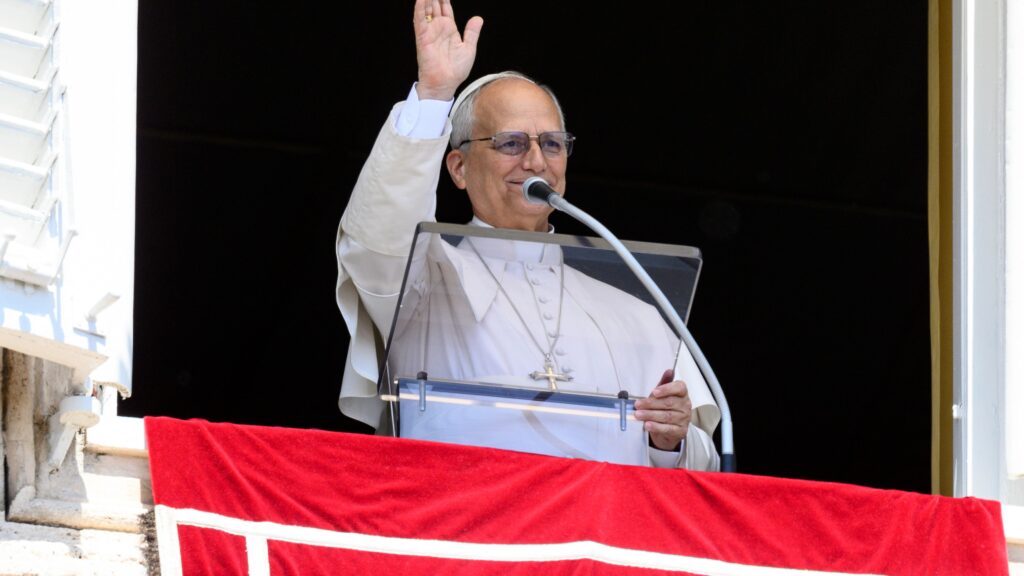
The conclave lasted just twenty-four hours. At sunset on May 8th, as thousands gathered in St. Peter’s Square, the world was introduced to a new pope.
Pope Leo XIV stepped onto the balcony and offered his first words:
“It is the peace of the risen Christ. A peace that is unarmed and disarming, humble and persevering. A peace that comes from God, the God who loves us all, unconditionally.”
A Pontificate Rooted in Peace
Cardinal Fernando Filoni, Grand Master of the Order of the Holy Sepulchre, saw in those words a defining theme for the new pontificate.
“I am sure this message will remain an essential part of his pontificate—not in a sociological or political sense, but as he said: ‘The peace of the Risen Lord.’ Without the peace that comes from the Lord, people will never achieve true peace.”
The man now known as Pope Leo XIV was born Robert Prevost, an Augustinian friar who had served as Bishop of Chiclayo, Peru, and later as Prefect of the Dicastery for Bishops. Created cardinal in 2023, he now became the 267th Pope of the Catholic Church.
Cardinal Filoni recalled a personal conversation with the new pope about the name he chose.
“I asked him, ‘Why did you choose that name?’ He said he was torn—Augustine, since he’s an Augustinian, or Leo. In the end, he chose Leo. Why? He told me, ‘At this moment, we need a man with a clear vision for the Church.’”
For those who know him well, that vision is already taking shape. Father Agnello Stoia described a deep continuity with Pope Francis, paired with a quiet resolve.
“I immediately sensed, from his tone, a continuity with Pope Francis — a message that is a great appeal to all humanity to build peace. Many asked Jesus questions; they wanted Him to overturn the established order… But Jesus pointed to another path — a much more difficult one — a path that calls for a personal response: to be about the Father’s business. And Pope Leo truly embodies this spirit; he is a very calm and composed person. He takes his time, yet it’s something you can sense from his gaze, from his words. His goal is clear, as is the path he is setting in motion…”
In a Jubilee that began with hope, passed through mourning, and now moves forward under new leadership, the Church continues its pilgrimage — guided by a pope whose first gift to the world was peace.
Adapted by Jacob Stein. Produced by Alexey Gotovskiy; Camera by Alberto Basile, Fabio Gonella, Patrick Leonard, Anthony Johnson; Video edited by Ilaria Chimenti