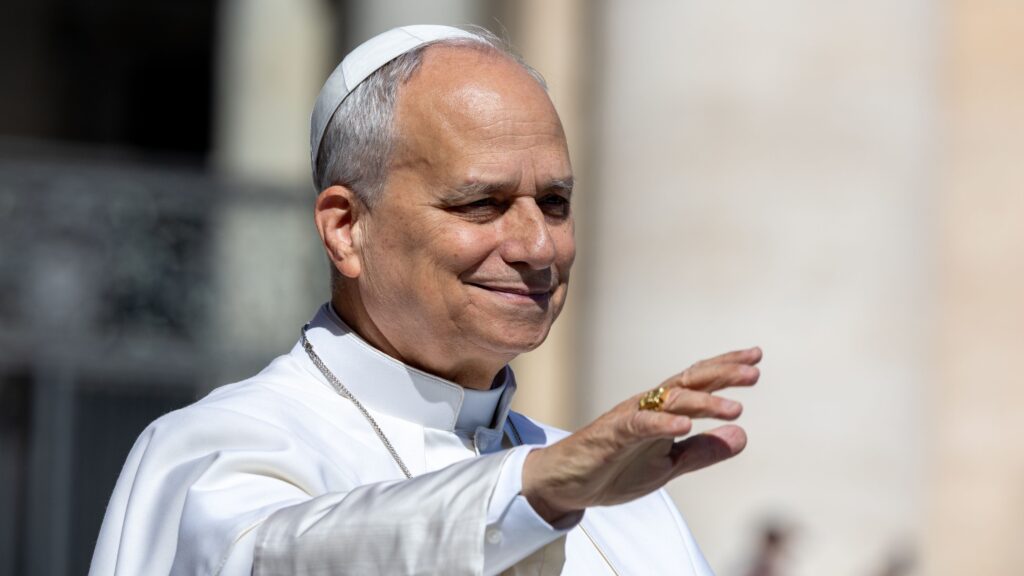
In his first encyclical, Pope Leo XIV draws on a broad range of cultural and philosophical figures for inspiration.
As the first encyclical of his pontificate, Magnifica Humanitas, published Monday, can beregarded as an indication of Pope Leo XIVʼs doctrinal approach.
One of the most significant aspects of magisterial documents like encyclicals is the sources of inspiration the pope draws upon beyond the strictly ecclesial sphere — that is, not only citations from great theologians, Church Fathers, or pontiffs but also references from traditions and disciplines outside the Church.
For example, Leo XIV cites Viktor Frankl, the physician and survivor of four Nazi concentration camps, including Auschwitz, between 1942 and 1945. From that extreme experience — marked by the total destruction of his surroundings and the extermination of his loved ones — emerged his universal work “Man’s Search for Meaning,” in which Frankl argues that, despite suffering, life remains worth living.
The pope also points to the “almost prophetic significance” of various cultural expressions: Beethoven’s Ninth Symphony, which he describes as a “desire for unity”; Pablo Picasso’s “Guernica,” “as a denunciation of dehumanization”; and Steven Spielberg’s film “Schindler’s List,” “as a call not to consign the past to oblivion.”
In the encyclical, the pontiff warns of the risks facing democratic life in a context in which “the question of what is true loses interest,” giving way to a pragmatism satisfied with “what seems useful or effective.”
To illustrate the consequences of this indifference to truth — which, according to the pope, “leads slowly but inexorably toward totalitarianism” — he turns to the German-American philosopher and political theorist Hannah Arendt.
In “The Origins of Totalitarianism,” published in 1951, Arendt maintains that the ideal subjects of such regimes are not necessarily those who are ideologically convinced but rather “people for whom the distinction between fact and fiction (i.e., the reality of experience) and the distinction between true and false (i.e, the standards of thought) no longer exist,” as quoted in Magnifica Humanitas.
The pontiff also cites 20th-century Catholic writer J.R.R. Tolkien, specifically “The Lord of the Rings: The Return of the King,” the epic conclusion of his famous trilogy. Through the wizard Gandalf, the pope recalls the moral responsibility of each generation: “It is not our part to master all the tides of the world, but to do what is in us for the succor of those years wherein we are set, uprooting the evil in the fields we know, so that those who live after may have clean earth to till.”
Alongside these references, the pontiff evokes the civil rights movement in the United States, associated with the leadership of Martin Luther King Jr., as well as the end of apartheid in South Africa following Nelson Mandela’s release and his decision not to “surrender the future to hatred.”
The magisterial text also recognizes the witness of “courageous and generous” women such as St. Laura Montoya, St. Teresa of Calcutta, Dorothy Day, and Elisabeth Elliot (1926–2015), an influential American Christian missionary, writer, and speaker.
Alongside them, Leo mentions prominent figures from various fields of knowledge and social action who are not necessarily Catholic. Among them are Marie Curie (1867–1934), a pioneer in the study of radioactivity and the first person to receive two Nobel Prizes in different fields (physics and chemistry); Maria Montessori, the Italian physician, educator, and philosopher who revolutionized education by placing the child at the center of learning; and Wangari Maathai (1940–2011), the Kenyan activist, founder of the Green Belt Movement, and the first African woman to receive the Nobel Peace Prize in 2004 for her contribution to sustainable development, democracy, and peace.
He also refers to Benazir Bhutto (1953–2007), a prominent Pakistani political leader and the first woman elected to govern a Muslim-majority country, serving as prime minister on two occasions, from 1988–1990 and 1993–1996.
All of them, together with many other women from different continents, Leo XIV notes, have contributed through their efforts to “making history more humane.”
In addition, in the section addressing education, the pontiff cites Plato — specifically his Seventh Letter, dating to 353 B.C. — in which, while recounting his stay in Syracuse under the tyrants Dionysius the Elder and Dionysius the Younger, the Greek philosopher sets forth part of his political and ethical doctrine.
The encyclical also highlights religious communities that choose to live in poor and dangerous places. The pope calls them “martyrs of fraternity and justice,” such as St. Maximilian Mary Kolbe, St. Óscar Romero, and Blessed Enrique Angelelli; as well as other witnesses who, under harsh and often inhuman conditions, have embodied the hope of the Gospel and the dignity of the human person, such as the Venerable François-Xavier Nguyễn Văn Thuận.
This story was first published by ACI Prensa, the Spanish-language sister service of EWTN News. It has been translated and adapted by EWTN News English.