Over the centuries the Catholic Church has formally proclaimed four Marian dogmas: her immaculate conception, divine motherhood, perpetual virginity, and assumption into heaven.
The solemnity of the Assumption of the Blessed Virgin Mary on Aug. 15 is an opportune time to deepen our love for the Mother of God by understanding the “place” God has assigned her for our spiritual benefit and eternal salvation.
Mary’s assumption into heaven is a dogma of faith for Catholics.
Church dogmas encompass truths concerning God, Jesus Christ, the Virgin Mary, the Church, the sacraments, and the ultimate destiny of human beings. With regard to Mary, the Church has defined four dogmas.
Below is a review of the dogmas proclaimed regarding Mary, a helpful reminder of the role she plays in God’s plan of salvation for us.
1. The Immaculate Conception
The dogma of the Immaculate Conception states that the Blessed Virgin Mary was preserved by a singular grace of God and in view of the merits of Jesus Christ from all stain of original sin from the very first moment of her conception.
The Catechism of the Catholic Church (CCC) summarizes it thus: The Virgin was “preserved immune from all stain of original sin” such that her “entirely unique holiness” was enriched “from the first instant of her conception,” which God granted her to prepare within her a dwelling place for the Incarnate Word.
This dogma was defined by Pope Pius IX on Dec. 8, 1854, through the papal bull Ineffabilis Deus. Church teaching emphasizes that this grace comes from Jesus Christ, not apart from him: Mary was redeemed in a “prevenient” (or “preceding”) and perfect manner in virtue of her Sonʼs merits.
2. Divine motherhood
Mary’s divine motherhood means that the Virgin is truly the mother of God, because Jesus Christ, her son, is one divine person with two natures, the human and the divine. Therefore, the child born of Mary according to the flesh is the eternal Son of God made man; in this sense, Mary is truly Theotokos, the Mother of God (cf. CCC, 495).
This truth was solemnly proclaimed by the Council of Ephesus in the year 431 under the pontificate of Pope Celestine I. In the 20th century, the Second Vatican Council reaffirmed this doctrine by noting that “from the most ancient times, the Blessed Virgin is honored with the title of Mother of God” (Lumen Gentium, 66).
3. Her perpetual virginity
The dogma of perpetual virginity affirms that Mary was a virgin before, during, and after the birth of Jesus. This truth has been part of the Catholic faith since the early centuries.
It is not merely a matter of noting that Mary remained a virgin up to a certain point but of professing that her virginity was perpetual. St. John Paul II recalled that the Church has consistently regarded this truth as part of the faith received and deepened throughout its history.
Unlike the Immaculate Conception and the Assumption, this dogma was not defined in a single papal bull. Maryʼs perpetual virginity was formally defined through the Second Council of Constantinople (553) and the Lateran Synod (649).
4. The Assumption of the Blessed Virgin Mary
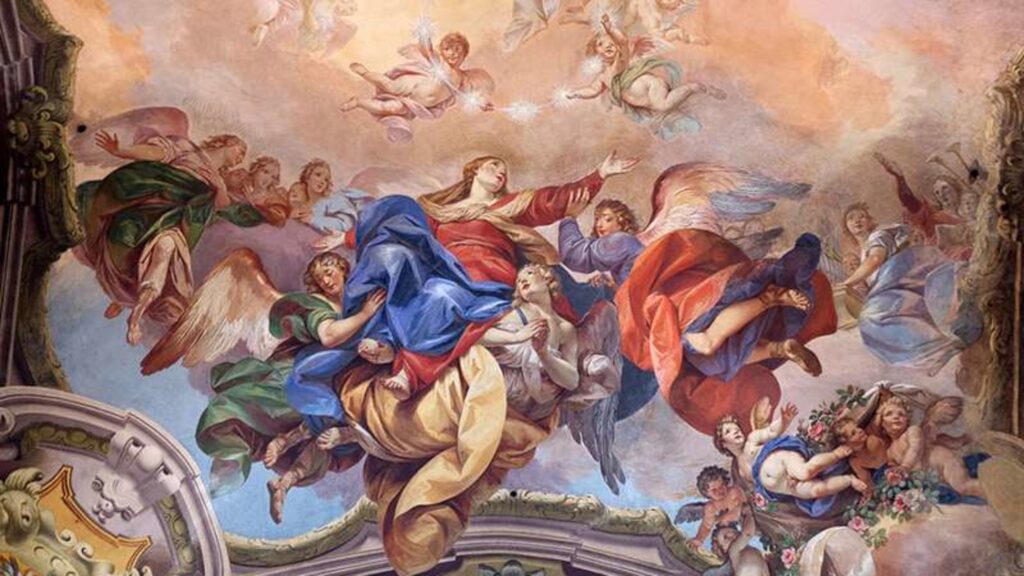
The dogma of the Assumption of the Blessed Virgin Mary states that the Blessed Virgin, having completed the course of her earthly life, was taken up body and soul into heavenly glory. The Church does not define the exact manner in which her earthly life ended, but it does proclaim with certainty that she was fully glorified by God (cf. CCC, 966).
This dogma was solemnly proclaimed by Pope Pius XII on Nov. 1, 1950, through the apostolic constitution Munificentissimus Deus. That document reaffirms that the Immaculate Mother of God was assumed body and soul into heavenly glory.
Important to remember
Marian dogmas do not detract in any way from Jesus Christ; on the contrary, they reveal the greatness of God’s saving work in the Virgin Mary. Therefore, authentic Marian devotion never separates Mary from Jesus Christ but rather contemplates her as the Lord’s first and most perfect disciple.
This story was first published by ACI Prensa, the Spanish-language sister service of EWTN News. It has been translated and adapted by EWTN News English.