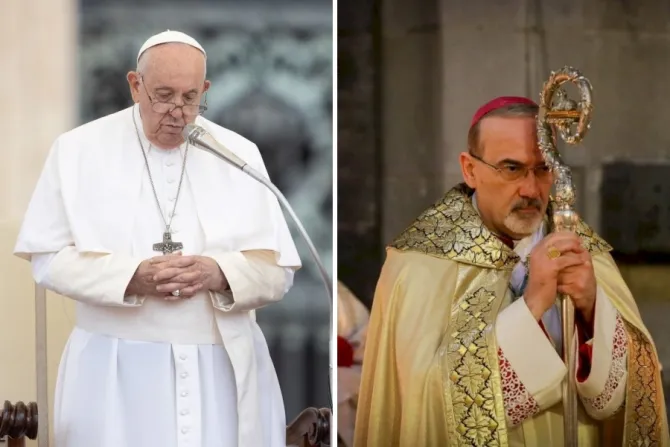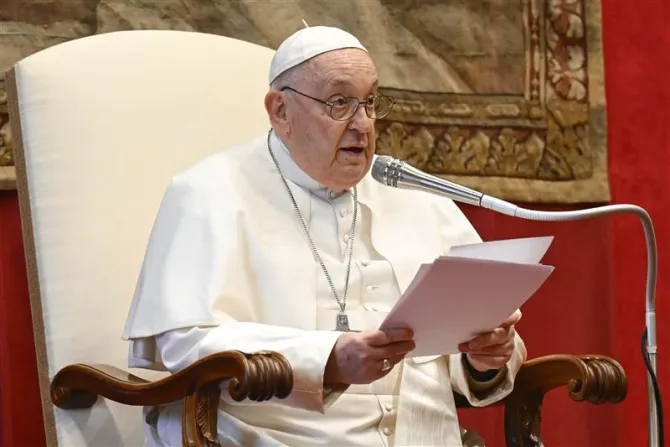
On the occasion of the 54th annual meeting of the World Economic Forum in Davos, Switzerland, Pope Francis sent a letter to the group’s leader to express his hope that it will be an opportunity to find “ways to build a better world.”
The pope’s Jan. 17 letter, addressed to the organization’s chairperson, Klaus Schwab, comes against the backdrop of what the pontiff described as an “increasingly lacerated world” and a “troubling climate of international instability.”
The letter opened with the pope’s characterization of modern wars, which “no longer take place only on clearly defined battlefields, nor do they involve soldiers alone.”
“In a context where it appears that the distinction between military and civil targets is no longer respected, there is no conflict that does not end up in some way indiscriminately striking the civilian population,” the pope wrote in his letter, quoting from his Jan. 8 address to the ambassadors accredited to the Holy See.
The pope noted that the cessation of armed conflict “calls for more than simply setting aside the instruments of war. It demands addressing the injustices that are the root causes of conflict.”
Francis’ letter touched upon many of the core themes of his pontificate, including the climate crisis, global food scarcity, economic inequality, and the exploitation of laborers in developing countries.
“The exploitation of natural resources continues to enrich a few while leaving entire populations, who are the natural beneficiaries of these resources, in a state of destitution and poverty,” Francis wrote.
The pope’s letter went on to also highlight the massive social changes brought about by the globalization of financial markets, which has “demonstrated the interdependence of the world’s nations and peoples.” The Holy Father appealed for a “fundamentally moral dimension” that “must make itself felt in the economic, cultural, political, and religious discussions that aim to shape the future of the international community.”
Speaking to the importance of harmonizing state policy and business practices to arrive at more sustainable models of growth and economic development, the pope reiterated that these new economic paradigms must be “farsighted” and “ethically sound,” which “by their very nature must entail subordinating the pursuit of power and individual gain, be it political or economic, to the common good of our human family, giving priority to the poor, the needy, and those in the most vulnerable situations.”
Pope Francis also emphasized the role nongovernmental organizations (NGOs) and intergovernmental organizations (IGOs) play as critical stakeholders in advancing social and economic development.
The Holy Father wrote that they must be free “to exercise their functions of control and guidance in the economic sector, since the achievement of the common good is an objective beyond the reach of individual states, even those that are dominant in terms of power, wealth, and political strength.”
“International organizations are also challenged to ensure the achievement of that equality, which is the basis of the right of all to participate in the process of full development, with due respect for legitimate differences,” the letter continued.
The World Economic Forum (WEF) was founded in 1971 by Klaus Schawab, a Swiss-German economist and engineer, to foster greater cooperation between private and public entities to confront political, economic, and social issues at the national, regional, and international levels.
The annual meeting — which is held every year in Davos, Switzerland — is attended by many of the world’s elite including heads of state, CEOs of Fortune 100 companies, financial leaders, the heads of some international organizations, and major cultural personalities.
In previous years the event has been attended by U.S. presidents including Donald Trump in 2018 and 2020 and Bill Clinton in 2000. President Joe Biden has not attended the event since taking office.
Leading the U.S. delegation to this year’s forum — which is being held Jan. 15–19 — is Secretary of State Antony Blinken, who is joined by U.S. National Security Advisor Jake Sullivan and Special Presidential Envoy for Climate John Kerry.
Other attendees include the premier of the People’s Republic of China, Li Qiang; French President Emmanuel Macron; Ukrainian President Volodymyr Zelenskyy; United Nations Secretary-General António Guterres; and World Bank President Ajay S. Banga.
This article was originally published on CNA.