World Youth Day is among the most significant initiatives of John Paul II’s pontificate. It reflected something that had marked Karol Wojtyła’s life from the beginning: his profound closeness to young people.
Gianfranco Svidercoschi, journalist and former Vice Director of L’Osservatore Romano, knew the Polish Pontiff closely for many years.
In conversation with Magdalena Wolinska-Riedi, he helped us retrace the roots and the enduring legacy of that extraordinary bond with young people.
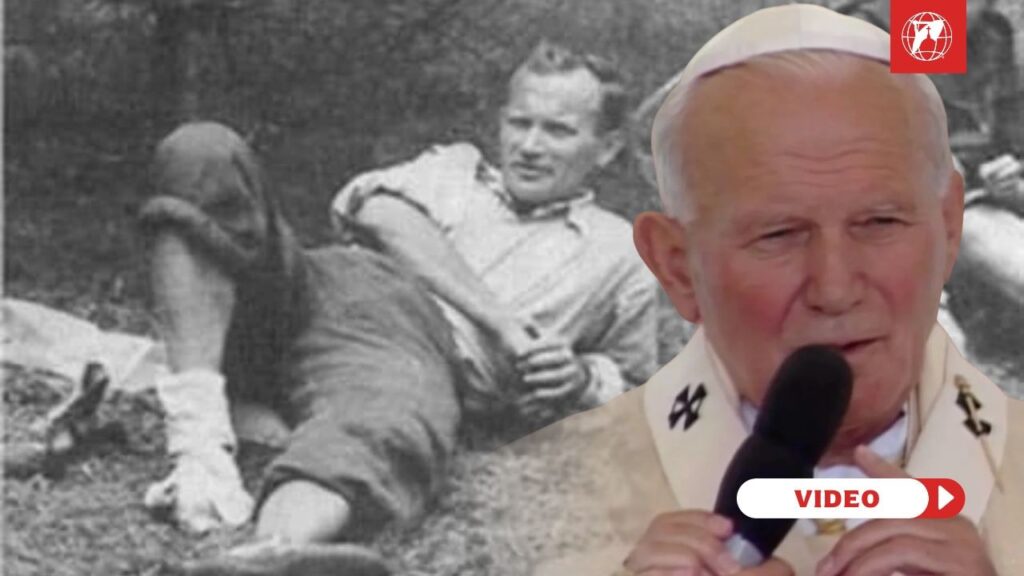
I remember when he was a young priest who had just returned from Rome after two years of study. He was assigned to the parish of St. Florian, and it was there, along with a residence for university women, that he began meeting with young people. Those encounters soon expanded through what he called the “apostolate of excursions.” They would hike through forests, climb mountains, paddle canoes across lakes. It was there that a special bond developed between the young people and this young priest. Why? Because they saw in him someone different from other priests. He didn’t speak only about the Church or religion. He also spoke about how to live in freedom. Under communism, he talked with them about marriage, relationships between men and women, and even sexuality.
This relationship began back in Kraków, where he came to see that young people could be the force capable of bringing about the change needed to overturn the system.
When the Pope made his first trip to Poland, it was an extraordinary visit. No one expected what would happen. As Lech Wałęsa later said, “The Polish people raised their heads again.” Some time after the trip, the Pope asked me what I thought had been its most important moment. He believed it was the gathering in Victory Square on the first day, when the crowd applauded for ten minutes. But I told him no. For me, it was his meeting with the young people at St. Anne’s the following morning. The university students stood there holding their crosses aloft toward him. In that moment, communism was finished. It was finished because these young people no longer believed in Marxism. And I think that was something he understood, even if at that time it concerned only Poland.
What insight or intuition of the Pope lay behind the idea and decision to create World Youth Day? What did he want to communicate to young people themselves, and to the world, through that decision and initiative?
John Paul II once said: “I brought the meetings with university students from Kraków to St. Peter’s.” And he did. But something changed in the process. It was no longer simply a Pope, or a former archbishop, taking an interest in young people. Rather, young people began to look at this Pope in a different way. They saw in him a Church that was open, not clerical; a Church that welcomed the laity and reached out to everyone. There is also an episode many people do not know. During a visit to France in 1980, a young man suddenly broke through the crowd shouting, “Pope, Pope, I’m an atheist. I don’t believe. You have to tell me why you believe.” French security officers quickly took him away. But those standing near the Pope heard him say, “We must answer that young man. I must answer him.”
Perhaps that moment helped inspire what would become World Youth Day. These gatherings, with their energy, hope, and creativity, brought something entirely new to the life of the Church. Young people did not come simply to see the Pope or attend a major event. They came because they felt that this Pope was saying something new, challenging them to go against the current, to live with conviction, and even to aspire to holiness. Above all, he made them believe they could help change history. That was what resonated so deeply with the young.
This phenomenon, with its huge gatherings, millions of young people, and so much music, continues to work, as we can see today. Why?
When young people gathered at Tor Vergata for the Jubilee, who was present among that million-strong crowd? Many of those who had been there twenty-five years earlier returned, this time with their own children. The same spirit was still alive. Then, during the evening vigil, there was that extraordinary minute of silence, almost a response to a world filled with so much noise and distraction. Why was there such an immediate connection between Pope Leo and young people? Because he spoke to them on the same wavelength as John Paul II. He did not offer a watered-down Gospel. Instead, he presented the Gospel in all its demands, telling them, as John Paul II did, that they are called to be saints and to go against the current, whatever circumstances they may face. In my view, that was Pope Leo’s first great success with young people, and I believe it is something that will continue.
“The sentinels of the morning,” as Pope St. John Paul II called young people. Thank you very much, Professor, for taking the time to speak with us today.
Produced by Bénédicte Cedergren; Camera by Alberto Basile, Fabio Gonnella; Video Edited by Andrea Manna.