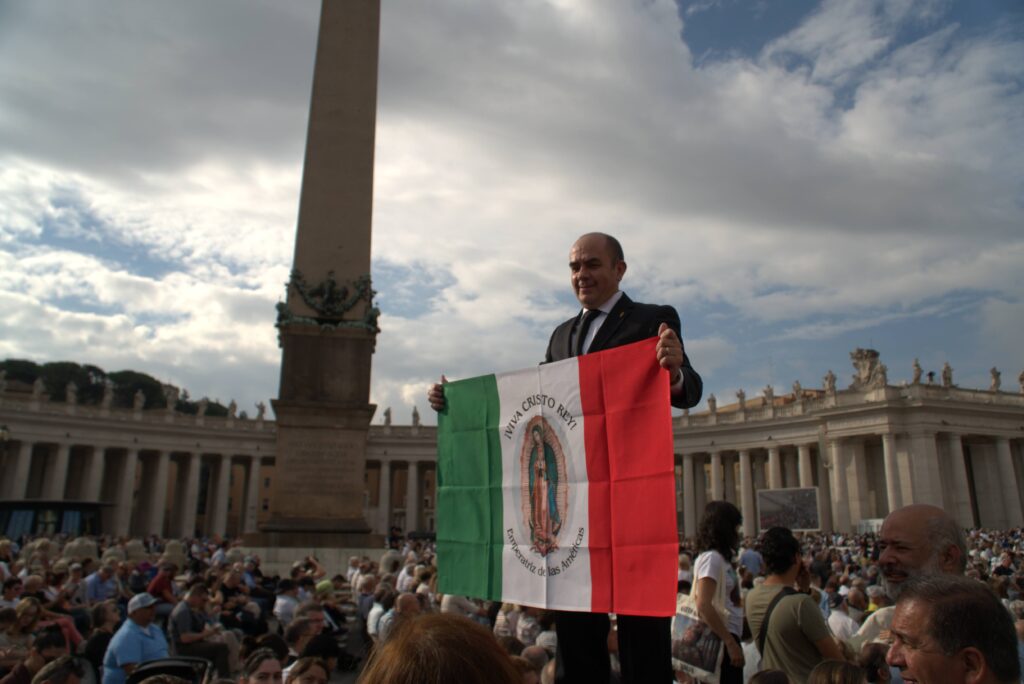
A conference in Rome reflected on the legacy of Mexico’s Cristero movement, marking the 100th anniversary of the Catholic uprising against the country’s secular government.
The “Viva Cristo Rey! Centenary of the Cristero Epic” began Oct. 7 at the Pontifical University of the Holy Cross in Rome and continues through Oct. 9. The Cristero War began in 1926, and scholars examined its martyrs’ legacy and church-state relations across Latin America.
Among those present were the Mexican ambassador to the Holy See, Alberto Medardo Barranco Chavarría; Rodrigo Guerra Lopez, secretary of the Pontifical Commission for Latin America; and Italian Catholic politician and intellectual Rocco Buttiglione.
La Cristiada: A just war?
The Cristero War in Mexico lasted from 1926-1929, during which armed Catholics, known as the Cristeros, resisted the government’s fierce anticlerical laws. According to estimates from the Mexican Bishops’ Conference, more than 200,000 people were killed for defending the faith against persecution, producing martyrs such as St. José Sánchez del Río and Blessed Miguel Agustín Pro.
Amid these figures, debates have arisen about the movement’s legacy in light of the violence committed by members of the Cristeros in retaliation against anticlerical laws.
Buttiglione, who withdrew as Italyʼs nominee to the European Commission in 2004 after lawmakers objected to comments rooted in his Catholic beliefs about marriage, defended their actions as courageous despite their mistakes.
“We honor the courage of a people who fought and shed their blood for the freedom to live their faith,” Buttiglione said in his speech. “We are not afraid to acknowledge the mistakes and even the culpability of Catholics who lived through this immense tragedy. But they cannot condemn a people rebelling to defend the right to religious freedom.”
Conversely, Guerra described the Cristero movement to EWTN News as “complex” and cited Pope Leo XIV’s teaching on a “disarmed and disarming peace.”
“I believe that the Cristero movement was a complex movement,” Guerra told EWTN News. “It was neither entirely white nor entirely black. Those who lived Christianity and the faith, guided by Pope Leo XIV’s conviction for a disarmed and disarming peace, even if they did not use that language, are today recognized as martyrs and blesseds, and let’s hope many saints in the future.”
Church and state in Latin America
During the conference, scholars also examined the relationship between the Church and secular governments before and after the Cristero War.
In 1929, the war ended with the so-called “Agreements” between the Mexican bishops and President Emilio Portes Gil. The Cristeros laid down their arms after the agreements, but many, according to Franco-Mexican historian Jean Meyer, were still martyred afterward.
Barranco Chavarría told EWTN News that the characterization of the state’s stance against the Church is false.
“There is an interpretation that no longer corresponds to the current government of Mexico. It was always said that the government was trying to silence the Cristeros issue, that it was trying to minimize it. The truth is that no,” Barranco Chavarría told EWTN News.
Guerra added that their relationship was shaped by laicism, the doctrine of separation between church and state.
“Laicism has been very harmful in the history of Mexico,” Guerra told EWTN News. “We continue fighting against that disease, but we need to learn every day how the right to religious liberty is promoted joyfully.”
A potential visit from Pope Leo to Mexico?
The last pontiff to visit Mexico was Pope Francis in 2016.
Barranco Chavarría expressed hope for a future visit from Pope Leo XIV, also noting the visit of Vatican Secretary of State Cardinal Pietro Parolin in August, during which he said the pope is “very eager to come to Mexico.”
“The pope received an official invitation on the day of his inauguration,” Barranco Chavarría told EWTN News. “During a phone call with the Mexican president Claudia Sheinbaum, the pope said he was strongly interested in visiting Mexico for the 500th anniversary of the Virgin of Guadalupe’s apparitions in 2031. We hope that next year, around October or November, this dream of the Mexicans can finally become a reality.”
Guerra added about his visit: “We hope that the pope will reinvigorate a new presence of Christian inspiration in public life, which we need so much in our Latin American countries, especially at times when extreme ideologies of the left or the right seem to tear the fabric of our societies.”