Here are 6 Augustinian saints and a blessed who the the Catholic Church celebrates in August.
August is a particularly important month for Augustinians, the Order of St. Augustine of Hippo to which Pope Leo XIV belongs, as the Catholic Church celebrates a number of Augustinian saints.
St. Augustine himself and his mother, St. Monica, are honored just one day apart at the end of August, but mystics, missionaries, and martyrs who lived out the Augustinian call to seek God through prayer, community, and charity also enjoy feast days this month.
Here are the Augustinian saints — and a blessed — the Church celebrates in August:
Blessed John of Rieti — Aug. 2
Blessed John of Rieti was an Italian Augustinian friar whose short life became a remarkable example of holiness lived through simplicity, charity, and joy.
Born around 1318 in Castel Porchiano, near Amelia, Italy, John entered the Augustinian order as a teenager and was sent to the friary in Rieti. Though he died at just 18 years old in 1336, those who knew him remembered him for his humility, friendliness, and deep love for his fellow friars.
John was particularly attentive to the sick and to visitors, treating everyone with kindness and reverence. According to the Augustinian tradition, he never did or said anything contrary to fraternal charity.
His remains can be found at the St. Augustine Church in Rieti, and he was declared blessed by Pope Gregory XVI in 1832.
St. Clare of Montefalco — Aug. 17
St. Clare of Montefalco was an Italian Augustinian nun, abbess, and mystic who developed a profound devotion to the passion of Christ.
Born around 1268 in Montefalco, Italy, Clare joined an order of Franciscan tertiaries at a young age. Her sister, Giovanna, was the abbess and their small community eventually became a formal convent of nuns following the Rule of St. Augustine in 1290. After Giovanna’s death, Clare became abbess at just 23 years old.
Clare was especially known for her contemplation of Christʼs passion and for mystical experiences connected to the cross. Due to this, she is sometimes called “Clare of the Cross.”
During her final illness, she told her sisters that she carried Christʼs cross in her heart. After her death in 1308, her heart was examined and the sisters reported finding symbols associated with Christʼs passion formed within it. Clare was canonized by Pope Leo XIII in 1881.
St. Ezekiel Moreno — Aug. 19
St. Ezekiel Moreno was an Augustinian Recollect friar, missionary, and bishop who spent much of his priestly life serving Catholics in the Philippines and Colombia.
Born in Alfaro, Spain, in 1848, he joined the Augustinian Recollects as a teenager and professed his religious vows in 1865. After being ordained a priest in Manila in 1871, he spent 15 years working in the Philippines before returning to Spain and eventually being sent to Colombia, where he devoted himself to missionary work and the renewal of religious life.
In Colombia, Ezekiel became the first vicar apostolic of Casanare and later served as bishop of Pasto. His episcopacy took place amid civil war, anti-Catholic persecution, and significant challenges for the Church.
Despite these difficulties, he remained committed to his people and strongly defended the Churchʼs rights. Diagnosed with cancer, he returned to Spain for treatment and died on Aug. 19, 1906. He was canonized by Pope John Paul II in 1992.
Sts. Liberatus, Boniface, and Companions — Aug. 26
Sts. Liberatus, Boniface, and their five companions were seven monks who were martyred in North Africa in 484 during the persecution of Catholics under King Hunneric.
The monks belonged to a monastery at Gafsa, in present-day Tunisia, that had been founded under Augustinian inspiration. The group included Liberatus, their abbot; Boniface, a deacon; Servus and Rusticus, subdeacons; and three lay monks named Rogatus, Septimus, and Maximus.
The monks were taken prisoner and pressured to abandon their Catholic faith, but they refused. The youngest of the group, Maximus, was only 15 and was especially urged to separate himself from the others, but he remained steadfast. The authorities attempted to burn the monks alive, but when the fire would not ignite, they were ultimately beaten to death.
Pope Clement X granted the Order of St. Augustine the right to celebrate their collective liturgical memorial in 1671.
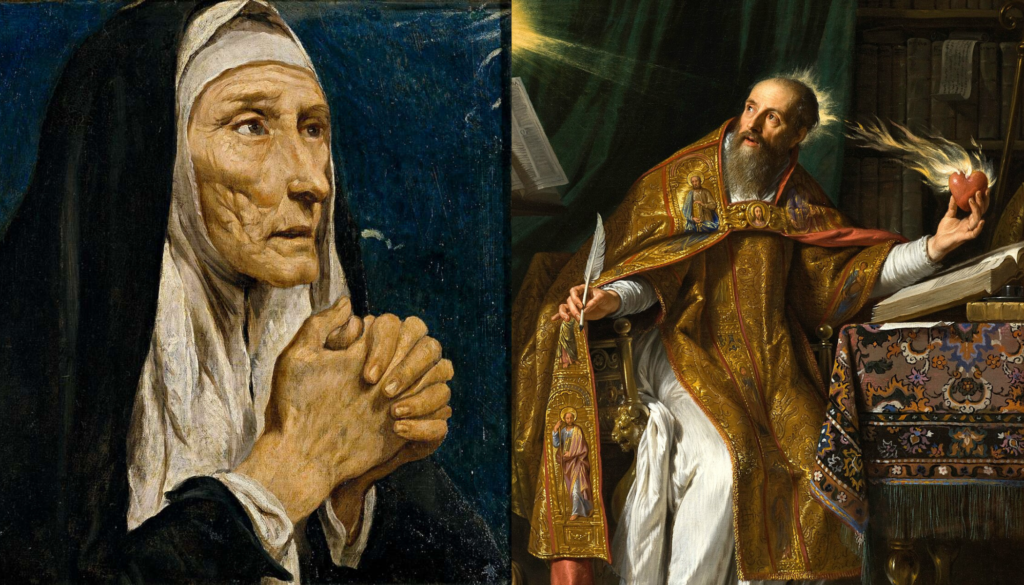
St. Monica — Aug. 27
St. Monica is best known as the mother of St. Augustine of Hippo, but her own life offers a powerful example of perseverance in prayer and trust in God.
Born around 331 in Tagaste, North Africa, Monica was raised in a Christian family and married Patricius, a pagan. She became the mother of three children, including Augustine, and patiently worked to guide her family toward the Catholic faith. Her example and persistent prayers eventually helped lead her husband to conversion.
Monica is especially remembered for the years she spent praying and shedding tears over Augustine, who pursued a very different path from the faith in which she had raised him. Her perseverance was eventually rewarded when Augustine converted to Christianity and was baptized by St. Ambrose in Milan in 387.
Monica died shortly afterward at Ostia while preparing to return to Africa with her son. The Church celebrates her feast on Aug. 27, one day before the feast of St. Augustine. She was canonized by Pope Gregory IX in 1234.
St. Augustine of Hippo — Aug. 28
St. Augustine of Hippo is one of the most influential figures in the history of Christianity and is honored as a bishop, doctor of the Church, theologian, and spiritual father of the Augustinian order. Born in Tagaste, North Africa, in 354, Augustine spent much of his youth searching for truth and happiness outside the Catholic faith. Through the prayers of his mother, Monica, and his own long spiritual journey, he eventually experienced a profound conversion and was baptized by St. Ambrose in Milan in 387.
After returning to North Africa, Augustine established a monastic community and was later ordained a priest and named bishop of Hippo. He became a prolific writer and preacher, producing works that would profoundly influence Christian theology and spirituality.
Augustine died on Aug. 28, 430, as the Vandals were invading North Africa. His feast day follows immediately after that of his mother, St. Monica. Pope Boniface VIII later named him a doctor of the Church in 1298.
Discover more about Pope Leo’s connection to Saint Augustine with this Vaticano segment:
This article was originally published on EWTN News English.