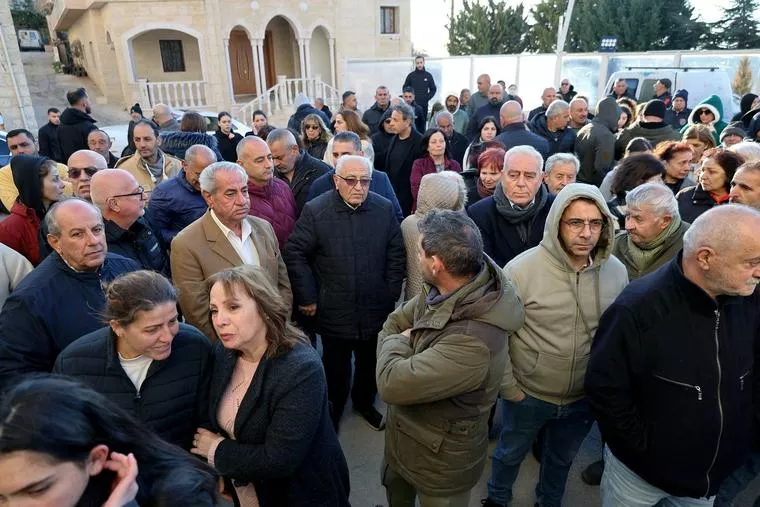
Attacks and counterattacks between Israel and Hezbollah, an Iranian-backed militia, have created a dire situation for Christians in the Israel-Lebanon border region.
JERUSALEM — Christians are a minority in the Middle East, but they have as much of a stake in the region’s latest war as any other residents, local church leaders say.
Since Israel and the United States joined forces in a war against Iran’s Islamic regime on Feb. 28, Iran has launched barrages of ballistic missiles at numerous Israeli towns and cities.
Last week, Hezbollah, a terrorist organization with a large military arsenal funded by Iran, launched waves of rockets from Lebanon at northern Israel, the home of most of Israel’s nearly 200,000 Christians.
In response, Israeli ground troops have pushed into southern Lebanon in a bid to destroy Hezbollah strongholds near the Israel-Lebanon border. Over the years, and especially after the Oct. 7, 2023, Hamas massacre, Hezbollah has repeatedly rocketed Israeli towns and kibbutzim.
The death toll is rising.
On March 9, an Israeli tank strike in the Christian village of Qlayaa in southern Lebanon killed Maronite Father Pierre al-Rahi. Like many other Lebanese priests and residents of Lebanese Christian villages, he had refused to heed the Israeli Defense Forces’ orders to evacuate, in the hopes of preventing Hezbollah from entering the village and Israel from attacking.
“We carry nothing but kindness, goodness, love and prayer,” Father al-Rahi told the France24 television channel on the steps of his church the day before he was killed.
“We chose to stay under danger because these are our homes. We won’t leave them for anyone who wants to come in and use them and occupy them,” he said, in a clear reference to Hezbollah fighters.
According to media reports, Father al-Rahi was killed by an IDF strike on a building that had been infiltrated by Hezbollah fighters. He was tending to villagers injured in an earlier IDF strike when the IDF struck again.
Many Lebanese Christians blamed both Israel and Hezbollah.
“Father Pierre was killed in a peaceful Christian Lebanese village dragged by Hezbollah into war with Israel. We call on the international community to place Lebanon under Chapter VII,” which would designate the area under the aegis of the United Nations, Amine Bar-Julius Iskandar, president of the Maronite Union-Tur Levnon, wrote on Twitter.
Pope Leo expressed his “profound sorrow” for the victims of the Middle East attacks, “for the many innocent people, including numerous children, and for those who were helping them, such as Father Pierre al-Rahi.” The Pope “is following the events with concern and prays for a swift end to all hostilities,” the Holy See Press Office said.
Jesuit Father John Paul, the rector of the Tantur Ecumenical Institute in Jerusalem, said that Holy Land Christians “have a stake in what is going on here. People own homes, land. They harvest their olive trees. Christians have deep roots here. We’re impacted by everything that is happening here. We are not an outside group of people, but we are often overlooked by a lot of Jewish and Muslim leaders.”
Father Paul said that local churches “have a significant role to play in peacebuilding and mediation. Because we are part of this land, part of the people, part of everything that happens here.”
In the northern Israeli city of Nazareth, Auxiliary Bishop Rafic Nahra, who serves as patriarchal vicar for Israel and the Latin Patriarchate of Jerusalem, told the Register that local Christians are reeling from the violence in the region. Many Christians in Israel — both citizens and foreign workers — have spent more than a week in and out of bomb shelters. A Catholic Filipina caregiver was killed in an Iranian air strike.
“We are not separate. We feel the effects of war like everyone, whether they be Christians, Muslims or Jews,” Bishop Nahra said. “Each one is feeling this war, and we are praying it will end. We see the news; we see the destruction after destruction and threats. We’ve had so many wars in this region.”
Since the start of the war, “many” Christian families have emigrated from Israel, Bishop Nahra said. He fears that the current war and violence within Israeli Arab society will lead to more departures.
“I am worried seeing many Christians leaving. We encourage our people to stay, to witness our Christian faith and our need to be here, but we cannot force anybody to stay. We cannot protect them. What can we say to them is ‘God bless.’”
Yousef Barakat, director general of the Notre Dame of Jerusalem Center in Jerusalem, is one of those considering emigration in the foreseeable future. He has already told his son, who recently earned an advanced degree in the U.S. and now lives in Texas, not to return home.
“Every two or three years we have a crisis, and I think that even when this war ends, it will be very challenging for Christians to live here,” Barakat said. “Most Christians in Jerusalem and Bethlehem work in the tourism industry. In the West Bank, I’d say 70%-80% of the Christians are thinking of leaving, provided they could obtain proper documents, including visas.”
Unless the situation vastly improves, Barakat said, in a few decades “there could be no more than a few Christian families here.”
This article was originally published on NCRegister.