Skip to content

Miracle of the liquefaction of blood of St. Januarius is repeated in Naples, Italy

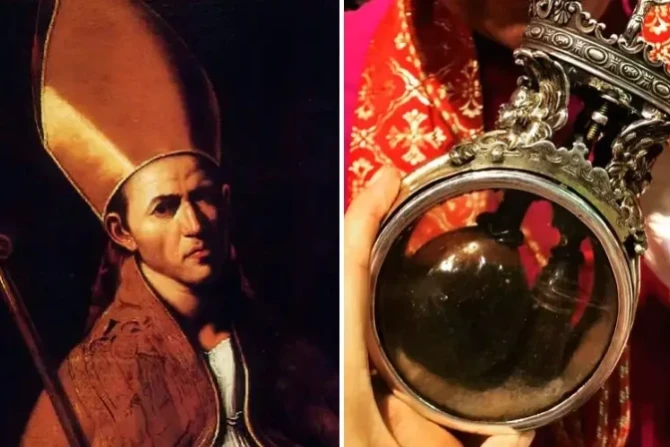
St. Januarius (left) and the relic of the blood of St. Januarius. | Credit: Chapel of St. Januarius

The miracle of the liquefaction of the blood of St. Januarius, patron saint of the Italian city of Naples, occurred again on Tuesday, Dec. 16.

According to the Archdiocese of Naples, the miracle took place after Mass in the Royal Chapel of the Treasure of St. Januarius on the feast of the patronage of St. Januarius.

“At 9:13 a.m. local time, the blood already appeared semi-liquid. At 10:05 a.m., the complete liquefaction was announced,” the archdiocese reported.

“Dec. 16 is the third of three annual celebrations in honor of the martyred saint. This date commemorates the eruption of Mount Vesuvius in 1631, when the Neapolitans requested and obtained the miraculous intervention of St. Januarius to prevent the lava from engulfing the city,” he explained.

The announcement of the miracle was made by Monsignor Vincenzo De Gregorio, abbot of the Chapel of the Treasure of St. Januarius. The phial, once the miracle had occurred, was carried in procession to the chapel so that all those present could see it.

The miracle usually occurs on two other days of the year: every Sept. 19 (the anniversary of St. Januarius’ martyrdom) and the Saturday before the first Sunday of May (in remembrance of the transfer of his remains to Naples).

When the blood does not liquefy, as happened on Dec. 16, 2020, the inhabitants of Naples usually take it as a bad omen. However, in the face of this possibility, the Church encourages the faithful not to lose sight of what is essential.

On Sept. 19, 2024 — despite the miracle having occurred that day — the archbishop of Naples, Cardinal Domenico Battaglia, urged the faithful not to place their hope in physical manifestations but in Jesus, who calls us to care for the most vulnerable.

“I implore you, we should not worry about whether the blood of this relic liquefies or not, but rather we should worry about whether the blood of the dispossessed, the marginalized, the least fortunate, and the innocent is flowing in our streets and in our world,” the cardinal said.

“The blood of Bishop Januarius, let us never forget, always points to the blood of Christ, both the blood of Christ himself and the blood of the poor and the least fortunate in whom Christ lives,” he added.

This story was first published by ACI Prensa, CNA’s Spanish-language news partner. It has been translated and adapted by CNA.

Receive the most important news from EWTN Vatican via WhatsApp. It has become increasingly difficult to see Catholic news on social media. Subscribe to our free channel today

Share

Would you like to receive the latest updates on the Pope and the Vatican

Receive articles and updates from our EWTN Newsletter.

I agree that EWTN will keep me informed about news, faith stories and how to best support their work. You will never receive e-mails from us that you do not want to receive. You can unsubscribe any time. For more information on how to unsubscribe, our privacy practices, and how we are committed to protecting and respecting your privacy, please review our Privacy Policy.

More news related to this article

Pope Francis explains why Catholics make the sign of the cross

Each time that a Catholic makes the sign of the cross, it is a reminder that God is

Pope Francis in East Timor says children show us how to ‘be cared for by God’

On the second day of his apostolic visit to East Timor (Timor-Leste), Pope Francis first met with children and religious sisters at the Irmãs Alma School in Dili on Tuesday morning and thanked them for their testimony of love.
About half of Nigeria’s bishops visit the tomb of St. Paul after celebrating Mass at the Basilica of St. Paul Outside the Walls in Rome during their ad limina visit on March 4, 2026. | Credit: Ishmael Adibuah/EWTN News

Synod study group proposes broader role for Catholics in bishops’ ad limina visits

Study Group 7 says bishops’ visits to Rome should be instruments of missionary conversion, communal discernment, and greater

Lessons From the Christmas Gospels

COMMENTARY: The first witnesses to the messianic birth are not the great and the good but the lowly

Exclusive interview with Cardinal Parolin on Vatican Diplomacy

Our exclusive interview with Cardinal Pietro Parolin, Vatican Secretary of State, during the 26th St. Francis de Sales

Religions United in Music 2023: Concert Celebrating the Bicentenary of St. Paul Outside the Walls

Join us for a spectacular concert, “Religions United in Music,” organized by the Embassy of Israel and the

LIVE
FROM THE VATICAN

Be present live on EWTNVatican.com