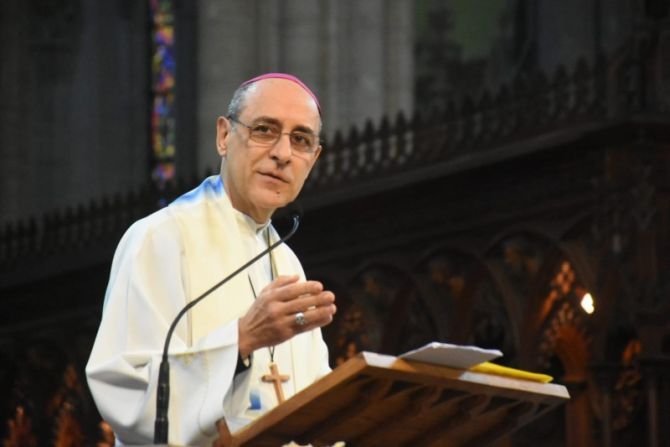
Cardinal-elect Víctor Manuel Fernández, who is poised to take up his position as the head of the Vatican’s chief doctrinal office in the coming days, has signaled an openness to theological debates, saying they help deepen the Church’s understanding of the Gospel.
“True doctrine can only be a light, a guide for our steps, a sure path and a joy for the heart. But it is clear that even the Church does not yet fully grasp the full richness of the Gospel,” Fernández told veteran Vatican journalist Edward Pentin of the National Catholic Register, CNA’s sister news outlet, in an exclusive interview conducted by email on Sept. 8.
“The doctrine does not change, the Gospel will always be the same, Revelation is already settled,” said the incoming prefect of the Dicastery for the Doctrine of the Faith. “But there is no doubt that the Church will always be tiny in the midst of such an immensity of truth and beauty and will always need to continue to grow in her understanding.”
The 61-year-old Argentine theologian also criticized bishops — both “progressive” and those from “traditionalist groups” — who think they have a “special gift of the Holy Spirit to judge the doctrine of the Holy Father,” warning that are on a road to “heresy” and “schism.”
“Remember that heretics always think they know the true doctrine of the Church,” Fernández said.
Fernández, a close confidante and purported ghostwriter of Pope Francis who has been the archbishop of La Plata since 2018, has expressed an openness to consider Church blessings of same-sex unions, provided they don’t result in “confusion.” But in the interview with Pentin he chafed at media implications that his views align with the German Church’s so-called Synodal Way, which has called for dramatic changes to the Church’s teaching on sexual morality and other issues.
The cardinal-elect said the German Church “has serious problems and obviously has to think about a new evangelization,” but he professed to know “little about it” and instead highlighted what he calls his own “formula for dealing with the religious indifference of society” in the way he evangelized as a priest and bishop in Argentina.
“Look, my most famous book is called ‘Los Cinco Minutos del Espiritu Santo’ (‘The 5 Minutes of the Holy Spirit’) and contains a daily meditation on the Holy Spirit that has sold 150,000 copies. Did you know that?” Fernández asked.
“On the other hand, I was a parish priest and I was also a diocesan bishop. Go and ask the faithful in my parish what I did when I was parish priest, and you will see: Eucharistic adoration, catechism courses, Bible courses, home missions with Our Lady and a prayer to bless the home. I had 10 prayer groups and 130 young people,” he continued.
“As diocesan bishop I used to ask people about what I’d discuss in my homilies in the cathedral and in my visits to the parishes: about Christ, about prayer, about the Holy Spirit, about Mary, about sanctification. And last year I proposed to the whole archdiocese to concentrate on ‘growing together towards holiness.’”

Pope Francis on July 1 named Fernández to succeed Cardinal Luis Ladaria Ferrer, SJ, 79, who has been prefect of the dicastery since 2017.
“As the new prefect of the Dicastery for the Doctrine of the Faith, I entrust to you a task that I consider very valuable,” Pope Francis wrote in a letter to Fernández, published with the announcement of his appointment.
The pope said the dicastery at times has promoted pursuing “doctrinal errors” over “promoting theological knowledge.”
“What I expect from you is certainly something very different,” Francis said. “I ask you as prefect to dedicate your personal commitment in a more direct way to the main purpose of the dicastery, which is ‘guarding the faith.’”
Fernández struck a similar chord in discussing his new role in his interview with Pentin.
“I believe that this dicastery can be a space that can welcome these debates and frame them in the secure doctrine of the Church, thus avoiding for the faithful some of the more aggressive, confusing, and even scandalous media debates,” he said.
But he had more pointed things to say about bishops who judge the “doctrine of the Holy Father.”
The pope not only has a duty to guard and preserve the “static” deposit of faith, Fernández said, but also a second, unique charism, only given to Peter and his successors, which is “a living and active gift.”
“I do not have this charism, nor do you, nor does Cardinal [Raymond] Burke. Today only Pope Francis has it,” he said, an apparent reference to a preface that Burke wrote for a book that is critical of next month’s Synod on Synodality.
“Now, if you tell me that some bishops have a special gift of the Holy Spirit to judge the doctrine of the Holy Father, we will enter into a vicious circle (where anyone can claim to have the true doctrine) and that would be heresy and result in schism,” he said.
“Remember that heretics always think they know the true doctrine of the Church. Unfortunately, today, not only do some progressives fall into this error but also, paradoxically, do some traditionalist groups.”
You can read Pentin’s full interview with Fernández here.
This article was originally posted on CNA.