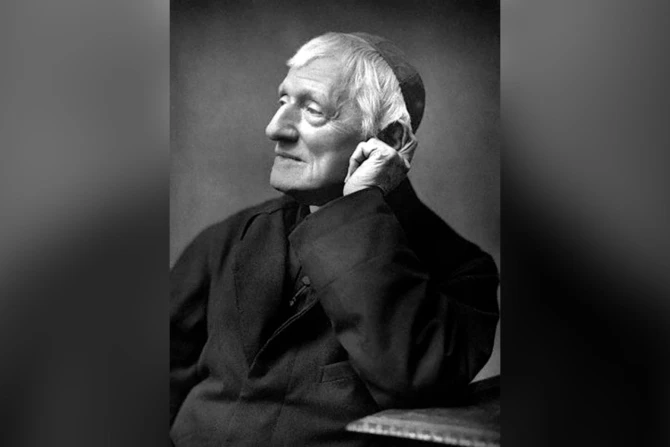
Pope Leo XIV will name St. John Henry Newman a patron saint of Catholic education in a document to be published on Oct. 28 for the 60th anniversary of Gravissimum Educationis, the Second Vatican Council’s declaration on Christian education.
The Holy Father will designate Newman as an official co-patron saint of education, together with St. Thomas Aquinas, during the Vatican’s Jubilee of the World of Education from Oct. 27 to Nov. 1, which is expected to draw 20,000 pilgrims.
The saint will also be declared the 38th doctor of the Church by Leo at the jubilee’s closing Mass on Nov. 1, the solemnity of All Saints.
Cardinal José Tolentino de Mendonça, the prefect of the Dicastery for Culture and Education, announced the upcoming designation during an Oct. 22 press conference.
Newman, de Mendonça said, is an “extraordinary educator and great inspiration for the philosophy of education.”
The pope will also publish a document on Oct. 28 to commemorate the 60th anniversary of Gravissimum Educationis.
Leo’s document will “reflect on the topicality of the declaration and on the challenges that education must confront today, in particular the Catholic schools and universities,” de Mendonça said.
Gravissiumum Educationis, the cardinal said, is a “fundamental document with a strong impact on the contemporary vision of education. The document had a fundamental role in and outside of the Church, and it should be recognized.”
In addition to reaffirming the universal right to education, the Vatican II declaration marked “an important change in the language, that is, the mentality, for speaking about school, not in terms of institutions but rather in terms of educational communities,” he added.
The cardinal quoted at length from the pope’s document to be published Oct. 28, which says that Gravissimum Educationis “has lost none of its bite” since its publication.
“Since its reception, a constellation of works and charisms has been born … a spiritual and pedagogical heritage capable of crossing the 21st century and responding to the most pressing challenges,” the pope says in the document.
“This heritage is not set in stone: It is a compass that continues to point the way,” Leo says. “Today’s expectations are no less than those the Church faced 60 years ago. Indeed, they have expanded and become more complex. … History challenges us with new urgency. Rapid and profound changes expose children, adolescents, and young people to unprecedented fragility. It is not enough to preserve: We must relaunch.”
“I ask all educational institutions to inaugurate a season that speaks to the hearts of the new generations, recomposing knowledge and meaning, competence and responsibility, faith and life.”
According to the latest Vatican statistics shared at the Oct. 22 press conference, there are 230,000 Catholic universities and schools present across 171 countries, serving almost 72 million students.
This article was originally published on CNA.