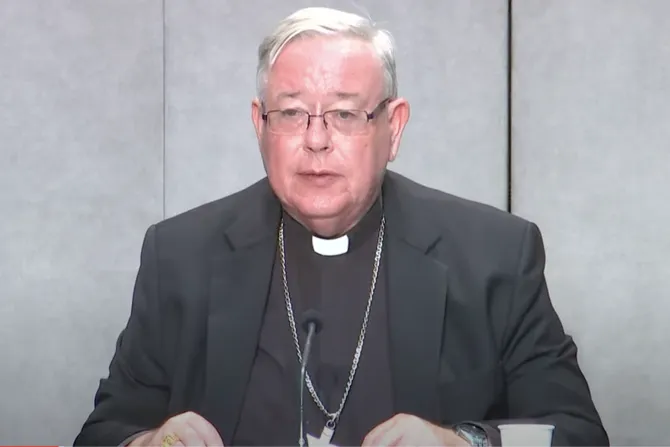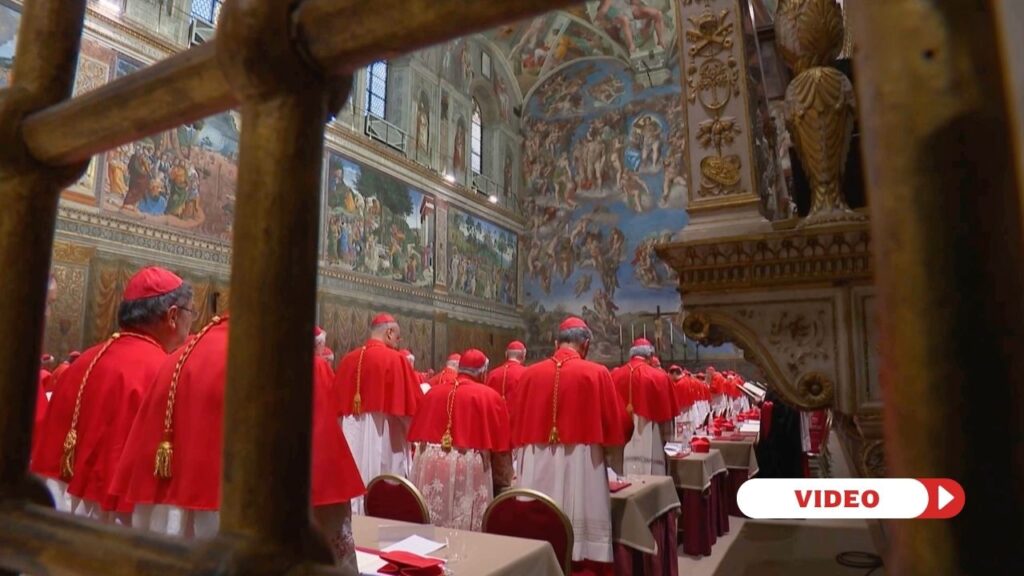
Polish Cardinal Grzegorz Ryś is among the youngest cardinals that participated in the last conclave.
In an exclusive interview with EWTN, conducted inside the Archbishop’s Palace in Kraków, the Metropolitan Archbishop of Kraków reflects on why the election of the new pope proceeded so quickly, whether Robert Prevost was considered a leading candidate from the outset, and what kind of superior he was before his election to the papacy.
As a longtime member of the Dicastery for Bishops, Cardinal Ryś offers us insights that few others can provide.
Your Eminence, it’s been a year since the conclave in which you participated for the first time. Why was that conclave so fast, so swift—why did you decide so quickly?
I suppose that’s not a question for me—you’d have to ask the Holy Spirit. Well, these questions aren’t simple, because in the end it’s not entirely clear what is and isn’t covered by secrecy. But I think I can say this much: nothing indicated it would go that way.
And certainly not what we call the pre-conclave—it was a time of rather firm discussions among the cardinals, not an easy time, with various opinions being expressed. I wouldn’t say extreme, but certainly strongly contrasting. And the fact that the conclave itself went so quickly—many of us, not just me, understood it in this way: that the Holy Spirit showed His hand, that something happened which we didn’t expect of ourselves—that we would reach such unity in voting so quickly.
I think few people realize that one of the key moments is the pre-conclave, the general congregations of cardinals. They are essential, and in this last conclave perhaps even more important than before, because the College of Cardinals was extremely diverse: 133 cardinals from over 70 countries—a real Tower of Babel. So how do you reach agreement?
Getting to know one another is indeed one of the goals of the pre-conclave, because with that many cardinals it’s obvious that we don’t know each other—or only to a very limited extent. But the main goal is actually a bit different.”
The cardinals are aware that among them sits the future pope. Some even said so, beginning their speeches with “Holy Father.” At that point everyone would look around, slightly confused, but then came the explanation: we all know that Peter is here—we just don’t yet know who he is.
And so it would be good if that “Peter,” who will be revealed after the election, already knows about the problems of the Church—problems that are different in the Vatican, where Cardinal Prevost was one of the most important officials, or in Latin America, where he was a bishop. But there are also other regions—Australia, Oceania, Asia. He probably knows Europe somewhat from traveling as the head of the Augustinians, but no one knows the whole reality of the Church—there are no such people.
So the pre-conclave exists mainly for this purpose.
What was Cardinal Prevost like as Prefect in those moments when you had direct contact—what was he like as a person?
We worked together for three years. I was appointed to the Dicastery under his predecessor, so it was a very beautiful experience, starting from the very first meeting he attended—but did not yet lead, because it was still led by Cardinal Ouellet. It was a non-procedural meeting, devoted to a fundamental reflection on the office of the bishop and on the ways bishops are appointed—what might require some change, or at least some adjustment. It was an important session.
Later, he proved to be a man of extraordinary diligence, with a great ability to listen. But it also works this way procedurally: the prefect is usually the one who speaks last at plenary meetings.
So he had the opportunity to listen attentively to everyone at the table.
Did you also have direct contact with him—any specific tasks given to you, your Eminence?
It is a highly international and intercontinental group. It’s important that when dealing with matters that have a local character, there is someone you can approach as a starting point. For example, if someone comes from Central and Eastern Europe, it doesn’t mean they know all the local Churches—but at least it gives you a place to begin the conversation.
In such concrete situations, it’s important that the Prefect knows whom to turn to.
This is the first pope, who’s phone number you have at hand, your Eminence, that’s what I’ve heard
Of course, I use it very rarely. As they say in the highlander dialect: only when it’s absolutely necessary.
And when it’s necessary, then you have to call—call, not write.
And he answers?
Yes, sometimes immediately, sometimes after two days, but he always answers.