Two days after a naked man stood on the high altar of St. Peter’s Basilica in a shocking security breach, the basilica’s archpriest on Saturday held a penitential rite as required by canon law in cases where sacred places are desecrated.
Vatican News reported that the unidentified man was a Polish national who approached the high altar on June 1 as the basilica was about to close. He quickly undressed and climbed onto the altar. Photos posted online showed the words “Save children of Ukraine” written in marker on his back.
“As officers of the Vatican Gendarmerie approached, the man did not resist but cooperated as they led him to the police station inside the Vatican,” the Vatican News report said. “After ascertaining his identity, the man was handed over to the Italian police, according to the Italy-Holy See Treaty, and was issued an expulsion order and instructed to leave Italian territory.”
The basilica’s main altar, where the pope celebrates Mass, is called the Altar of the Confession. Reached by climbing seven steps, the marble altar is located directly above St. Peter’s Tomb and is crowned by Gian Lorenzo Bernini’s large Baroque sculpted bronze canopy.
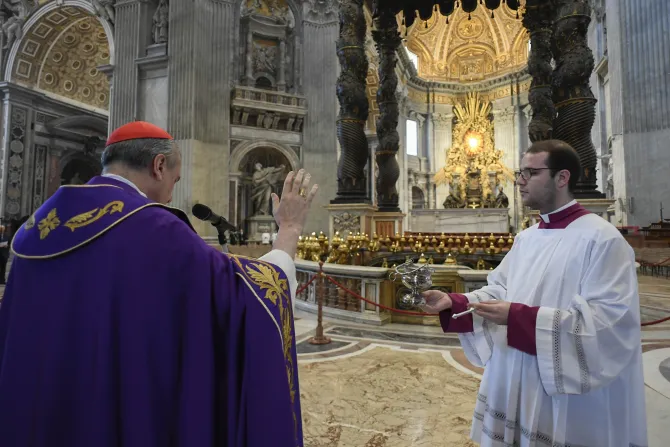
Cardinal Mauro Gambetti, the basilica’s archpriest, led the penitential rite, held at noon Rome time Saturday. Canons of the Chapter of the Papal Basilica of St. Peter’s and several members of the faithful also participated, Vatican News reported.
According to a report by ACI Prensa, CNA’s Spanish-language news partner, during the act of reparation, the cardinal pointed out that “it is the structure of sin that conditions the hearts and minds of people.”
“This structure of sin is the one that feeds the wars, the one that inhabits our society,” he added.
Referring to the desecration carried out on June 1, the cardinal pointed out that it is this “structure of sin” that pushed the man “to make an inappropriate and deplorable gesture,” ACI Prensa reported.
“We are here to tell the Lord that we recognize that this structure of sin conditions the actions of God’s people. Lord, we ask your forgiveness, purify us,” Gambetti said.
Next, after praying the Creed, the cardinal blessed the water and later spread it on the altar as a sign of purification. Later, two nuns dressed the altar with a tablecloth, candles, flowers, and a crucifix.
The Code of Canon Law and the Ceremonial of Bishops provide guidance for situations where altars or other sacred spaces are violated.
Canon No. 1211 states: “Sacred places are violated by gravely injurious actions done in them with scandal to the faithful, actions which, in the judgment of the local ordinary, are so grave and contrary to the holiness of the place that it is not permitted to carry on worship in them until the damage is repaired by a penitential rite according to the norm of the liturgical books.”
The Ceremonial of Bishops, Nos. 1070–1092, specifies that crimes that can desecrate a church are those that “do grave dishonor to sacred mysteries, especially to the eucharistic species, and are committed to show contempt for the Church, or are crimes that are serious offenses against the dignity of the person and society.”
A penitential rite, either a Mass or a Liturgy of the Word, should be carried out as soon as possible after such a desecration, the norms state.
This article was originally published on CNA (Catholic News Agency)