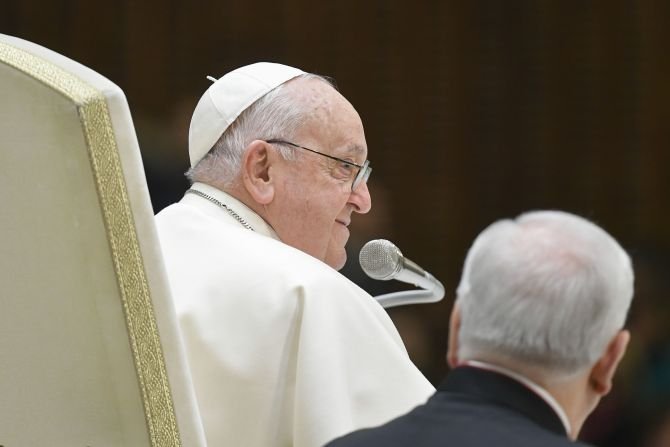
In a firm call to avoid “false mercy” in marriage annulment proceedings, Pope Leo XIV reminded that compassion cannot disregard the truth.
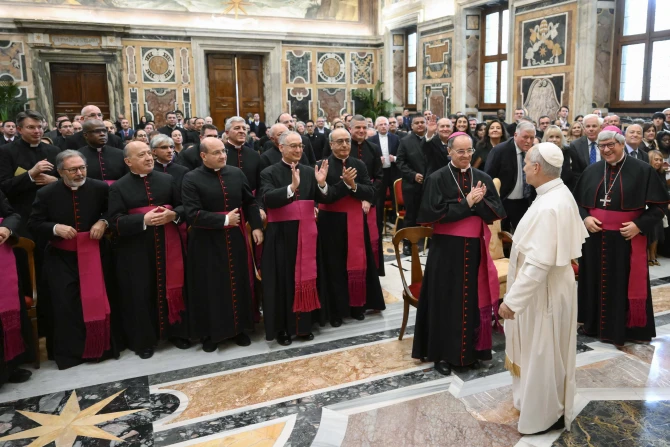
During a Friday audience with participants in the legal-pastoral training course of the Roman Rota, the Holy See’s court of appeals, the Holy Father read a lengthy speech in which he recalled the importance of the reform of marriage annulment processes initiated by Pope Francis 10 years ago.
The pontiff emphasized that theology, law, and pastoral care must be understood in a harmonious way, not as separate or opposing areas, and pointed out that annulment proceedings are not merely technical procedures to obtain the “free status of persons” but rather an ecclesial service based on the search for truth and on family pastoral care.
Judicial processes at the service of truth
In this context, Pope Leo stressed that ecclesial judicial processes must be “at the service of the truth” and also reiterated that “the mystery of the conjugal covenant” must be kept in mind.
“A fundamental aspect of pastoral service operates in judicial authority: the diaconia [ministry] of truth. Every faithful person, every family, every community needs truth about their ecclesial situation in order to walk well the path of faith and charity. The truth about personal and community rights is situated in this context: the juridical truth declared in ecclesiastical processes is an aspect of existential truth within the Church,” he stated.
Consequently, the Holy Father pointed out that “the sacred authority is participation in the authority of Christ, and its service to truth is a way of knowing and embracing the ultimate truth, which is Christ himself.”
A manifestation of justice and mercy
He then recalled that in God’s judgment on salvation, “his forgiveness of the repentant sinner is always at work, but human judgment on the nullity of marriage cannot however be manipulated by false mercy.”
“Any activity contrary to the service of the process of truth must certainly be deemed unjust. However, it is precisely in the proper exercise of judicial authority that true mercy must be practiced,” he emphasized.
In this regard, Pope Leo XIV insisted that the process of matrimonial nullity can be seen as “a contribution by legal practitioners to satisfy the need for justice that is so deeply rooted in the conscience of the faithful, and thus to accomplish a just work motivated by true mercy.”
“The aim of the reform,” he added, “which is to make the process more accessible and expeditious, but never at the expense of truth, thus appears as a manifestation of justice and mercy.”
The pontiff also emphasized the urgency of ensuring realism in annulment cases and appealed to the responsibility of the judges of the Roman Rota. He thus encouraged them to view the institution of the judicial process “as an instrument of justice” in which there is “an impartial judge” and the aim is to seek “a great benefit for all concerned and for the Church herself.”
He stressed the importance of making “efforts to promote reconciliation between spouses are very important, including, where possible, through the validation of the marriage.”
“Behind the procedural technicalities, with the faithful application of the current legislation, the ecclesiological presuppositions of the matrimonial process are therefore at stake: the search for truth and the ‘salus animarum’ itself [the salvation of souls],” he noted.
Synergy between justice and pastoral care
Pope Leo recalled in this regard that, in recent years, there has been “a growing awareness of the inclusion of the Church’s judicial activity in the field of marriage within the overall pastoral care of the family.”
“This pastoral care,” he pointed out, “cannot ignore or underestimate the work of ecclesiastical tribunals, and the latter must not forget that their specific contribution to justice is a piece in the task of promoting the good of families, with particular reference to those in difficulty.”
Thus, he emphasized that “the synergy between pastoral attention to critical situations and the judicial sphere has found significant expression in the implementation of preliminary investigations aimed at ascertaining the existence of grounds for initiating a case of nullity.”
This story was first published by ACI Prensa, CNA’s Spanish-language news partner. It has been translated and adapted by CNA.