Walking through St. Peter’s Basilica, Catholics can make a Marian pilgrimage by exploring the basilica’s images of the Virgin Mary from Michelangelo’s marble sculpture of the Pieta to Our Lady of Perpetual Help, a 12th-century painting brought into the basilica in 1578 in a solemn procession.
For those unable to travel to the Eternal City, EWTN Vatican is providing ten beautiful images of Our Lady in St. Peter’s Basilica for the month of October dedicated to the Holy Rosary.
Virgin Immaculate
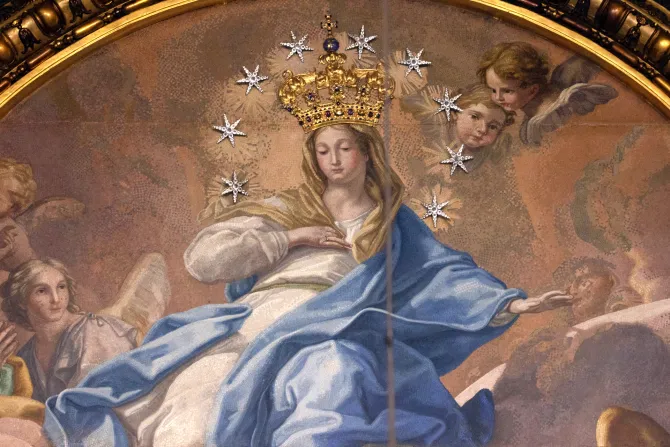
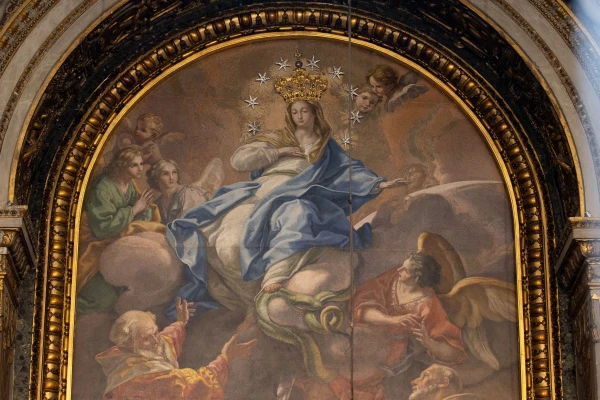
In the basilica’s Chapel of the Choir, a large altarpiece reveals Mary, Virgin Immaculate, in the glory of heaven above angels and saints. The mosaic based on an 18th-century painting by Italian artist Pietro Bianchi depicts St. John Chrysostom, St. Francis of Assisi, and St. Anthony of Padua venerating the Blessed Virgin Mary.
The chapel is located on the left side of the basilica behind an iron gate designed by Gian Lorenzo Bernini. St. John Chrysostom is buried beneath the altar, which also contains relics of St. Francis and St. Anthony.
When Pope Pius IX declared the doctrine of the Immaculate Conception of the Virgin Mary on December 8, 1854, he had a golden crown added to the mosaic of Mary. Pope Pius X later added a larger diamond crown to mark the 50th anniversary of the declaration in 1904.
The original painting by Bianchi can be found in Rome’s Basilica di Santa Maria degli Angeli e dei Martiri.
Mother of the Church
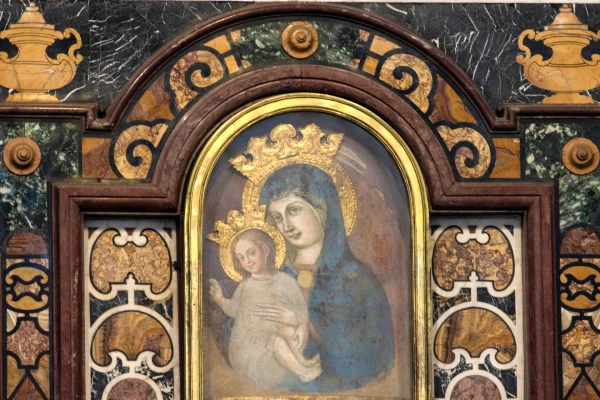
The basilica contains an icon of the Virgin Mary titled “Mater Ecclesiae,” which means “Mother of the Church.”
The original image of the Virgin Mary and the Christ Child was painted on a column in old St. Peter’s Basilica, built by Emperor Constantine in the fourth century. It was later transferred to the 16th-century St. Peter’s Basilica. Paul VI honored the icon with the title “Mater Ecclesiae” after the Second Vatican Council.
The icon can still be seen above one of the basilica’s side altars in the Chapel of Our Lady of the Column, which also contains the remains of Pope St. Leo the Great (440-461).
A mosaic of the Virgin Mary overlooking St. Peter’s Square was inspired by the original Mater Ecclesiae image. The mosaic was installed after the assassination attempt against St. John Paul II in 1981.
When he blessed the mosaic, John Paul II prayed “that all those who will come to this St. Peter’s Square will lift up their gaze towards you [Mary], to direct, with feelings of filial trust, their greetings and their prayers.”
In 2018, Pope Francis added the memorial of “Mary, Mother of the Church” to the liturgical calendar for the Monday after Pentecost.
Mother of Pilgrims
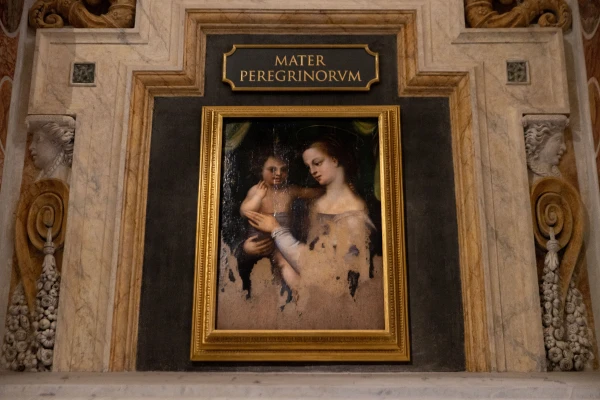
A restored 16th-century painting of Our Lady holding her son can be found in St. Peter’s Basilica above the sarcophagus of Pope Gregory XIV.
The image is titled “Mater Peregrinorum” or Mother of Pilgrims. The original artist is not known, but Italians also refer to the painting as the “Madonna di Scossacavalli” because it came from Rome’s Church of San Giacomo Scossacavalli, which was demolished in 1937 to create the current Via della Conciliazione leading to St. Peter’s Basilica.
Our Lady of Perpetual Help

A 12th-century painting on wood titled Our Lady of Perpetual Help, also known as Our Lady of Succor, was transferred to an altar in St. Peter’s Gregorian Chapel on February 12, 1578 with a solemn procession.
The painting was the first artistic restoration completed under Pope Francis’ pontificate during the Year of Faith, according to a book published by the Knights of Columbus.
The remains of the Doctor of the Church St. Gregory of Nazianzus (d. 390) are preserved in an urn beneath the Altar of Our Lady of Succor in the Gregorian Chapel, found on the right side of the basilica.
Ark of the Covenant
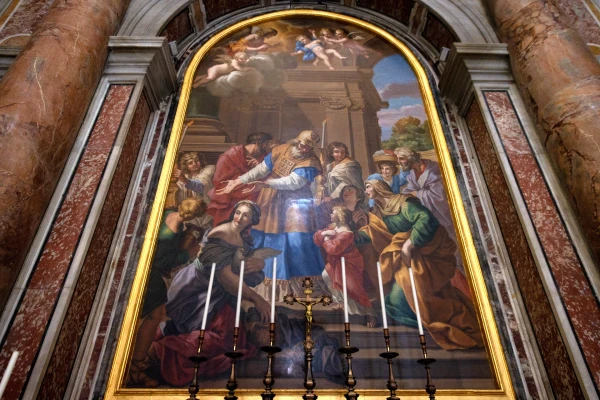
A colorful mosaic altarpiece of the Presentation of the Virgin Mary in the Temple brightens the wall above the tomb of Pope St. Pius X (d. 1914) in the Presentation Chapel near the left-front entrance of the basilica.
A young Mary is depicted on the steps of the Temple with her parents, Sts. Anne and Joachim, the grandparents of Jesus.
The mosaic completed by Pietro Paolo Cristofari in 1728 is based on a painting by 17th-century artist Giovanni Francesco Romaneli, the original of which can be found in Rome’s Basilica di Santa Maria degli Angeli e dei Martiri.
Gate of Heaven

The central door leading to basilica was retained from the old St. Peter’s Basilica and is known as the Filarete Door. Created by a Florentine artist in 1455, the door depicts Christ, the Virgin Mary, and the apostles Sts. Peter and Paul.
Queen Assumed into Heaven
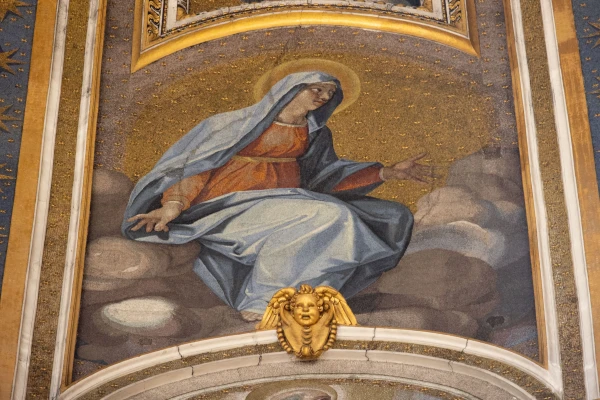
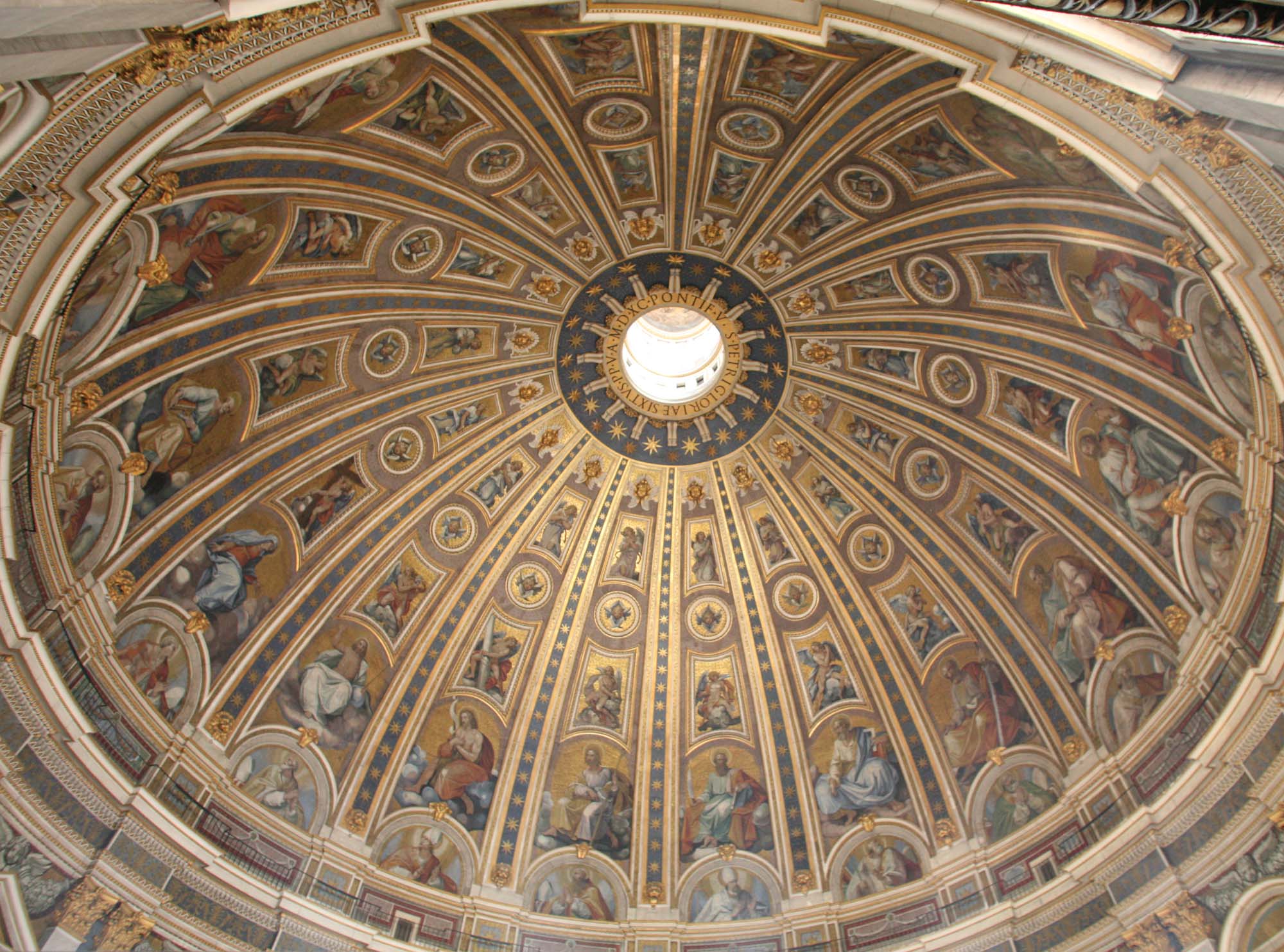
Looking up at the soaring cupola, or dome, of St. Peter’s Basilica, one sees mosaics depicting the Blessed Virgin Mary next to Christ the Redeemer, along with St. John the Baptist and the apostles.
Mother of the Redeemer
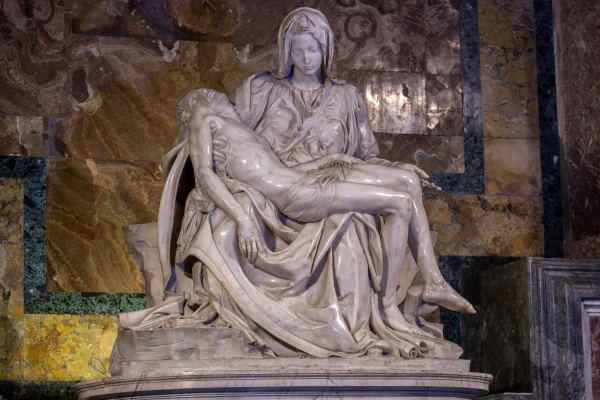
Michelangelo Buonarroti carved the Pieta from a single slab of Carrara marble when he was 24-years old. The sculpture was unveiled in St. Peter’s Basilica for the Jubilee of 1500.
The moving sculpture conveys the faith and emotion of the Blessed Virgin Mary as she cradles in her arms the dead body of her only son after witnessing him crucified.
The sculpture sits above a side-altar near the front entrance of St. Peter’s Basilica, where Mass was sometimes offered before recent restrictions. Visitors to the basilica can only see the Pieta behind bulletproof glass after a man attacked the sculpture with a hammer in May 1972.
The Pieta was the only work of art that Michelangelo ever signed.
Madonna della Bocciata

Now that morning Masses are celebrated in the Basilica Grottoes, pilgrims encounter the “Madonna della Bocciata” more than in centuries past.
Originally a small oratory commissioned by Gregory XIII in 1580, the chapel is located near the tomb of St. Peter. The oratory was expanded in 1592 by Pope Clement VIII and later dedicated to St. Paul in 1607 when a mosaic of the Apostle was discovered. The chapel was renamed “Bocciata” in 1636 when Pope Urban VIII installed the Marian image above the altar.
The 14th-century “Bocciata” fresco by Roman painter Pietro Cavallini is named for the Virgin Mary’s swollen face. According to legend, our Lady’s face bled when a drunken soldier, angry after losing a game, threw an object at the holy image.
Mounted on the wall and protected by iron grates, two stones from the ancient portico paving flank the image of the Madonna. Tradition holds that these stones received the drops of blood from this miraculous event in 1440.
Madonna and Child

At Papal Masses, a 19th-century statue of Mary with the Child Jesus, entitled “Our Lady of Montserrat,” is prominently placed near the altar, further witness to the great devotion of Mary in St. Peter’s Basilica. It was given to Pope St. Paul VI in 1963 by the Church in Brazil.
This article was originally published on Catholic News Agency and has been was adapted and updated with contributions by Jacob Stein.