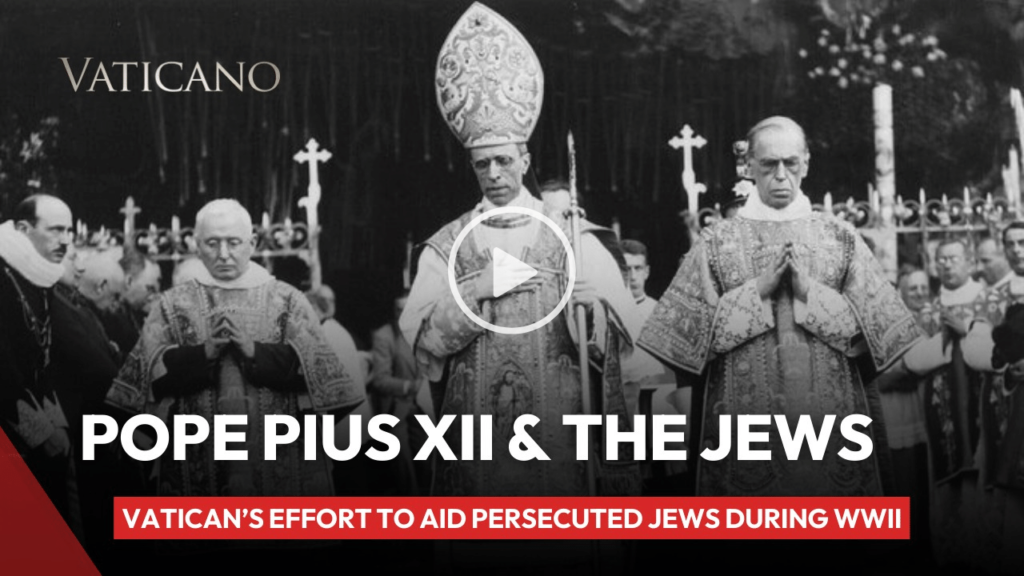
Pope Pius XII’s pontificate, which lasted from 1939 to 1958, coincided with the Second World War, one of the darkest periods of the 20th century. Though praised by many for his efforts during the war, he has been at the center of intense debate for over fifty years, surrounding his perceived silence when it came to helping the Jews of Europe and condemning Nazi atrocities. But is this true? Who is the real Eugenio Pacelli? What was his role during World War II, and how do we separate fact from fiction?
On March 4, 2019, Pope Francis, in an address to the Officials of the Vatican Apostolic Archive, formerly known as the Vatican Secret Archive, declared that he “decided that the opening of the Vatican Archives of the Pontificate of Pius XII [would] take place on March 2, 2020.”
The Holy Father’s decision to open the archives of Pius XII generated great excitement and anticipation among scholars worldwide. This has, in turn, ushered in a new period of scholarship and brought up old narratives that the Pope was inactive regarding intervention for the Jews.
After more than three years since the archives were opened, we may finally have some answers. One expert who knows this material more intimately than anyone is Dr. Johan Ickx, Director of the Vatican’s Historical Archives of the Section for Relations with States of the Secretariat of State. In 2021, he published his book Pio XII e Gli Ebrei (Pius XII and the Jews) after reviewing more than 800,000 documents. One series of particular interest to Ickx was the recently uncovered “Ebrei files” (“Jews”).
Dr. Johan Ickx, in an interview with Matthew Santucci of EWTN Vatican, explains the unique quality of the “Ebrei files” that they represent an archival series that is “very strange” because normally series are entitled according to “nations with which [the Vatican has] regular bilateral agreements and bilateral diplomatic activity.” What makes the “Ebrei files” unique is that the Vatican did not have regular bilateral diplomatic activity with the Jews. “All of a sudden in ’39,” a series emerges, Ickx tells us, “until ’45, ’46.”
Ickx notes that this formerly unknown series is filled with “thousands of letters that were sent from the whole of Europe to the Pope himself,” looking for help and sustenance in some way, “be it by money, by passports, or whatever,” to escape out of Europe, under the threat of Nazism.
The “Ebrei files” provide much information, contradicting the idea that the Pope was not intervening in the threatened wartime world, “There, under his very windows, was going on a mistreating of Jews, and he didn’t do anything.” Ickx describes the contrary. Pope Pius XII constituted within the Secretary of State not one, but two offices, two sections: the General Affairs of the Church and the Archives of Foreign Affairs, the office wherein Ickx works. “Now, foreign affairs also had a bureau, specifically for helping Jews, day and night. So, these letters came in, and this office was dealing, day and night, to help those Jews where they could because it was very difficult.”
Since the opening of the archives and the publication of Ickx’s book, there has been a renewed interest in Pius XII’s diplomacy and humanitarian efforts during the war, which could carry significant implications for a renewed evaluation of Pius XII’s legacy. Recently, however, there was the revelation of a document claiming that Pius XII knew about the concentration camps as early as 1942, which caused a media firestorm and revived the old storylines.
Dr. Suzanne Brown-Fleming, Director of International Academic Programs for the United States Holocaust Memorial Museum in Washington D.C., explains that this document helps to understand the complexity of the role of the papacy in an exceptionally challenging and delicate time of history. She says, “This document that’s been discussed in the press, actually, there is an earlier document from the Fall of 1941 that was published by the Vatican itself in 1974. It was the case of a Slovakian priest who gave the first report, and from that time, the Secretary of State, the Pope, and his officers received regular reports and were among the best informed about the Holocaust, as were the Allied governments, including the United States, including Great Britain.”
Further, Brown-Fleming emphasizes, “I think what we can see now from the archives, it’s not a question that Pope Pius XII knew about the suffering of Jews and the murder of Jews in massacres.” But, “now we can see all the different considerations that he had to weigh as the head of a city-state, but also the moral leader of the entire Roman Catholic Church.”
Currently underway in Rome is a three-day conference where scholars, historians, and theologians are meeting to discuss their findings further and to understand how to better contextualize Pius XII’s efforts and diplomacy within the broader context of the time. Brown-Fleming intimates that the study of the intervention of Pius XII will not be fully grasped overnight, “It’s the first international conference where dicasteries of the Roman Catholic Church and the Vatican archives as well as Jewish communities, here in Rome and across Italy, have come together to organize an event to try to understand this history better. And it will take many years to really understand the figure of the Pope and the decisions that he faced.”
Ickx relates a fascinating reality, “There were many Jews that were also in camps already, that were writing to the Pope. It’s very astonishing, but they did it exactly while their fellow Jews said to them, the one who can help you out, the only one who will do it is the Pope, and that is striking because it’s exactly the opposite of what we hear.”
Understanding Pius XII’s efforts to help the Jews of Europe will also help to understand the broader arc of papal diplomacy in this period, shedding a new light on the man as well as the Church and her role in the world. While more time will be needed to evaluate all of the documents in the archives, there are signs that Pope Pius XII will be remembered as a pope of goodness, charity, prudential wisdom, and resolve, not of silence and indifference.
(This article was edited by Jacob Stein.)