Skip to content

Polish Bishop at Synod: Practice Can Vary but Doctrine has to be the ‘Same for Everyone’

A Polish archbishop said Thursday one difficulty of synodality lies in distinguishing pastoral practice — which can be adapted to different cultural circumstances — from Church doctrine.

A Polish archbishop said Thursday one difficulty of synodality lies in distinguishing pastoral practice — which can be adapted to different cultural circumstances — from Church doctrine.

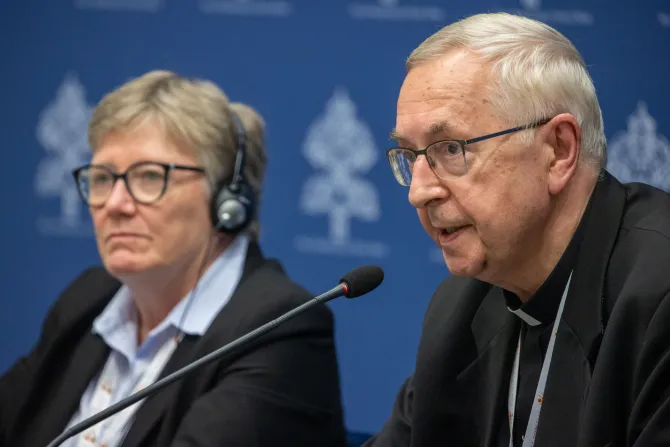
“In doctrine, the Church cannot bring to it the different viewpoints of those coming from the other continents or other parts of the world. Doctrine has to be ‘catholic’ [universal] and the same for everyone,” Archbishop Stanislaw Gadecki of Poznan said at a press briefing for the Synod on Synodality on Oct. 26.

This is in contrast, the president of the Polish bishops’ conference said, to “different pastoral expressions” of doctrine as appear in different cultures, languages, and historical situations.

Gadecki is one of three Polish bishops participating in the Vatican’s Oct. 4–29 assembly of the Synod of Bishops on synodality.

He said the method of this synod brings both differences and agreements, and participants are not hiding the challenges.

“It would be useless to get together for a month and hide difficulties that exist in different situations or in connection with different issues that require an answer,” he said.

On pastoral practice versus doctrine, Gadecki underlined that “countries have their own histories and they must also be in tune with that history” — including negative responses to the Church’s actions.

He said different pastoral expressions do not influence Christian doctrine, the magisterium, holy Scripture, and sacred tradition.

“As far as the essential things are concerned, there cannot be a development of Christian doctrine, but in the things that are not essential, there can always be a change as long as that change is a true development,” he said, referencing the theological concept of the development of doctrine.

A Romanian Orthodox bishop, who is taking part in the synod as a fraternal delegate, a participant without a vote, said one challenge in the Orthodox understanding of synodality is in reaching a consensus among bishops.

“In the Orthodox church, it’s not the majority that ‘decides’ as we often see in synodal processes,” Metropolitan Iosef of Western and Southern Europe said.

The good thing about synodality, he added, “is you’re never alone when you make decisions.”

This article was originally published on Catholic News Agency. 

Receive the most important news from EWTN Vatican via WhatsApp. It has become increasingly difficult to see Catholic news on social media. Subscribe to our free channel today

Share

Would you like to receive the latest updates on the Pope and the Vatican

Receive articles and updates from our EWTN Newsletter.

More news related to this article

PHOTOS: Pilgrims From All Over The World Pass Through Holy Door Of St. Peter’s Basilica

Pilgrims from around the world are passing through the open Holy Door of St. Peter’s Basilica, which Pope Francis opened on Christmas Eve to begin the 2025 Jubilee.

‘You Are Not Alone’: Pope Francis Meets Women Who Escaped the Mafia

Pope Francis on Monday encouraged a group of women who escaped criminal organizations in Italy to keep fighting despite fear and to know they are not alone.

Cardinal Koch meets with Serbian Orthodox Church bishop Andrej

The Holy See is considering a meeting between Pope Francis and the Patriarch of the Serbian Orthodox Church Porfirije in Koper, Slovenia, in June, as a first step towards dialogue and cooperation between the Catholic and Serbian Orthodox Churches.

Pope Francis presents “Dilexit nos”: an Encyclical on Human and Divine Love

An Initiative of Profound Spirituality Next Thursday, Pope Francis’ Encyclical, “Dilexit nos,” which explores the human and divine

Council of Nicaea: 1,700 years of Christian unity amid division

In the summer of A.D. 325, more than 300 bishops gathered in Nicaea — located in modern-day northern Turkey — to promulgate a common Christian creed, settle Christological disputes that arose from the Arian heresy, and promote unity in the Church.

As ocean temps hit record, Vatican hosts discussions on climate change, offers resources

April had the hottest global sea surface temperatures on record, per the EU’s Copernicus Climate Change Service. Amid this, the Vatican hosts a climate summit, May 15–17, to address environmental action.

LIVE
FROM THE VATICAN

Be present live on EWTNit