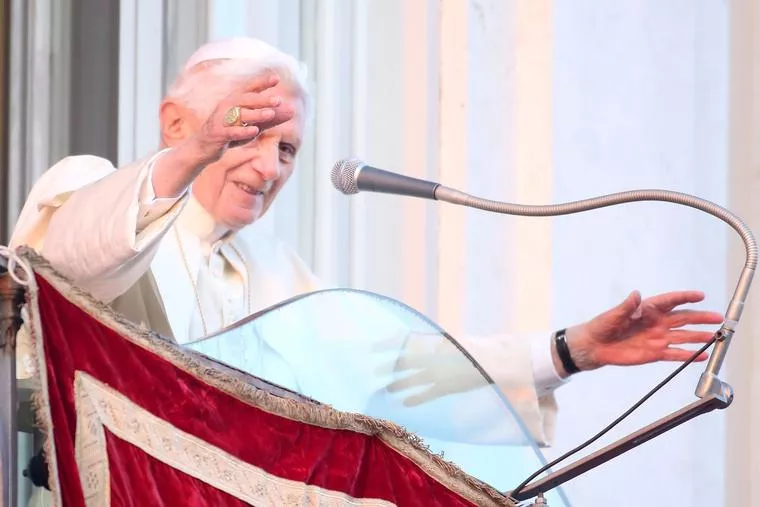
The 10th anniversary of Pope Benedict XVI’s abdication announcement — Feb. 11, 2013 — passed with little comment, given the attention paid just a month earlier upon his death. But the anniversary of the abdication itself, Feb. 28, offers an opportunity to revisit the decision in light of new information.
On the occasion of the fifth anniversary in 2018, I wrote, given that no one had ever resigned the papacy in serene circumstances, that the default position must be that Benedict was wrong to do so, and the burden of argument lay upon those who considered it the right thing to do.
Benedict himself argued clearly for the validity of his abdication, but unconvincingly for the rightness of the decision. I made that argument here.
Since the fifth anniversary, new information can help us to better understand Benedict’s decision.
Pope Francis Disagrees
While Benedict was still alive, Pope Francis always spoke favorably of the decision. But soon after his death, he said that the papal ministry was “for life” and that he saw “no reason” that it should be otherwise:
“Benedict had the courage to do it because he did not feel up to continuing due to his health. I, for the moment, do not have that on my agenda. I believe that the pope’s ministry is ad vitam. I see no reason why it should not be so. Think that the ministry of the great patriarchs is always for life! And the historical tradition is important.”
How to reconcile that recent answer with the Holy Father’s earlier statements — many of them — praising the decision? It seems that Francis believes that Benedict was sincere, humble and courageous in taking the decision, but that the decision was wrong in substance. To be gracious, he chose to emphasize the former while Benedict lived and the latter after his death.
The two popes met often and discussed much. From the public comments of Pope Francis, it is reasonable to surmise that they discussed whether Benedict’s abdication created a new reality in the Church, like the retirement age for bishops did a half-century ago. Francis seemed open to that possibility. But it seems, in the end, he remains unconvinced.
Imminent Death?
In 2021, Benedict’s private secretary, Archbishop Georg Gänswein, said that the Holy Father only expected to live a few months after his abdication.
“When he resigned in the spring of 2013, it seemed to him and to me — I can confess it here — that he had only a few months left, but not eight years,” Archbishop Gänswein told a conference in Austria.
If true, it would seem to make the abdication seem indulgent. Why create a rupture with unbroken tradition only for a few months of relief from the papal office? The Church had managed with diminished popes for much longer than a few months many times in the past.
In point of fact, Pope Benedict lived longer in retirement than he served in office. If he regretted his decision, given his unexpected longevity, he never made any public indication of such.
Jetlag, Insomnia and WYD
In an interview book after his abdication, Benedict XVI explained that, after his visit to Cuba and Mexico in 2012, he realized that he could not make another transoceanic trip. His doctor advised against it for reasons of the jetlag.
Given that papal trips are not obligatory, and that jetlag can be addressed with less drastic measures than resignation, Benedict’s explanation remained insufficient.
New information recently emerged that helps to explain that there was rather more to the jetlag problem than was previously known.
In late January 2023, Peter Seewald, Benedict’s longtime interlocutor and biographer, revealed that, in an October 2022 letter, the late Holy Father told him that the “central reason” for the abdication was chronic insomnia, for which he had been taking sleeping medication since 2005.
Benedict suffered a fall during a March 2012 trip, from which he woke to discover himself bleeding from the head. It appears that Benedict may have been asleep when he fell, or at least not fully conscious.
Seewald’s revelation may explain why Benedict put so much emphasis on international travel in his explanation of the resignation. Someone suffering from chronic insomnia would be all the more reliant on strong sleeping pills on a long trip with a large time change. If that medication was thought to have contributed to his fall, then it would make such trips inadvisable. And if such trips were thought essential to the papacy, the prospect of resignation arises.
Before Seewald’s insomnia revelation, Benedict’s travel explanation seemed disproportionate. The insomnia would also explain increasing exhaustion, to the point where continuing in office would seem daunting. On the other hand, Benedict was functioning sufficiently well that he completed a masterful encyclical on faith before leaving office (Pope Francis published it in July 2013).
Thus, on the 10th anniversary of the dramatic helicopter ride from the Vatican to Castel Gandolfo, we know more about the abdication than we did in 2013, but the case for the rightness of the decision remains to be made. Like Pope Francis, many are not fully convinced.