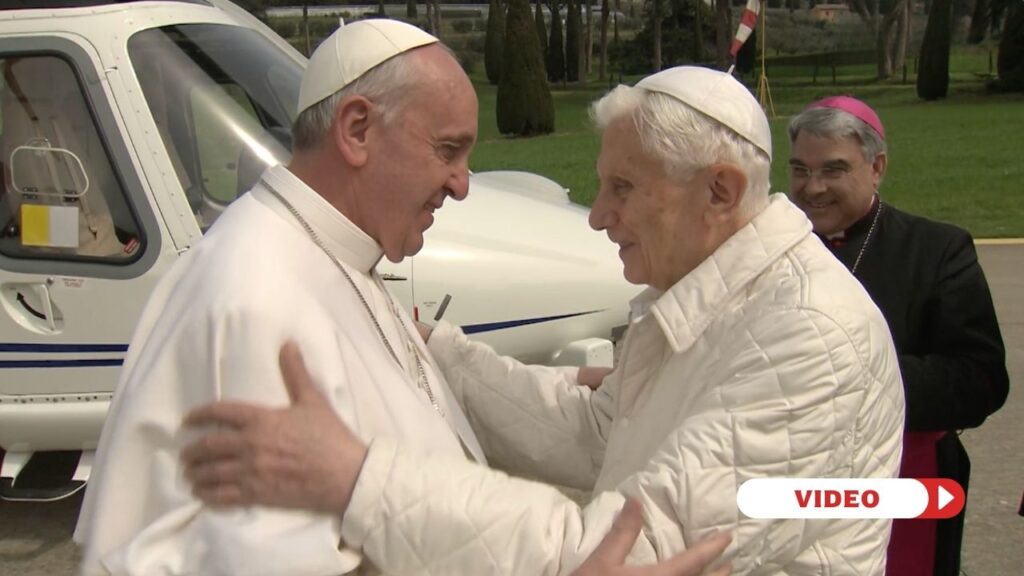
In a recent interview Pope Francis said his predecessor Pope Emeritus Benedict XVI was a leader in “taking responsibility” and responding with transparency to clerical sexual abuse — the latest defense by the Holy Father of his predecessor, who is facing criticism in his native Germany for his handling of several abuse cases as an archbishop decades ago.
In the Nov. 22 interview published Monday by America Magazine, Pope Francis discussed a wide range of topics including the Church’s response to revelations of abuse by clergy. Francis said although “official statistics” show that clergy abuse makes up a very small percentage of all abuse cases in society, [i]f there had been only one case, it would have been monstrous.”
Before the 2002 “Boston crisis,” abusers were simply moved from place to place as part of the institutional cover-up, he said.
“The practice, which is still maintained in some families and institutions today, was to cover it up. The Church made the decision to not cover up [anymore]. From there progress was made in judicial processes, the creation of the Pontifical Commission for the Protection of Minors,” the pope said, as reported by America.
“Here, a great [example] is Cardinal [Seán] O’Malley of Boston, who had the mindset to institutionalize [the protection of minors] within the Church. When honest people see how the Church is taking responsibility for this monstrosity, they understand that the Church is one thing while the abusers who are being punished by the Church are another. The leader in taking these decisions was Benedict XVI.”
During his almost eight-year pontificate, which began in 2005, Benedict XVI dismissed hundreds of abusers from the clerical state, regularly met abuse survivors, and addressed the abuse crisis in Ireland in a 2010 pastoral letter. He resigned from the papacy in 2013.
This is not the first time Pope Francis has spoken in defense of his predecessor’s record on responding to sexual abuse. Amid an ongoing reckoning over Benedict XVI’s handling of abuse cases in Munich, where he served as archbishop from 1977 to 1982, Pope Francis called to offer his support to Benedict XVI as the pope emeritus faced criticism.
A lengthy investigative report, compiled by a German law firm and released in January, criticized the nonagenarian retired pope’s handling of four cases during his time in charge of the southern German Archdiocese of Munich and Friesing.
In two of the cases, the report says, clerics committed abuse while then-Archbishop Ratzinger was in office. While they were criminally sanctioned by secular courts, they continued to perform pastoral duties, and no action was taken against them under canon law. In a third case, a cleric convicted by a foreign court worked in the Munich Archdiocese, and in a fourth case, a priest already accused of abuse was moved to Munich in 1980, where he committed further acts of abuse.
The 1,000-page report — which has drawn some criticism for its $1.53 million price tag — covered the years 1945–2019 and identified at least 497 victims of abuse as well as 235 alleged perpetrators, including 173 priests, during the 74-year period.
For his part, Benedict issued a grave apology to victims of sexual abuse, while four of his advisers defended his actions in each of the four cases mentioned in the report in a three-page rebuttal.
“I have had great responsibilities in the Catholic Church. All the greater is my pain for the abuses and the errors that occurred in those different places during the time of my mandate,” Benedict wrote.
“Each individual case of sexual abuse is appalling and irreparable. The victims of sexual abuse have my deepest sympathy and I feel great sorrow for each individual case.”
The advisers insisted that Benedict was not “aware of sexual abuse committed or suspicion of sexual abuse committed by priests” in any of the cases mentioned in the report.
Archbishop Georg Gänswein, Benedict’s longtime personal secretary, told EWTN in February that the pope emeritus “is being accused of something that contradicts 25 years of his work” in making the Church more transparent and effective at dealing with sexual abuse.
After leaving the Munich Archdiocese in 1982, the future pope served as prefect of the Vatican Congregation for the Doctrine of the Faith (CDF). In 2001, Pope John Paul II entrusted the CDF with investigating allegations of clerical abuse worldwide.
Gänswein said in February that Benedict encountered “internal resistance” at the Vatican as he sought to take decisive action against abusers but was able to overcome it with the Polish pope’s support.
“He did not only play a decisive role, he was the decisive figure, the decisive man; the one who not only suggested transparency, but also took concrete steps towards transparency. One can say, he is the ‘father of transparency,’ and thus he also managed to convince Pope John Paul II,” he said.
Sexual abuse is, Pope Francis said in the Nov. 22 interview, “a ‘new’ problem in its manifestation, but eternal in that it has always existed. In the pagan world they commonly used children for pleasure,” he said, going on to express his deep worry about the scourge of child pornography.
“The Church takes responsibility for its own sin, and we go forward, sinners, trusting in the mercy of God. When I travel, I generally receive a delegation of victims of abuse,” he noted.
On the topic of sexual abuse in the Catholic Church, Pope Francis was asked about the apparent lack of transparency when it comes to accusations against bishops, compared with the handling of accusations against priests. The pope called for “equal transparency” going forward, adding that “if there is less transparency, it is a mistake.”
In the America interview, Pope Francis also discussed the role of bishops, why women cannot be ordained priests, racism, polarization, the Vatican-China deal, and whether he has any regrets from his time as pope.
This article was originally published by EWTN News English.