The period of the octave of Christmas, or the eight days of festivities that follow the remembrance of Jesus’ birth, are punctuated by “some dramatic figures of martyred saints.” And this is because, says Pope Francis, “Christmas is not the fairy tale of the birth of a king, but the coming of the Savior, who frees us from evil by taking upon himself our evil: selfishness, sin and death.” Hence, then, the figure of the martyrs, from the protomartyr St. Stephen, who is celebrated today, to the Holy Innocents, the children who were made to be killed by King Herod.
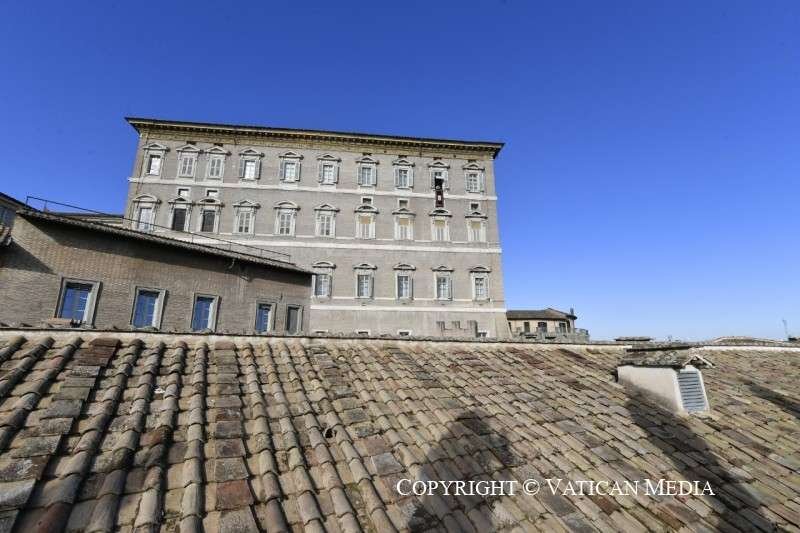
It’s a cloudy and somewhat dreary day in Rome, but a small crowd gathers nonetheless for the feast of the first martyr Stephen, also a circumstance when the Pope looks out of his study window for the Angelus prayer.
Why, then, are martyrs closer to Jesus? Pope Francis explains, “the word martyr means witness: martyrs are witnesses, that is, brothers and sisters who, through their lives, show us Jesus, who overcame evil with mercy.”
The Pope notes that even today “martyrs are numerous,” and asks for prayers for “persecuted brothers and sisters who bear witness to Christ.”
The figure of St. Stephen, Pope Francis says, helps to understand how to improve witness. For Stephen was “one of the seven deacons whom the Jerusalem community had consecrated for the service of soup kitchens, for charity,” giving the first witness “not in words, but through the love with which he served those most in need.”
In addition to this work of assistance, Stephen “spoke of Jesus to those he met,” showing a “second dimension of witness,” namely that of “welcoming the Word and communicating its beauty, telling how an encounter with Jesus changes lives.”
It was something so important, for the martyr Stephen, that he – Pope Francis recounts – “did not allow himself to be intimidated even by the threats of his persecutors, not even when he saw that things were going badly for him.”
Stephen was “charity and proclamation,” although his greatest witness is when he “was able to unite charity and proclamation,” namely when he “forgave his killers on the point of death” following the example of Jesus.”
The Pope concludes that “we can improve our witness through charity toward our brothers and sisters, faithfulness to the Word of God and forgiveness.” And it is precisely forgiveness that tells “whether we really practice charity toward others and whether we live the Word of Jesus.”
Pope Francis recalls that the etymology of forgiveness is “greatest gift,” and that it is therefore “a gift we give to others because we are Jesus’, forgiven by Him.”
Thus, the Pope invites us to think about “our capacity to forgive, in these days in which perhaps we encounter, among the many, some people with whom we have not gotten along, who have hurt us, with whom we have never mended relationships.”
And he invites us to ask “of the newborn Jesus the newness of a heart capable of forgiveness. We all need this grace, let us ask the Lord for a heart capable of forgiveness. The strength to pray for those who have hurt us and to take steps of openness and reconciliation.”
After the Angelus prayer, Pope Frances renews “the wish for peace, peace for families, peace in parish and religious communities, peace in movements and associations, peace for those peoples tormented by war, peace for dear and martyred Ukraine. We ask for peace for this martyred people.”
This article was originally published on ACI Stampa.