Discovering Santa Maria in Via Lata: The Apostles’ Early Home in Rome
Fr. John D’Orazio from the Opera Romana Pellegrinaggi, the office managing pilgrimages in Rome and beyond, takes us to the ancient Church of Santa Maria in Via Lata. This historic site is believed to have housed some of Jesus’ earliest followers during their time in the Eternal City.
Fr. D’Orazio presents:
We are currently in the underground crypt beneath one of the churches in the center of Rome, Santa Maria in Via Lata. This crypt is believed to be one of the places where Peter, Paul, and their collaborators, Mark and Luke, stayed when they first arrived in Rome. The church is located a little further from the Jewish ghetto. Since Peter had been imprisoned three times in Jerusalem, though he preached to the Jews, he preferred to live among the Gentiles. This is one of the reasons why this place is considered to be Saint Peter’s first dwelling in Rome, and later also Saint Paul’s when he arrived in the city.
The Apostles’ Work and Legacy at Santa Maria in Via Lata
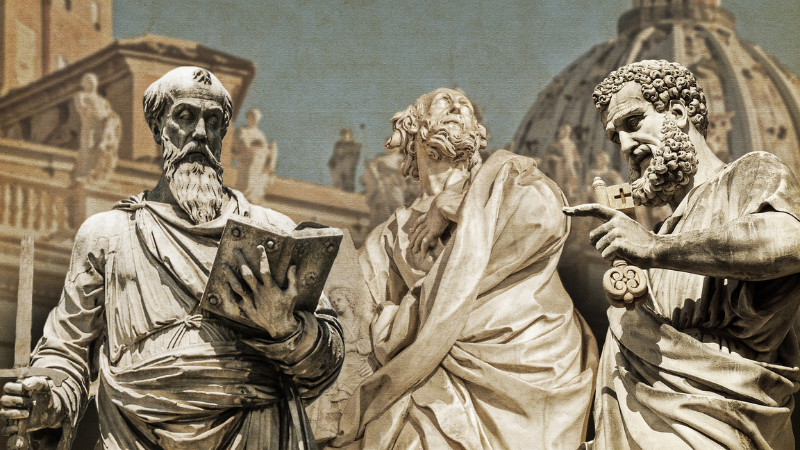
Inside the crypt, visitors encounter a Baroque bas-relief depicting Saint Paul with a sword, Saint Peter with the keys, and Saint Luke writing the Acts of the Apostles. Fr. D’Orazio notes, “It is believed that Saint Luke wrote part of the Acts here. Additionally, this is the place where Saint Paul penned several of his letters, including the second letter to Timothy, and letters to the Ephesians, Colossians, and Philemon.”
Saint Martial, faintly visible in the background of one of the artworks, welcomed the apostles here. A convert baptized by Saint Peter, Martial eventually became one of the Church’s first bishops, later sent to Le Mans in France. This location holds significant historical weight as the apostles stayed and wrote letters that formed the basis of many Church teachings.
Relics and Memorials of Saint Paul’s Imprisonment
A Roman pillar stands in the crypt, commemorating Saint Paul’s time under house arrest. “Paul spent two years in chains after arriving in Rome. The inscription on this pillar reminds us of one of his letters to Timothy, the second letter, which reads: ‘Remember Jesus Christ, raised from the dead, a descendant of David—this is my Gospel, for which I am suffering even to the point of being chained like a criminal. But the word of God is not chained,’” Fr. D’Orazio explains. The pillar emphasizes that, while Paul was bound, the Word of God remained unchained.
Nearby, Paul’s actual chains are displayed in a protective case, a powerful testament to his trials.
An ancient, deep well where the chains were discovered further supports the history of this place as an old Roman domus, where Peter, Paul, Mark, and Luke likely lived. The well was also used for baptizing some of Rome’s first Christians.
The Upper Church and the Icon of “Mary Advocata”
Moving into the Upper Church, visitors find a Baroque structure built over the original medieval church, dating back to the 17th century. At its center stands a 12th-century icon of Mary, known as “Mary Advocata.” Fr. D’Orazio describes its significance: “This title highlights her role as intercessor, with one hand raised in prayer, interceding for us before the throne of Jesus.” Among the paintings in the Upper Church is one of Saint Paul baptizing Saint Sabina, an early Roman convert who lived on the Aventine Hill. Though dedicated to Mary and featuring the icon of “Mary Advocata” said to be painted by Saint Luke, the church’s paintings also remind us of the apostles’ presence in Rome—their preaching, their impact, and their enduring legacy.
Adapted by Jacob Stein