The Vatican announced Monday that Pope Francis has created a “new” diocese in mainland China — a decision that tacitly recognizes diocesan borders drawn by Beijing, according to Asia News.
The pope has suppressed the former Apostolic Prefecture of Yiduxian, which had been a vacant see since 2008, and replaced it with the Diocese of Weifang, which takes its name from the prefecture-level city of more than 9 million people in China’s central Shandong province.
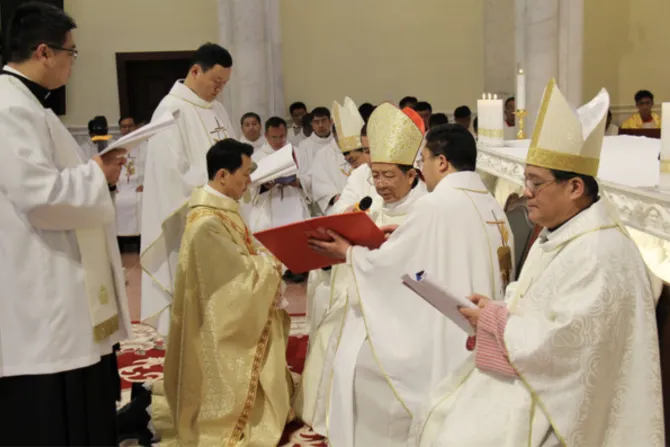
The Vatican announced the erection of the Weifang Diocese on Jan. 29, the day of the consecration of the diocese’s first bishop, Bishop Anthony Sun Venjun.
The Holy See Press Office said that Pope Francis established the diocese on April 20, 2023, “in the desire to promote the pastoral care of the Lord’s flock and to attend more effectively to its spiritual good.”
Diocesan border dispute
Diocesan borders have been an area of dispute between the Vatican and China in the decades since the Chinese Communist Party came to power and started to redraw diocesan lines.
According to Asia News, the pope’s elevation of the Diocese of Weifang accepts the diocesan borders redrawn by Beijing.
The Catholic Church has 147 ecclesiastical jurisdictions in China with 20 archdioceses, 97 dioceses, 28 apostolic prefectures, and two ecclesiastical administrations.
However, the Chinese Communist Party government has claimed that only 104 dioceses exist in mainland China and has redrawn borders in a way that combines dioceses.
Chinese diocesan borders have been a key issue in the ongoing negotiations between the Holy See and Beijing, according to Agenzia Fides, the information service of the Pontifical Mission Societies.
The Diocese of Weifang
The Diocese of Weifang covers an area of about 6,240 square miles stretching from Qingzhou to Gaomi encompassing the metro area of the prefecture-level city of Weifang. Its cathedral is the Cathedral Church of Christ the King located in Qingzhou to the west of Weifang city.
According to the Vatican, about 6,000 Catholics live in the new diocese, which has a total population of 9.39 million people and is served by 10 priests and six nuns. Weifang is a suffragan diocese of the Archdiocese of Jinan.
The diocese replaces the former Apostolic Prefecture of Yiduxian, which was created on June 16, 1931, by Pope Pius XI, who entrusted its administration to Franciscan missionaries from France.
Bishop Sun
Bishop Sun was consecrated in Qingzhou on Jan. 29 by Bishop John Fang Xingyao of Linyi, the president of the Chinese Patriotic Association, who presided over the ordination along with four other bishops from Shandong Province.
More than 300 people attended the consecration Mass, including 44 priests, according to the government-sanctioned Chinese Catholic Patriotic Association.
Sun, 53, is originally from Weifang. He studied at the Sheshan Seminary from 1989 to 1994. He was ordained a priest at the age of 25 in December 1995 in the Beijing Cathedral. He spent a year in Ireland for formation between 2007 and 2008 before returning to his ministry in Weifang.
Vatican-China deal on the appointment of bishops
Sun is the second Chinese bishop consecrated in the mainland in the past five days. The Vatican announced on Jan. 25 that Pope Francis had appointed Father Thaddeus Wang Yuesheng as the bishop of Zhengzhou, an announcement that also came on the day of his episcopal consecration.
The Vatican signed a provisional agreement with Beijing in 2018 on the appointment of bishops, which is up for renewal in October.
According to the Vatican, both appointments announced in the past week took place within the framework of the provisional agreement — a noteworthy step after bishops were installed in violation of the Vatican-China deal in April 2023 in Shanghai and in November 2022 in the so-called Diocese of Jiangxi, a diocese that is not recognized by the Vatican.
The creation of the Weifang Diocese and appointment of the bishop took place about two weeks after a bishop was unilaterally installed by the Chinese government in Shanghai in April and three months before Pope Francis accepted the Shanghai bishop’s appointment in July.
This article was originally published on Catholic News Agency.