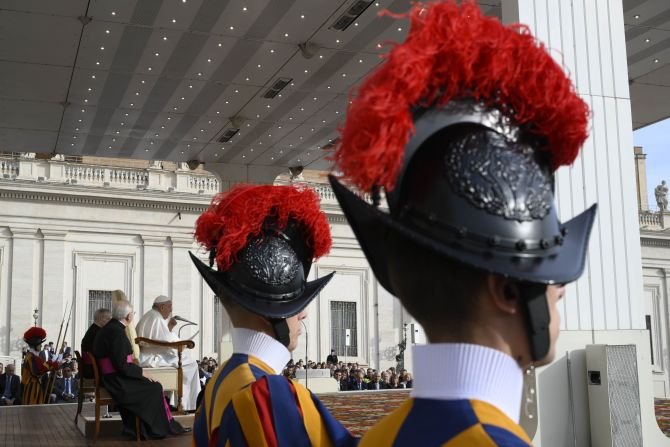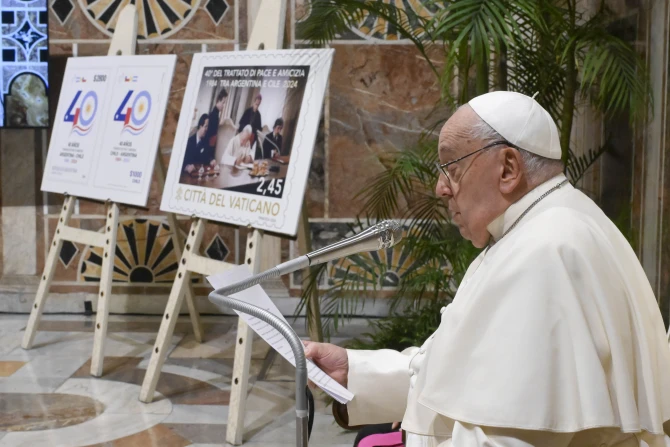
Pope Francis presided over a solemn event Monday at the Apostolic Palace in the Vatican commemorating the 40th anniversary of the Treaty of Peace and Friendship between Argentina and Chile that settled a border dispute between the two countries.
The pontiff denounced the hypocrisy of some countries “where there is much talk of peace” but “the highest yielding investments are in the production of arms.”
This pharisaical attitude, he continued, always leads “to the failure of fraternity and peace. May the international community make the force of law prevail through dialogue, for dialogue “must be the soul of the international community.”
The agreement between Chile and Argentina resolved the crisis caused by a territorial dispute over the Beagle Channel and sovereignty over several islands. The Vatican played an essential role in this peace agreement after St. John Paul II sent Cardinal Antonio Samorè as mediator, who worked out the agreement between both nations, avoiding an armed conflict.
Speaking before the authorities and the diplomatic corps of both countries, among whom were the Argentine ambassador to the Holy See, Luis Pablo Beltramino and the Chilean foreign minister, Alberto van Klaveren, Pope Francis praised the papal mediation that avoided the conflict that was “about to set two brother peoples against each other.”
In his speech, the Holy Father proposed this agreement as a model to imitate, while renewing his call for peace and dialogue in the face of current conflicts, where “recourse to force” prevails.
Mediating role of St. John Paul II
He recalled in particular the mediation of St. John Paul II, who from the first days of his pontificate showed great concern and demonstrated a constant effort not only to prevent the dispute between Argentina and Chile “from degenerating into a disgraceful armed conflict,” but also to find “the way to definitively resolve this dispute.”
The pontiff noted that after receiving the request of both governments “accompanied by concrete and stringent commitments,” St. Pope John Paul II agreed to mediate the conflict with the aim of proposing “a just and equitable, and therefore honorable solution.”
For Pope Francis, this agreement deserves to be proposed “in the current world situation, in which so many conflicts persist and degenerate without an effective will to resolve them through the absolute exclusion of recourse to force or the threat of its use.”
The pope recalled the words of Benedict XVI on the 25th anniversary of the treaty, who said that the agreement “is a shining example of the power of the human spirit and the desire for peace in the face of the barbarity and senselessness of violence and war as a means of resolving differences.”
For the Holy Father, this is “a most timely example” of how it is necessary to persevere at all times with ”firm determination to the final consequences in an endeavor to resolve disputes with a real desire for dialogue and agreement, through patient negotiation and with the necessary compromises, always taking into account the just requirements and legitimate interests of all.”
In conclusion, Pope Francis described what is happening in Ukraine and Palestine as “two failures” of humanity today where the “arrogance of the invader prevails over dialogue.”
This story was first published by ACI Prensa, CNA’s Spanish-language news partner. It has been translated and adapted by CNA.