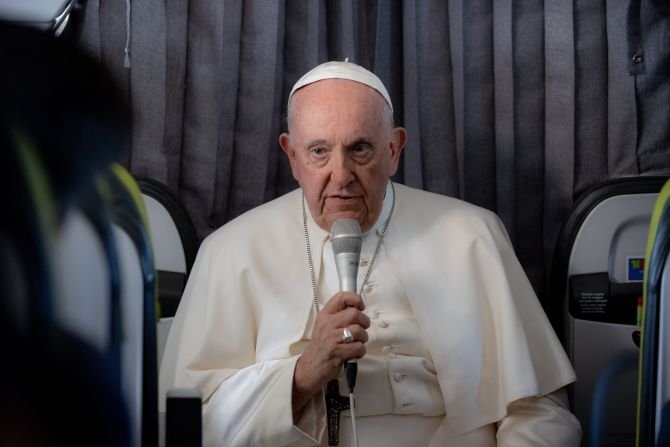
On his return flight from World Youth Day on Sunday, Pope Francis explained why he opted to skip reading a prayer in Fatima that consecrated the Church and “countries at war” to the Blessed Virgin Mary.
When asked by a journalist why he did not pray publicly for an end to the war in Ukraine during his visit to the Fatima shrine, the pope explained that he prayed for peace but did not want to “advertise” his private prayer.
“I prayed, I prayed. I prayed to Our Lady, and I prayed for peace. I did not advertise this, but I prayed. And we must continually repeat this prayer for peace,” the pope said during an in-flight press conference on his return from Lisbon on Aug. 6.
“She [Our Lady] made this request during the First World War. And this time I appealed to Our Lady and I prayed. I did not advertise.”
Last year, Pope Francis consecrated Russia and Ukraine to the Blessed Virgin Mary in St. Peter’s Basilica with a prayer asking for peace in the world, one month after Russia’s full-scale invasion of Ukraine, asking all of the bishops of the world to join him.
Immediately following the pope’s Saturday morning visit to Fatima, where he chose to simply pray a “Hail Mary” rather than read a prepared consecration prayer, the Vatican published an excerpt of the prayer on Pope Francis’ official Twitter account, now known as X.
The skipped prayer was one of many instances that the pope deviated from his prepared speeches during World Youth Day in Portugal Aug. 1-6. Noting how often the pope had done this, one journalist asked him about his health, and his eyesight, in particular.
“My health is fine,” Pope Francis responded, explaining that he cut off one of his speeches because “there was a light in front of me and I couldn’t read.”
In other instances, he said he shortened or changed his homilies based on the response of his audience.
“When I speak, I don’t do academic homilies, but I try to make it as clear as possible,” he explained.
“You noticed that I asked a few questions and immediately the feedback showed me where it was going, whether it was wrong or not,” he said. “Young people don’t have a long attention span. Think about it: If you make a clear speech with an idea, an image, an affection, they can follow you for eight minutes.”

The Holy Father also shared his impressions of World Youth Day — the fourth he’s attended as pope.
The attendance in Lisbon, he noted, was “impressive,” pointing to estimates that as many as 1.4 million or more attended the Saturday evening vigil. In addition to this youth event being “the most numerous” it was the “best prepared,” he added.
“The young people are a surprise. Young people are young, they act youthful, life is like that. But they are seeking to move forward. And they are the future. The idea is to accompany them,” he said.
“The problem is knowing how to accompany them,” the pope continued. “And that is that they shouldn’t detach themselves from their roots. That’s why I insist so much on dialogue between old and young, between grandparents with grandchildren. This dialogue is important, more important than the parent-child dialogue. The grandparents, the roots. Young people are religious. They seek faith, not something artificial … They seek an encounter with Jesus.”
He added: “Some people say, ‘But young people don’t always live life according to morality.’ But who among us has not made a moral mistake in his life? Everyone has.
“There should be commandments. Each of us has our own downfalls in our own history. Life is like that. But the Lord is always waiting for us because he is merciful and [he is] Father and mercy goes beyond everything,” he said.
During the 25-minute in-flight press conference, Pope Francis stressed that mental health and suicide are serious issues facing young people today and that he does not believe that it is discussed enough by the media.
The pope revealed that a young man had confided in him (not in the context of confession) that he had considered committing suicide last year.
“Youth suicide is a major issue today,” the pope added.
“So many young people are anxious and depressed … In some countries that are very, very demanding at the university, young people who do not succeed in getting a degree or finding a job, (and) commit suicide because they feel great shame.”
In the press conference, Pope Francis also touched on the membership of the Catholic Church and access to the sacraments. A journalist recalled the pope’s own words during the World Youth Day welcome ceremony Aug. 3, that, “In the Church, there is room for everyone, for everyone,” and asked why women and homosexual people cannot access every sacrament.
Pope Francis said the question concerned two different aspects of ecclesiology: the membership of the Church and its regulations.
“What you say is a simplification: ‘He cannot participate in the sacraments.’ This does not mean that the Church is closed,” Francis said.
He emphasized that the Church welcomes everyone, including homosexual people.
“The Lord is clear: the sick and the well, the old and the young, the ugly and the beautiful, the good and the bad. Even the immoral [person], which is bad, but the immoral too,” he said.
Pope Francis described the Church as a mother who guides her children in the maturation of their faith through prayer, interior dialogue, and dialogue with pastors.
“In [ministry], one of the important things is patience: accompanying people step by step on their way to maturity,” he said. “Each one of us has this experience: that the Mother Church has accompanied us and accompanies us in our own path of maturation.”
“I don’t like the reduction,” he added. “This is not ecclesial, it is gnostic. … A certain Gnosticism that reduces ecclesial reality, and that doesn’t help. The Church is ‘mother,’ receiving everyone, and everyone makes their own way within the Church, without advertisement, and this is very important.”
This article was previously featured on CNA.