Pope Francis revealed the existence of a joint China-Vatican commission on the appointment of bishops during an in-flight press conference on Monday — giving the clearest explanation to date as to what could be in the secret Vatican-China deal.
Speaking during his 10-hour return flight from Mongolia on Sept. 4, the pope said that there is a joint commission between the Chinese government and the Holy See on the appointment of Catholic bishops in China presided over by Vatican Secretary of State Cardinal Pietro Parolin.
“There is a commission working for the appointment of bishops — Chinese government and the Vatican — and there has been dialogue for some time,” Pope Francis told journalists on the papal plane.
The pope described the Vatican’s relations with the People’s Republic of China as “very respectful.”
“I think that we need to advance further into the religious aspect to understand each other more. The Chinese must not think that the Church does not accept their culture and their values and that the Church is dependent on a foreign power,” he added.
The “friendly” commission presided over by Cardinal Parolin is doing well, he said.
“They are doing a fine job. Relations are like this, let’s say that they are underway. And I have great respect for the Chinese people.”
The pope’s comments on the papal plane give a glimpse into what could be in the Holy See’s confidential provisional agreement with Beijing on the appointment of bishops, the contents of which have not been made public since it was first signed in September 2018.
Prior to this, the Vatican Secretary of State had only disclosed that the provisional agreement had to do with “consensual decisions” on the appointment of Chinese bishops and that China had violated the agreement by unilaterally appointing Catholic bishops in Shanghai and the “diocese of Jiangxi,” a large diocese created by the Chinese government that is not recognized by the Vatican.
Pope Francis also told the journalists that the Vatican and China have engaged in foreign exchanges with Catholic priests and intellectuals teaching at a university in China, describing this as an example of “openness” on the part of the Chinese.
The Vatican’s diplomatic relationship with China was a topic of focus during the pope’s four-day trip to Mongolia, which shares a nearly 3,000-mile border with China.
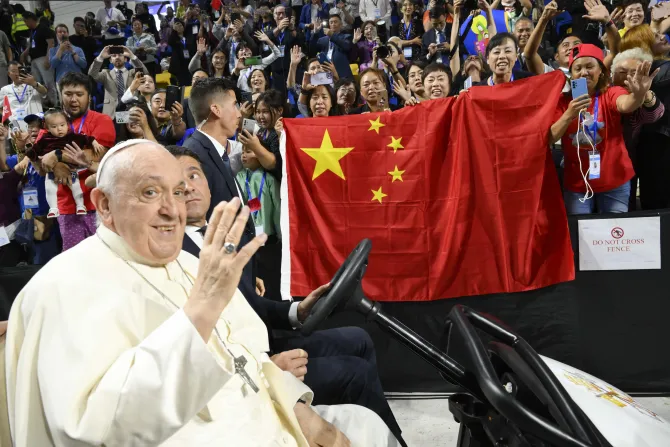
Chinese Catholics, including self-described “underground Catholics,” attended the first-ever papal Mass in Mongolia and other events with some choosing to shield their identities using facemasks and sunglasses at the official welcome ceremony for fear of potential retribution from the government. Others enthusiastically waved Chinese flags at papal events when Pope Francis passed by.
During the 40-minute in-flight press conference, Pope Francis was asked about the upcoming Synod on Synodality, the update to his environmental encyclical Laudato si’, and further clarified his recent comments on Russian imperialism.
The pope also responded to a question about the possibility of a papal trip to Vietnam, saying that he was “very positive about relations with Vietnam,” despite the problems in the past in the Holy See’s “slow” dialogue with the country’s socialist government, adding that he thinks that any future problems can be overcome.
Pope Francis joked: “If I do not go [to Vietnam], I’m sure that [a future Pope] John XXIV will go!”
The 86-year-old pope added: “To tell the truth, travel is not as easy for me as it was in the beginning.” He added that he has some physical limitations with walking that can make traveling more difficult, but that he is looking into the possibility of visiting a small country in Europe.
Vietnam is home to an estimated 8 million Catholics but has never had full diplomatic relations with the Holy See or a papal trip. The Vatican has been engaged in formal bilateral discussions with Vietnam since 2009 and earlier this year, during the visit of Vietnam’s President Vo Van Thuong to the Vatican, the Vietnamese government agreed to allow a permanent papal representative in the country. Pope Francis said that he believes that Vietnam “merits” a papal trip someday and that it is “a land that deserves to go forward.”
The pope’s trip to Mongolia was a historic first for the Catholic Church as no pope had ever traveled to the large landlocked Asian country sandwiched between Russia and China.
During his four days in the Mongolian capital of Ulaanbaatar, Pope Francis met with government leaders, engaged in interreligious dialogue with Buddhists or other Eastern religions, and presided over the first papal Mass for the country’s small Catholic population of only 1,450 Catholics.
In the press conference, Pope Francis described Mongolia as a land that “lives between two great powers, Russia and China,” and praised the country’s pursuit of ongoing dialogue, including with “third neighbors.”
The pope has a busy schedule in the month ahead leading up to the first global Synod on Synodality assembly in October.
Pope Francis is scheduled to make another international trip to Marseilles, France to participate in a meeting of Catholic bishops from the Mediterranean region, publish an update to his environmental encyclical Laudato Si’, preside over an ecumenical prayer vigil, and create 21 new cardinals at a consistory at the end of September.
This article was originally published on Catholic News Agency.