During the summer, Rome endures intense heat, prompting most residents to retreat to the mountains and even the Pope to pause public appearances and the General Audience. To alleviate the heat, over 2,000 drinking fountains are spread throughout the city, providing free, fresh water to everyone. These fountains are a defining feature of Rome’s urban landscape, earning it the title of “the city of fountains.”
Ancient Engineering Marvels
The origins of Rome’s 2,000 fountains are shrouded in history, but the city has a long tradition of hydraulic engineering dating back to the ancient Romans. They constructed 11 aqueducts to supply fresh water to its inhabitants, one of which, the Acqua Virgo aqueduct, is still in use today.
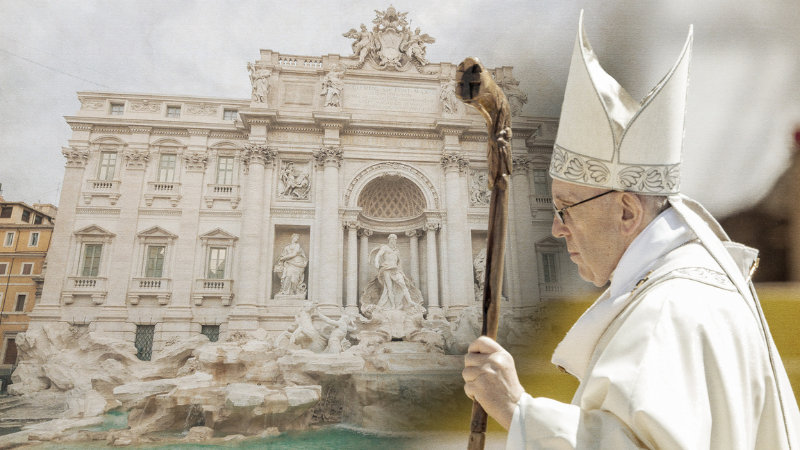
Agnieszka Gembka, a guide in the city of Rome, explains the Trevi Fountain, “We can see the pure and healthy water that flows out from under the giant statue of Neptune, the god of the seas and oceans, water that arrives at this point in the heart of Rome through the aqueduct that flows as far as 20 kilometers under the city.”
Symbolic and Practical Significance
Prof. Massimo Carlo Giannini, an expert on Papal History, notes, “The fountains have a dual significance, both symbolic-religious and practical. Symbolically, they represent the water of baptism and purification, symbolizing the rebirth of Christians. Practically, they serve essential daily needs: providing drinking water for people and animals and were used to offer a place to wash clothes.”
Fountains as Symbols of Power
The fountains were not only a source of drinking water but also a symbol of power and prosperity. Over the centuries, Rome’s fountains evolved from simple water points to astonishing and elaborate works of art.
“From the 16th century onwards,” Prof. Giannini continues, “especially during the modern age, the popes sought to enhance the magnificence of Rome. They aimed to leave their mark on the city through grand projects. This legacy is evident in the rich palaces of their families and the numerous fountains adorned with their coats of arms.”
Iconic Fountains and Papal Legacy
Rome is home to several iconic fountains, with the world-famous Trevi Fountain standing out above all. Built by Nicola Salvi in 1732 using the side part of the palace of the Poli family, it attracts over 1,000 people per hour, totaling 5.5 million visitors a year!
“The papal seal,” Gembka explains, “symbolizes the continuity of papal history, prominently displayed on various fountains throughout Rome. This seal, visible on this fountain and many others, exemplifies the role of the pope as a patron who funded their construction. It can be found on numerous structures built during their era, serving as a lasting reminder of their influence and contributions.”
Artistic Masterpieces
These artistic masterpieces that grace Rome’s squares were created by some of the most renowned artists, including Giacomo della Porta and Gian Lorenzo Bernini. Bernini’s Fountain of the Four Rivers stands out as an unparalleled Baroque creation, prominently placed in one of the city’s most important squares.
Giannini explains, “Piazza Navona’s Fountain of the Four Rivers symbolizes the greatness and universality of Catholicism. The fountain features four great rivers representing Europe, Asia, Africa, and America, reflecting the global reach of the Church.”
Quirinal Hill and the Papal Residences
From the late 16th century onward, the Quirinal Hill became the residence of the popes. Pope Sixtus V restored the ancient Dioscuri statues of Castor and Pollux, which had stood on the Quirinal Hill since antiquity, and commissioned the first fountain to be placed at their base, supplied by the Acqua Felice aqueduct. The current fountain was installed by Pope Pius VII in 1818.
Enhanced by the beauty of these fountains, before you leave, don’t forget to throw a coin into the Trevi Fountain.
Adapted by Jacob Stein
Subscribe to our newsletter to get exclusive content, updates and information from the Vatican.