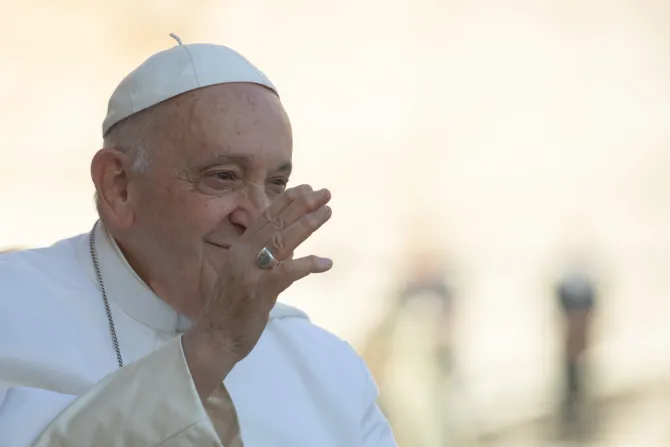
Pope Francis on Wednesday released a new document on the environment that he has described as the “second part” of his 2015 encyclical Laudato Si’, and which warns of “grave consequences” if humanity continues to ignore the threat of climate change.
The apostolic exhortation, titled Laudate Deum (“Praise God”), is meant to address what Francis in the document calls the “global social issue” of climate change. The pope said that in the eight years since Laudato Si’ was published, “our responses have not been adequate” to address ongoing ecological concerns.
“Climate change is one of the principal challenges facing society and the global community,” the pope wrote in the document, arguing that its effects are borne by the world’s “most vulnerable people” and that the climate issue is “no longer a secondary or ideological question.”
Francis wrote that the effects of climate change “are here and increasingly evident,” and warned of increasing heat waves and the possible melting of the polar ice caps, which he said would lead to “immensely grave consequences for everyone.”
“No one can ignore the fact that in recent years we have witnessed extreme weather phenomena, frequent periods of unusual heat, drought, and other cries of protest on the part of the earth that are only a few palpable expressions of a silent disease that affects everyone,” the pope said.
Warns of ‘resistance’ to climate science
Environmentalism has long been a favorite topic of Francis. Laudato Si’ was heralded at the time of its publication as a revolutionary papal document for its emphasis on Catholic ecological responsibility.
Then-U.S. Conference of Catholic Bishops President Bishop Joseph Kurtz called the encyclical “our marching orders for advocacy.” The document launched the Laudato Si’ Movement, which bills itself as a “broad range of Catholic organizations and grassroots members from all over the world” walking “on a journey of ecological conversion.”
In the earlier document Francis conceded that the Church “does not presume to settle scientific questions or to replace politics,” but in the exhortation this week the Holy Father took a more forceful line, criticizing those who “have chosen to deride [the] facts” about climate science and stating bluntly that it is “no longer possible to doubt the human — ‘anthropic’ — origin of climate change.”
“It is not possible to conceal the correlation of these global climate phenomena and the accelerated increase in greenhouse gas emissions, particularly since the mid-20th century,” Francis wrote. “The overwhelming majority of scientists specializing in the climate support this correlation, and only a very small percentage of them seek to deny the evidence.”
Francis said in the document that what he described as a “technocratic paradigm” has “destroyed” the mutually beneficial relationship with the environment that humans have at times enjoyed. Humanity’s “power and the progress we are producing are turning against us,” the pope argued.
Francis noted that climate mitigation efforts over the years have been met with both “progress and failures,” though the pope expressed hope that next month’s 2023 United Nations Climate Change Conference could “allow for a decisive acceleration of energy transition, with effective commitments subject to ongoing monitoring.”
He argued, however, that longtime global diplomatic arrangements have failed to meet the challenges of the climate emergency.
“It continues to be regrettable that global crises are being squandered when they could be the occasions to bring about beneficial changes,” he wrote. The world, he argued, should look toward “the development of a new procedure for decision-making” to solve global problems.
The pope pointed to what he described as the “spiritual motivations” of climate action, noting that the Book of Genesis records that, upon his creation of the universe, “God saw everything that he had made, and indeed, it was very good.”
“‘Praise God’ is the title of this letter,” Francis wrote at the encyclical’s conclusion. “For when human beings claim to take God’s place, they become their own worst enemies.”
Francis since 2015 has been active in warning about the potential devastation posed by climate change. In 2021, he launched the Catholic Church’s seven-year “Laudato Si’ action plan,” which he described as the Church’s part in “a new ecological approach that can transform our way of dwelling in the world.”
The pope later that year joined religious leaders in calling upon the global community to “achieve net zero carbon emissions as soon as possible” to head off potentially devastating temperature rises.
Laudate Deum’s publication date — Oct. 4 — is the feast of St. Francis of Assisi, from whom Francis drew his pontifical name at the start of his papacy in 2013. It is also the start date of the first monthlong assembly in Rome of the ongoing Synod on Synodality.
This article was originally published on Catholic News Agency.