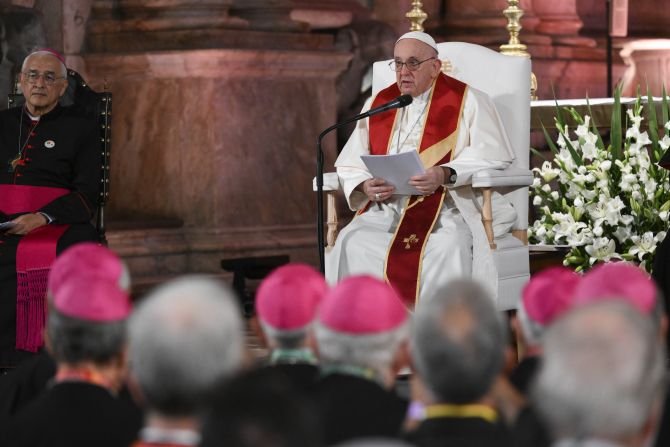
From Lisbon, Portugal, Pope Francis on Wednesday reflected on the urgency of taking up again “the prayer of adoration” before the tabernacle to recover “the taste and passion for evangelization” in a message addressed to bishops, priests, deacons, consecrated women religious, and seminarians.
“I would like to ask a question here, but each one should answer it interiorly. How do I pray? Like a parrot — blah blah blah blah blah? Or taking a nap in front of the tabernacle because I don’t know how to talk to the Lord? I pray? How do I pray? Only in adoration, only before the Lord can the taste and passion for evangelization be recovered,” the pontiff said during his Aug. 2 homily for vespers at the Jerónimos Monastery.
After noting that “to trust every day in the Lord and in his word, words are not enough” but rather “a lot of prayer is needed,” he pointed out to the approximately 1,100 attendees that the Church has abandoned prayer in front of the Blessed Sacrament.
“Curiously, the prayer of adoration — we have lost it. We have lost it, and everyone — priests, bishops, consecrated men and women, laypeople — have to recover it. It’s to be in silence, before the Lord,” Francis urged.
In this context, the pope invited his listeners to follow the example of St. Teresa of Calcutta, who, despite being “involved in so many things in life, never gave up adoration even at times when her faith wavered and she wondered if it was all true or not.”
“So, in prayer the temptation to carry out a pastoral ministry of nostalgia and complaining is overcome,” he added.
To further exemplify the need to redirect our gaze to eucharistic adoration, the pontiff recalled the anecdote of a nun who “complained about everything” in her convent.
“In a convent there was a nun who, I don’t know what her name was, but they changed her name and called her ‘Sister Lamentela’ [the whiner]. How many times do we transform our inabilities, our disappointment, into ‘lamentela’ [being whiners]? And leaving behind these ‘lamentelas,’ one gets the strength to sail out to sea, without ideologies, without worldliness. The spiritual worldliness that gets into us and which engenders clericalism not only in priests; clericalized laymen are worse than priests,” he explained.
Pope Francis stressed that clericalism is “one of the most serious evils that can happen to the Church” and, consequently, ruin it.
Fishers of men, without ‘proselytizing’
During his homily, Pope Francis also called for overcoming the aforementioned difficulties “without ideologies and without worldliness, animated by a single desire: that the Gospel reach everyone.”
Using the example of a young saint from Lisbon, St. John of Brito, he recalled that all Catholics “are called to immerse our nets in the time in which we live, to dialogue with everyone, to make the Gospel understandable, even when doing so we may run the risk of a storm.”
“Be fishers of men. Don’t be afraid. That’s not proselytizing, it’s announcing the Gospel that [draws forth a response],” the Holy Father explained.
“Therefore, fishing for people and pulling them out of the water means helping them to get out of the abyss where they had sunk, saving them from the evil that threatens to drown them, resuscitating them from all forms of death. But this without proselytizing, but with love,” he added.
And so, according to the pope, “one of the signs of some ecclesial movements that are going wrong is proselytism.”
“When an ecclesial movement or a diocese or a bishop or a priest or a nun or a layperson proselytizes, that’s not Christian. Christian is inviting, welcoming, helping, but without proselytizing,” he said.
Pope Francis added that the “Gospel, in fact, is an announcement of life in the sea of death; it is an announcement of freedom in the whirlwinds of slavery, of light in the abyss of darkness.”
“We, as the Church, have been entrusted with the task of immersing ourselves in the waters of this sea, casting the net of the Gospel, without pointing fingers, without accusing, but bringing to the people of our time a proposal for life, that of Jesus: to bring the welcome of the Gospel, to invite them to the celebration,” he concluded.
This article was originally published on ACI Prensa