Pope Francis this week merged the Diocese of Takamatsu with the Metropolitan Archdiocese of Osaka in Japan.
Cardinal Thomas Aquino Manyo Maeda, archbishop of Osaka since 2014, was named on Aug. 15 as the first archbishop of the new Archdiocese of Osaka-Takamatsu. The last bishop of the Diocese of Takamatsu, John Eijiro Suwa, died in 2022.
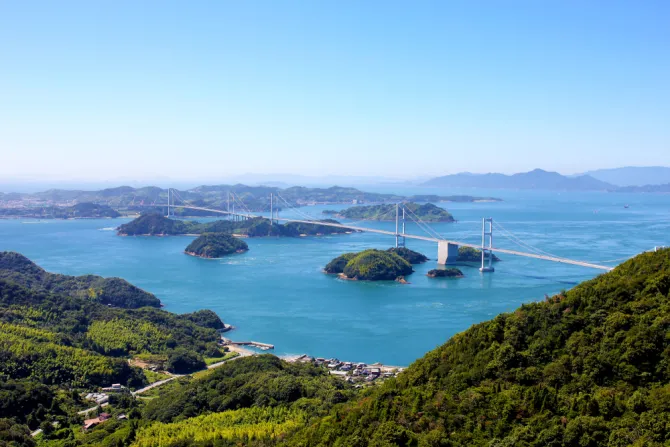
The two territories are on different islands: Takamatsu is on Japan’s Shikoku Island while Osaka is on Honshu. They are connected by water through the Osaka Bay and Seto Inland Sea or by land by crossing Awaji Island, already part of the territory of the former Archdiocese of Osaka.
The new archdiocese has just 51,413 Catholics, less than a third of 1% of the area’s 19 million inhabitants.
The total population of the Archdiocese of Osaka has remained mostly steady over the past 20 years, while the number of inhabitants of the Diocese of Takamatsu declined 9% from 2000 to 2020.
The number of Catholics in the Diocese of Takamatsu declined by 4% and the number of priests almost halved over the same period.
The Catholic Church in Japan has 15 dioceses. According to the latest available Vatican statistics, Catholics make up just .5% of the population in the largely secular country. Approximately half of these Catholics are foreign nationals let into the country as temporary workers in unskilled jobs.
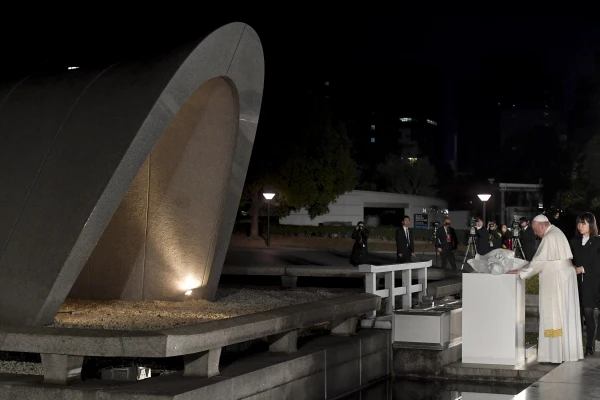
During a visit to Japan in 2019, Pope Francis said the Church’s small size “must not diminish your commitment to evangelization.”
“The starting point for every apostolate is the concrete place in which people find themselves, with their daily routines and occupations, not in artificial places,” he told the country’s bishops.
Catholicism reached Japan in 1549 with the arrival of the Jesuit missionary St. Francis Xavier.
Nagasaki became the center of Catholicism in Japan for four centuries. The area was home to the so-called “hidden Christians,” who preserved the faith through waves of fierce persecution.
Hundreds of Christians from the end of the 16th through the 18th century lost their lives for the faith in Japan, including St. Paul Miki and his 25 companions, who were crucified on Nishizaka Hill in Nagasaki in 1597.
This article was originally published on CNA.