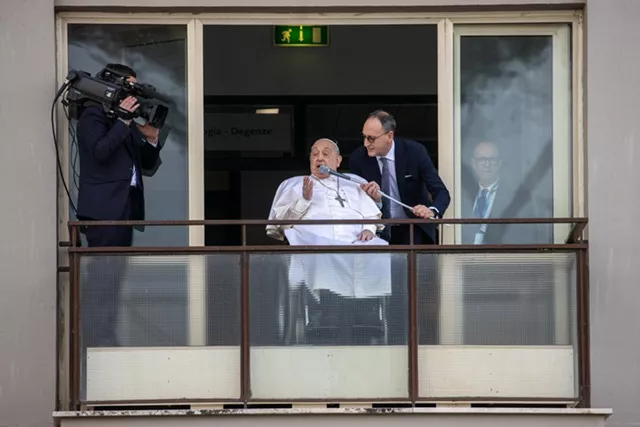
Pope Francis is back at the Vatican after spending 38 days in the hospital, his longest stay yet. Doctors have said he now needs at least two months of rest, during which he should avoid large gatherings. But they also noted that he remained mentally active throughout his hospitalization, and they expect him to keep working during recovery.
Nevertheless, this marks a turning point. The convalescence that began Sunday will be unlike anything in the 88-year-old Pontiff’s 12-year reign.
The Pope has described himself as incorrigibly gregarious, a trait reflected in his decision to live at the Santa Marta guesthouse rather than the papal apartments in the Apostolic Palace. Until recently, the Pope regularly dined in the guesthouse dining hall and, until his mobility declined a couple of years ago, he often mingled or chatted with other guests.
He kept a demanding schedule, often holding several official meetings in a single morning, plus informal encounters and personal calls in the afternoon. The same day he was hospitalized last month, he held five meetings despite struggling to breathe. That level of activity is over, at least for now.
Pope Francis’ brief appearance Sunday, when he was wheeled onto a hospital balcony to greet some 3,000 well-wishers, offered a glimpse of his condition. He spoke only a few words, with audible effort, and appeared unable to lift his arms.
Just last September, Pope Francis made the longest journey of his pontificate: a 12-day tour of Asia and Oceania. His foreign visits have produced some of the most defining moments of his pontificate, including headline-making in-flight press conferences. The Vatican hasn’t ruled out a hoped-for trip to Turkey to mark the 1,700th anniversary of the Council of Nicaea, but a return to international travel seems increasingly unlikely.
Francis may still give interviews, which have been a distinctive feature of his communications strategy. The bigger shift may be the Pope’s forced withdrawal from his favored mode of engagement: direct, often spontaneous, contact with the public. Anyone who has seen him at a public audience or greeting pilgrims knows how much he feeds off those moments, especially with children or the elderly. Isolation will be painful.
Delegation will also be difficult. Francis is known for hands-on governance, often surprising subordinates with unannounced visits or unexpected questions. Now he will need to conserve his energy and entrust more to others.
Doctors made no mention of cognitive impairment, so the question will be how and where he chooses to focus. One clue: While still hospitalized, he approved a major extension of the Synod on Synodality, culminating in a Vatican assembly in 2028.
Synodality has been central to Francis’ vision of Church governance, and the Vatican assemblies have been major platforms for his agenda. During his hospital stay, he also approved several sainthood causes and bishops’ appointments, though many of these decisions were likely in the works beforehand. For now, only his closest aides may know where he plans to direct his attention.
The predicament of a housebound, ailing pope inevitably recalls the long, slow decline of St. John Paul II more than two decades ago. At that time, questions about who was actually governing the Church hovered over the final years. The best way to avoid a similar atmosphere is transparency, something the Vatican has struggled to deliver in moments like this.
The Pope is expected to miss Holy Week and Easter liturgies, which will make for an especially conspicuous and poignant absence at the most sacred time of the Church’s year, but a written message or brief appearance seems likely.
Perhaps the most powerful way Pope Francis can lead during this period is by example. In his written remarks for the Angelus on the day of his discharge, he offered a reflection on patience in suffering. “During this long period of hospitalization,” he wrote, “I had the opportunity to experience the Lord’s patience, which I also see reflected in the tireless care of the doctors and healthcare workers, as well as in the attentiveness and hopes of the families of the sick. This trusting patience, anchored in God’s unfailing love, is truly necessary for our lives, especially when facing the most difficult and painful situations.”
Coming from such a dynamic and energetic leader, that could be the Pope’s most striking and inspiring message in the months ahead.
This article was originally published on National Catholic Register.