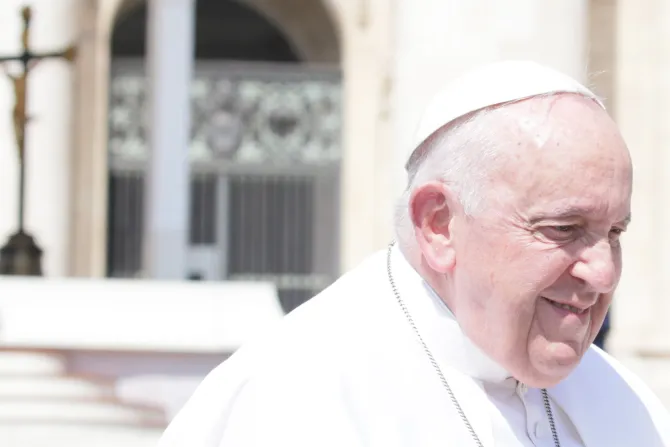
Pope Francis dedicated his entire general audience on Wednesday to sharing the life of Venerable Matteo Ricci, a 16th-century Jesuit missionary in China.
The pope, who has mentioned China at every Wednesday general audience in the past three weeks, praised Ricci’s “missionary spirit” in witnessing to the Gospel in the heart of the Imperial city of Beijing.
“Matteo Ricci died in Beijing in 1610, at the age of 57, a man who gave his entire life for the mission,” Francis said in St. Peter’s Square on May 31.
“His love for the Chinese people is a model, but what represents a current path is his consistency of life, the witness of his life as a Christian.”
Ricci is known for introducing Christianity to China’s imperial Ming Dynasty. By studying the language and adopting the local clothes and customs, the Jesuit priest gained access to the interior parts of the country that had been closed to outsiders.
“He always followed the path of dialogue and friendship with all the people he met, and this opened many doors for him to proclaim the Christian faith,” the pope said.
“After Francis Xavier’s attempt, another 25 Jesuits had tried in vain to enter China. But Ricci and one of his confrères prepared themselves very well, carefully studying the Chinese language and customs,” he said.
After first arriving in Macao in 1582, Ricci persevered in China for 18 years before he was able to enter Beijing’s Imperial city.
Pope Francis described how Ricci engaged in dialogue with Chinese scholars, sharing mathematical and astronomical knowledge that “contributed to a fruitful encounter between the culture and science of the West and the East.”
“However, Ricci’s fame as a man of science must not obscure the deepest motivation of all his efforts: that is, the proclamation of the Gospel,” the pope said.
“With the scientific dialogue, with the scientists, he went forward, but he gave testimony of his own faith, of the Gospel. The credibility obtained through scientific dialogue gave him the authority to propose the truth of Christian faith and morality, of which he spoke in depth in his principle Chinese works, such as ‘The True Meaning of the Lord of Heaven.’”
Once Ricci entered Beijing in January 1601, he never left. He is buried in Beijing’s Zhalan Cemetery, the first foreigner to be buried on Chinese soil during the Ming dynasty.
“In the last days of his life, to those who were closest to him and asked him how he felt, Matteo Ricci ‘responded that he was thinking at that moment if the joy he felt inside was greater than the idea that he was close to the end of his journey to go and taste God, or the sadness that could cause him to leave the companions of the whole mission that he loved greatly, and the service he could still do to God Our Lord in this mission,’” the pope said.
Pope Francis underlined that it was prayer that nourished Ricci’s missionary life in which he helped “lead many of his disciples and Chinese friends to accept the Catholic faith.”
He said that missionaries can learn from how Ricci testified with his own life to what he proclaimed. Francis said: “This is the consistency of evangelizers. … I can say the ‘Creed’ by heart, I can say all the things we believe, but if your life is not consistent with what you profess, it’s useless.”
“What attracts people is the testimony of coherence; we Christians are called to live what we say, and not pretend to live as Christians but live as worldly.”
Pope Francis advanced the sainthood cause for Ricci last December on the pope’s 86th birthday. In the decree promulgated on Dec. 17, the pope declared that Ricci lived a life of heroic virtue, making him “venerable.”
Last week, at the end of his general audience, Pope Francis asked Catholics Wednesday to pray that the Gospel can be fully and freely shared in China.
“I invite everyone to lift up prayers to God that the good news of the crucified and risen Christ can be announced in its fullness, beauty, and freedom, bearing fruit for the good of the Catholic Church and all of Chinese society,” he said.
This article was originally published on Catholic News Agency.